

“Muss ja.” (“Well, you have to.”)
This dry, everyday exchange in German society may seem like a mundane greeting, but it reveals a paralyzed portrait of Western civilization mechanically maintaining its routines even in the face of an overwhelming crisis. Das Deutschlandherz (The German Heart), a new work by Bonn Park and staged at the Kammerspiele of Schauspiel Frankfurt is a black comedy and body-horror play that probes the collective anxiety and paralysis hidden behind this seemingly innocuous phrase.
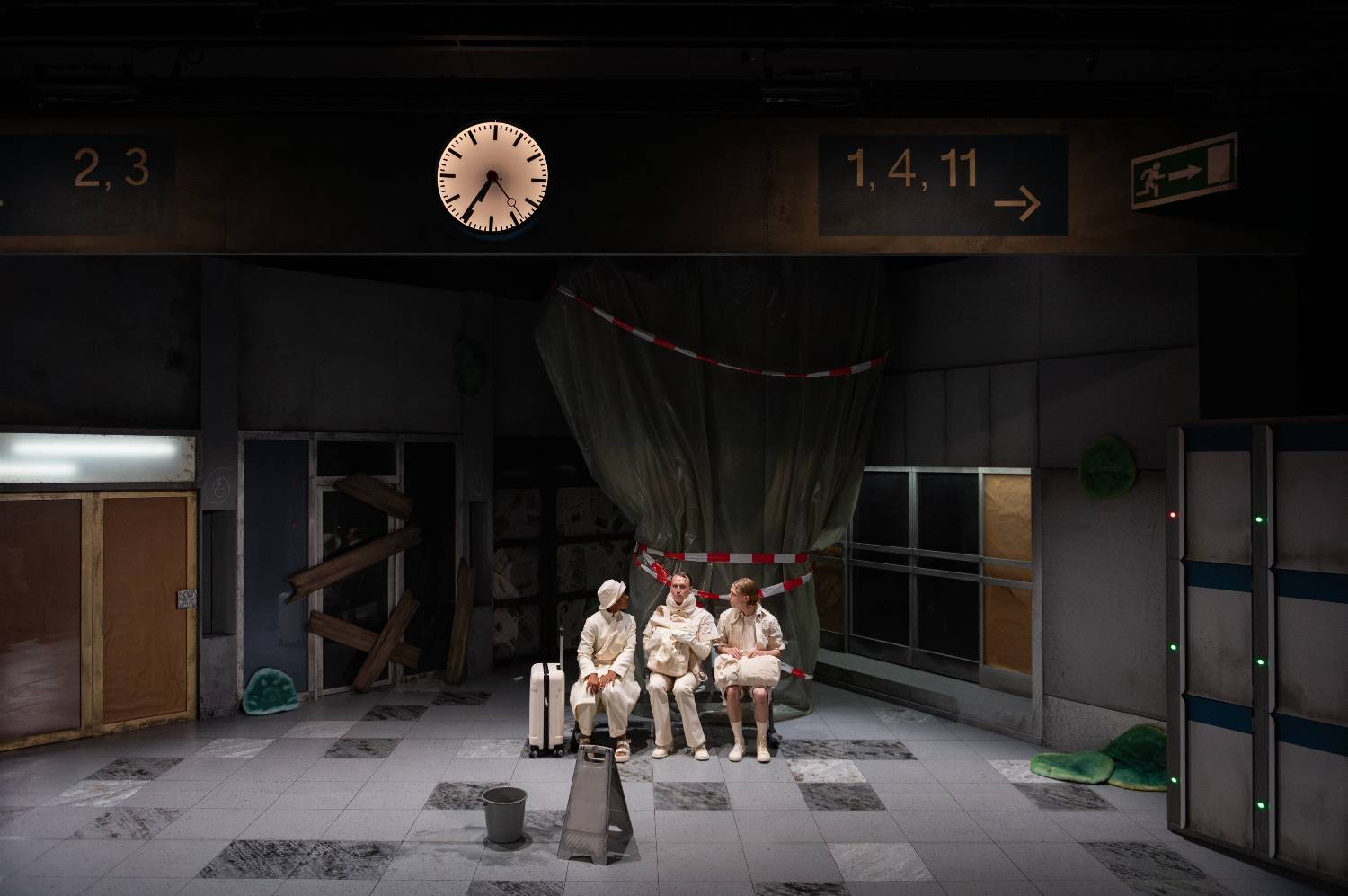
The play takes place at a Hauptbahnhof (Central Station), where countless people gather to travel. Yet, this station has become a sealed-off space, trains are delayed or canceled indefinitely, communication networks have collapsed to the point that electronic tickets cannot be downloaded, and announcements dissolve into the noise of a malfunctioning system. A space that should symbolize movement and progress has, paradoxically, become one of confinement—where not a single step forward is possible. The three isolated characters—Richard (Steffen Link), Walter (Mitja Over), and Naomi (Rokhi Müller)—are not merely passengers. They embody the German Heart itself: survivors of a collapsing society and the last remnants of a bankrupt civilization. Walter cries out that he witnessed Germany’s downfall “not with his eyes, but with the German heart,” while Naomi confesses, “I tried to escape the Germany inside me.” Carrying the collapsing system within themselves, the trio dreams of escape, yet they ultimately remain trapped in the station by the “German Angst” deeply rooted within them. Ultimately, the play uses these three abandoned figures to show that settling into a stagnant space while telling oneself, “Someone will come and fix this soon,” is not safety, but a form of “collective decay unfolding in slow motion.” Trapped in the habitual illusion that “everything will return to normal,” the German Heart—having entirely lost its capacity for movement—begins to slowly rot within the stationary space.
A Diasporic Observer at the Border and the B-Movie Horror Genre
Bonn Park, the playwright and director was born in West Berlin in 1987 to Korean parents and grew up moving between Berlin, Korea, and Paris. As a child of immigrants and a figure positioned between cultures, Park has observed the German society from both inside and outside. This background has given Park a critical distance from which to examine the conventions and complacency of mainstream society. One of the defining characteristics of Park’s dramaturgy is the transplantation of the conventions of contemporary B-movie horror—such as Jordan Peele’s Get Out and Ari Aster’s Midsommar—onto the theatrical stage. The use of horror is not simply intended to provide sensational spectacle. Rather, it reveals that the most disturbing terrors do not stem from otherworldly monsters, but from the seemingly benign, ordinary routines at the very center of society. Borrowing the structural logic of these horror films, Park avoids delivering a simplistic, enlightenment-style message that “we are good and they are evil.” Instead, the play exposes how the most unremarkable aspects of everyday life can themselves become sources of a horror that quietly erodes and oppresses those perceived as "others.” This technique of dissecting collective pathologies and the “hypocrisy of normality” through B-movie horror also functions as one of the central dramatic weapons of Das Deutschlandherz. By transforming the utterly familiar setting of a stalled train station into a landscape of bodily decay, the production makes visible the accumulated helplessness and anxiety concealed beneath the name of “normality.”
The Motionless Human vs. Decay at Lightning Speed
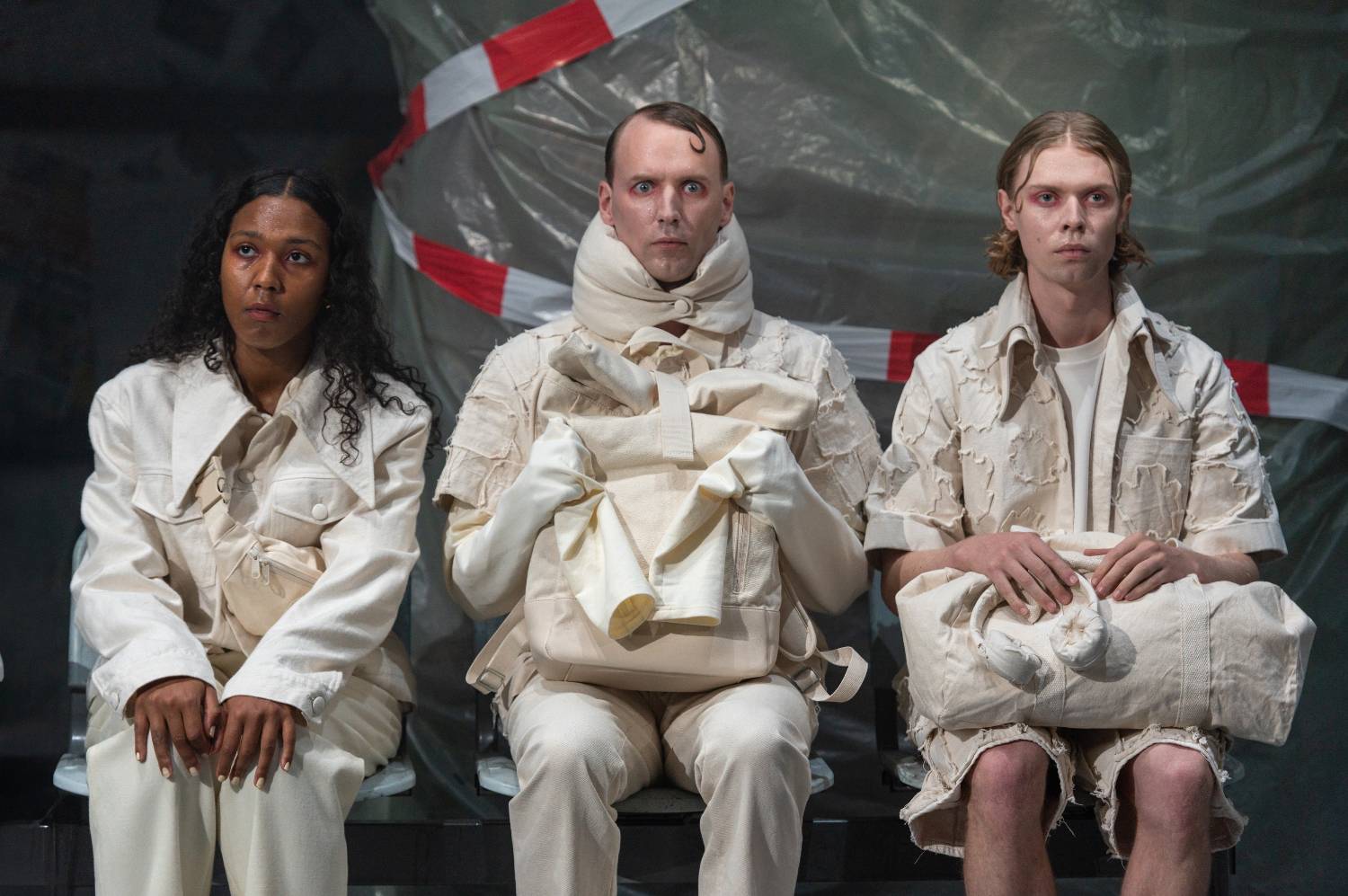
The audience's first encounter with strangeness and frustration stems from the extreme absence of movement onstage and the mechanical repetition of dialogue. The actors move as little as possible, appearing almost frozen in place, repeatedly saying “Nein” (“No”), wandering aimlessly around the station in search of 30-cent coins to pay the €1 toilet fee, and obsess over the precise conditions required to receiving a 50-cent refund voucher. Yet this static direction is a deliberate theatrical device designed to make the audience physically experience a “coma of helplessness” (Koma der Hilflosigkeit). By completely eliminating physical movement within a train station—a space designed for departure—the production forces the audience to witness the severity of the characters’ paralysis firsthand. This is where the play’s central critical axis emerges: the “Asymmetry of Velocity.” Onstage, the speed of human thought, physical movement, and problem-solving approaches an absolute zero. The train does not arrive, the signal does not connect, and the human beings cannot move even a single step forward. Meanwhile, the mold and mushrooms sprouting across the bodies of these motionless characters, along with the spread of collective conspiracy theories and fear of immigrants and otherness, move with terrifying speed—toward infinity. The humans who should be moving have hardened like stone, while the social diseases that should disappear are the only things still moving at lightning speed. This imbalance of velocity is precisely the tragedy of modern civilization diagnosed by the play.
The Truth Revealed, Bodies in Decay, and Blood-Stained White Clothes
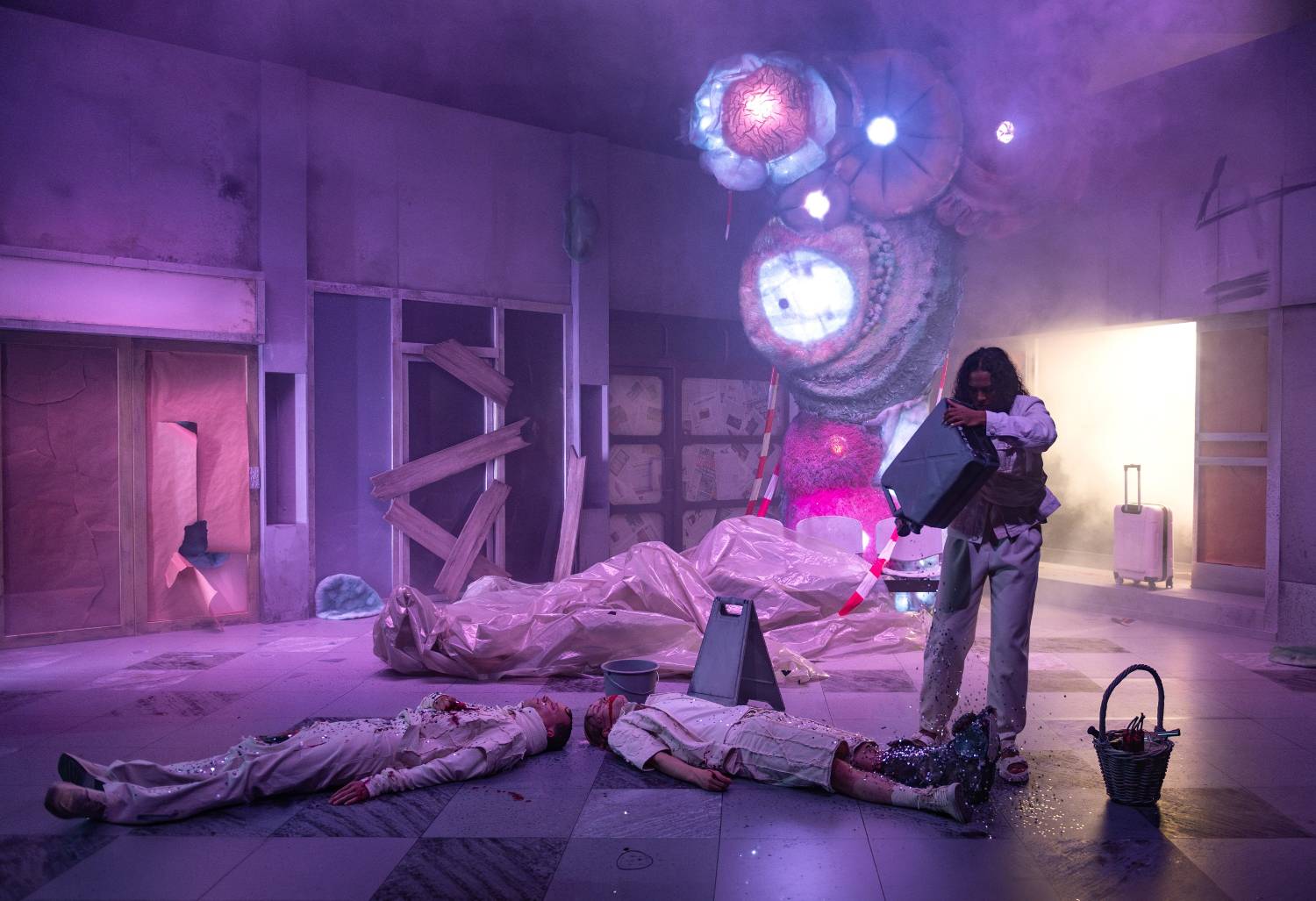
The stage designed by Sina Manthey presents a striking visual reversal of social concealment and decay. At the beginning of the play, the central pillar onstage is tightly wrapped in gray plastic sheeting and red-and-white caution tape, giving the impression that ordinary maintenance work is underway. It embodies the hypocritical exterior of a system insisting that “everything is under control and will soon return to normal.” Yet as the play unfolds and the covering is removed, enormous forms of mold and mushrooms erupt from within, bursting through the ceiling and floor. These grotesquely proliferating fungal masses, which have been growing abnormally within the sealed environment beneath the plastic, are the true substance of Das Deutschlandherz revealed once the packaging of hypocritical normality is torn apart. This stage metaphor is combined with the body-horror device of the characters’ own bodies decaying, physically embodying and exposing three pathological attitudes that modern individuals are prone to adopting.
As the covering of the station is removed and the decay of the individual bodies is exposed, the production reaches its critical climax through a narrative device that reveals the bankruptcy of political leadership and a visual confrontation reminiscent of splatter horror. The decay that has consumed both the space and the human body becomes inseparable from the moment when the hypocrisy of power is exposed, producing an even more visceral visual shock.
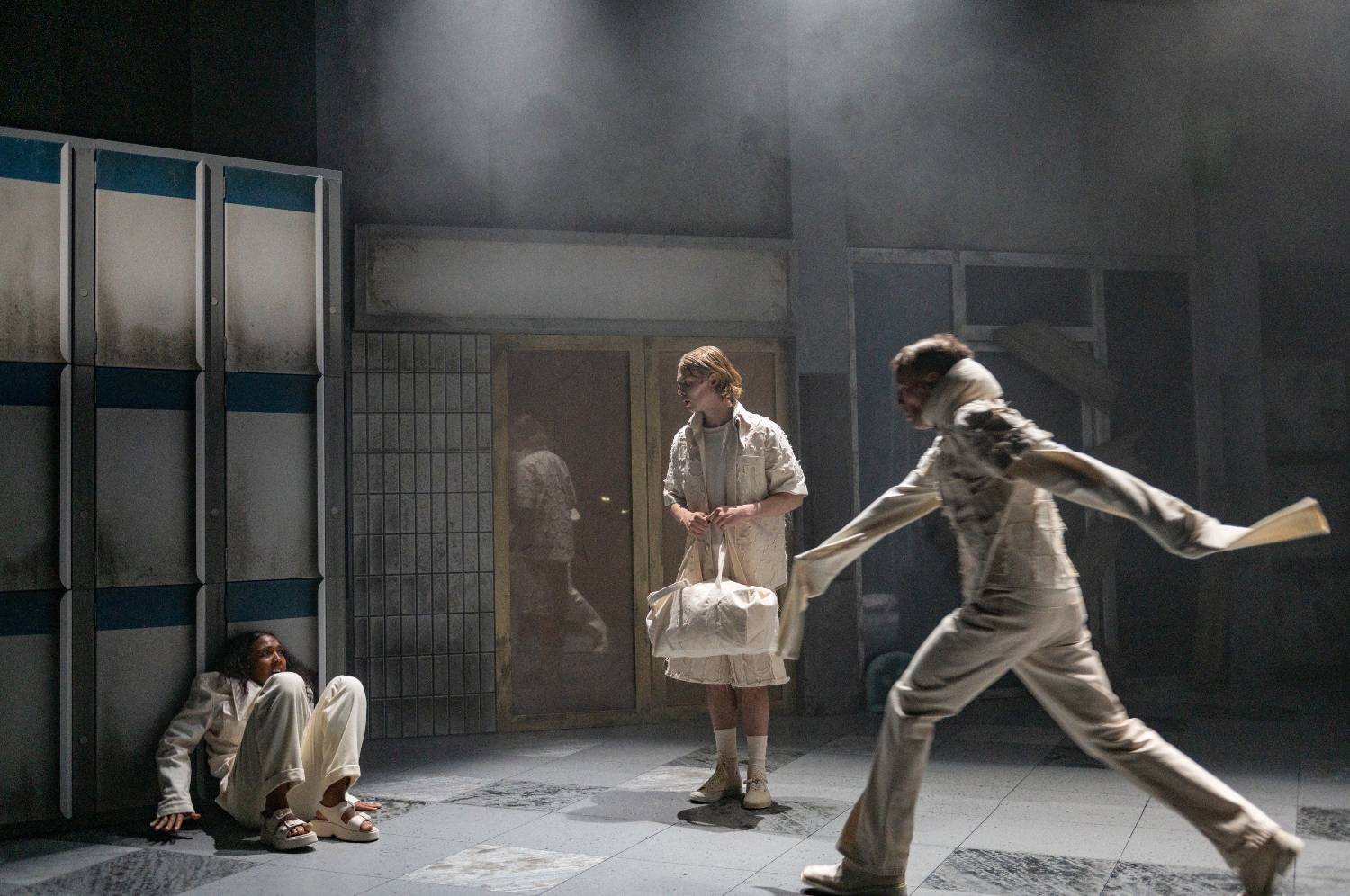
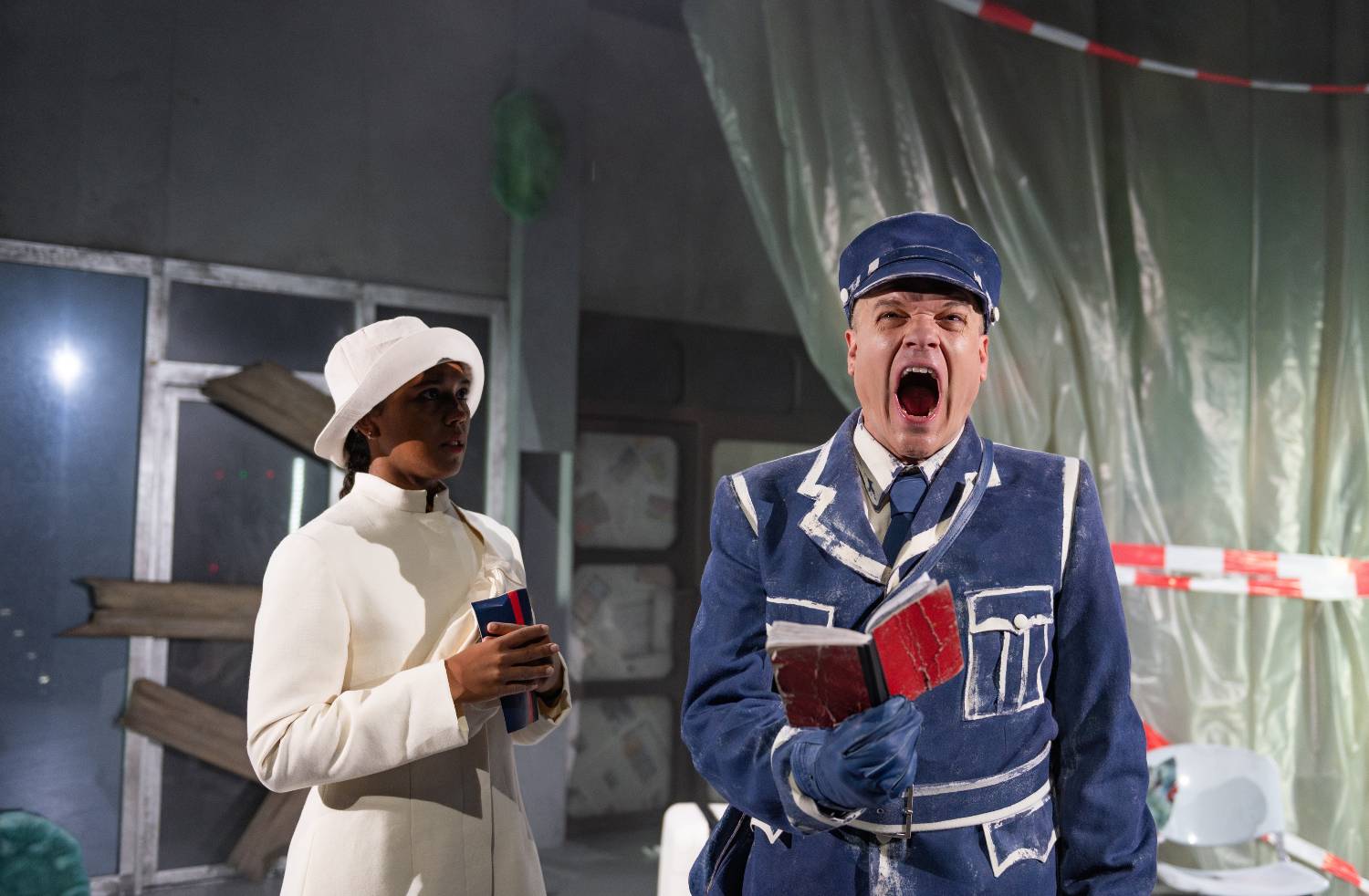
Late in the play, the voice of a surreal figure calling herself the “Queen of Germany” (Königin von Deutschland) emerges from Naomi’s phone. This authority figure—who has no place in the reality of the German republic—has commandeered the final train and fled alone, offering a hollow apology: “I have abandoned you. When I said that everything would return to normal, I didn’t mean this.” The figure serves as a sharp metaphor for the political bankruptcy of leadership and public institutions that have long governed by feeding the public reassuring slogans—such as “Wir schaffen das” (“We can do this”)—and other forms of hypocritical platitudes.
Even more revealing is the reaction of the characters immediately after the Queen’s phone call. They become angry with Naomi, insisting that speaking to someone without legitimate authority is against the rules. They even claim that the mobile phone she is holding is a “knife,” attempting to deny reality itself. The political leadership that was supposed to save its citizens has fled and the system has collapsed, yet what remains among the public is the mechanical bureaucratic oppression and cruelty of controlling and condemning the “other.” The Queen’s false promise of salvation—“If you jump from the moving train, I will catch you”—ultimately proves that the expectation that some great authority or the state will come to save us is nothing more than an absurd fantasy.
This political tragedy is intensified through the production’s striking visual contrasts. Throughout the play, the actors appear in hygienic, immaculate white clothing. These clean white clothes symbolize the sterile, almost laboratory-like “Normality” that German society seeks to maintain, as well as the supposedly flawless exterior of “Made in Germany.”
Yet as the play progresses, vivid red blood splatters across the supposedly immaculate white clothes, while dark reddish-brown mold spreads across them. The contrast between blood and decay bursting through a surface that initially resembles a sterile environment becomes a powerful visual device exposing the internal violence, racial anxieties, fear of immigrants, and historical trauma that society has suppressed. The blood-soaked white clothing marks the moment when the hypocrisy of “clean civilization” begins to unravel, making it viscerally clear that the more these forms of decay are concealed, the more violently they eventually erupt from within.
The Attitude of Staying Alert at a Station That Has Come to a Halt
The point reached by Das Deutschlandherz goes far beyond a diagnosis of systemic collapse. Amid the overlapping crises of climate change, war, and bureaucratic paralysis, the play offers an intuitive portrait of modern society’s structures of paralysis by contrasting motionless human beings with fear and hatred spreading at lightning speed. The station—the infrastructure of civilization—has ceased to function, demonstrating just how fragile the sense of security beneath the efficiency and sophistication of the systems Western society has long taken pride in can actually be. The three attitudes embodied by the characters—procedural passivity (Richard), apocalyptic cynicism (Walter), and dissociative detachment (Naomi)—are not merely dramatic traits confined to the stage. They are portraits of contemporary people who retreat into individual survival and silence, telling themselves, “I’m too busy taking care of myself.” The mold that consumes the station’s pillars and the surfaces of the human body is not a virus imported from outside. It is the consequence of an internal helplessness produced by refusing to confront a collapsing reality and choosing instead to remain comfortable within the hypocritical boundaries of “normality.” Faced with massive structural paralysis, no one can remain a neutral bystander.
Rather than offering a clear solution or comforting reassurance, the production unsettles the audience by exposing the raw devastation of this stagnant space. The audience is no longer permitted to remain mere passengers safely observing the stage from their seats; they are called upon to become active subjects of reflection, forced to confront the hypocrisy of the everyday world they inhabit. The extreme claustrophobia produced by the station paradoxically becomes the catalyst for breaking through a reality that has come to a standstill. Ultimately, the play confronts its audience with a final, chilling question: Will you acknowledge that the system has become paralyzed and take the first step forward—or will you remain at the motionless station, your white clothes stained with blood and mold, slowly rotting away?
production photos ©Robert Schittko
