
Interview with Korean Artist Subi Lee on the German Figurentheater Stage
There is a theatrical genre for which Korean has no fully adequate translation. In German, it is called Figurentheater. Often fragmented into categories such as puppetry, mask theatre, object theatre, and visual theatre, this genre is described by performer Subi Lee as object theatre.
While conventional theatre tends to explain situations and narratives through carefully constructed language and dialogue, object theatre communicates with audiences beyond words. Unlike traditional puppetry (Puppentheater), which carefully conceals the puppeteer and uses technique and timing to make puppets appear convincingly human, the contemporary object theatre practised by Lee does not seek to make objects “strive to become human.”
On stage, performers are not puppeteers hidden behind puppets; they appear as themselves, just as they are. Everyday objects and materials—a lemon, a teacup, an A4 sheet of paper, or aluminium foil—are not merely props. Instead, they become equal performance partners, responding to the performers and sharing the stage with them. When the physical qualities of objects, which have neither facial expressions nor dialogue, meet the performer’s body and produce unexpected moments of chance, audiences can draw on their own lives and experiences to fill the open spaces on stage with their imagination.
Having studied Figurentheater at the State University of Music and Performing Arts Stuttgart (HMDK), Korean performer Subi Lee recently turned the stage of Stuttgart’s FITZ theatre yellow with her new production, Nach Zitrone schmeckt die Welt (The World Tastes of Lemon). I was invited into the silent dialogue between performer and object, and spoke with her about a stage on which she stands entirely as herself.
When Lemons Dance and Chance Makes Us Laugh
Two performers dressed in black stand on a dark stage. The only striking colours are a blue table and a vivid yellow lemon resting on it. The performance begins as the two performers suddenly inhale the lemon’s sharp, refreshing scent. What appears to be the setting for a simple, orderly tea party soon transforms into a space of unpredictable imagination. At one moment, the yellow lemon seems to sprout invisible arms and legs, rolling around the stage and getting into a fierce fight with the performers. At another, it sulks after trying to stop a knife from cutting it. Eventually, this eccentric lemon wanders beneath a streetlamp in the night sky and begins dancing joyfully to “Singin’ in the Rain.” The lemon’s freshness, sourness, and the laughter they provoke spread throughout the audience. This is the vivid stage world of Nach Zitrone schmeckt die Welt.
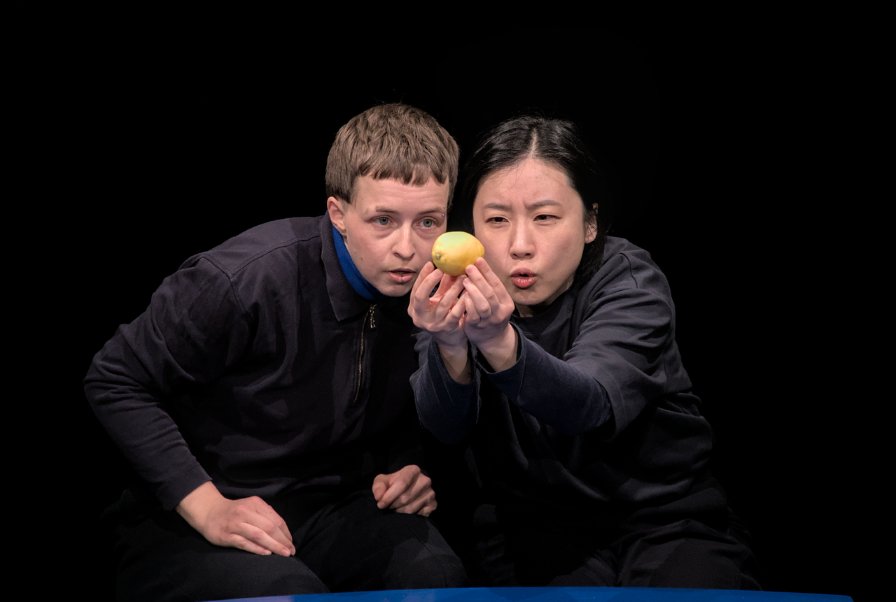
Q. Your new production, Nach Zitrone schmeckt die Welt, is a quirky and delightful 40-minute performance in which two performers play with teacups and a lemon. Could you tell us how the piece came about and share some behind-the-scenes details? Why did you choose a largely non-verbal form, with very little dialogue?
“It wasn’t a carefully planned project that began with the idea, ‘Let’s make a children’s show with a lemon!’ It started with a simple idea I had during my undergraduate studies: combining a puppet head with a living hand. My colleague Eva Mario Hasler really liked the idea, so we created a short performance called Mr. Lonely Head, featuring two human performers, a head wandering around without a body, and a hand that became its body.
As we approached graduation, we decided to develop the piece into something longer, and that was when the creative process really began. During this process, we replaced the ‘head’ from the original work with a lemon.
At first, we wanted to explore food culture and the process of cooking. We experimented with all kinds of everyday ingredients, putting peppers, salad, Chinese cabbage, forks, and chopsticks on the table. But after inviting fellow artists to give us feedback and gradually removing ingredients, we asked ourselves, ‘What is the one ingredient we really want to keep until the very end?’ The answer was the lemon. It’s difficult to explain exactly why, but we kept being drawn to it. Out of all those ingredients, the lemon was the one that remained—and eventually became the protagonist.
From the beginning, we had a non-verbal format in mind so that the production could travel easily and be performed in a compact form anywhere in the world, including Korea. Of course, language is not always excluded from object theatre. Language itself can also be a subject or a material.
What we try to avoid, however, is explaining every situation on stage through dialogue. Objects in motion already have the power to let audiences connect the dots and create a narrative for themselves.”
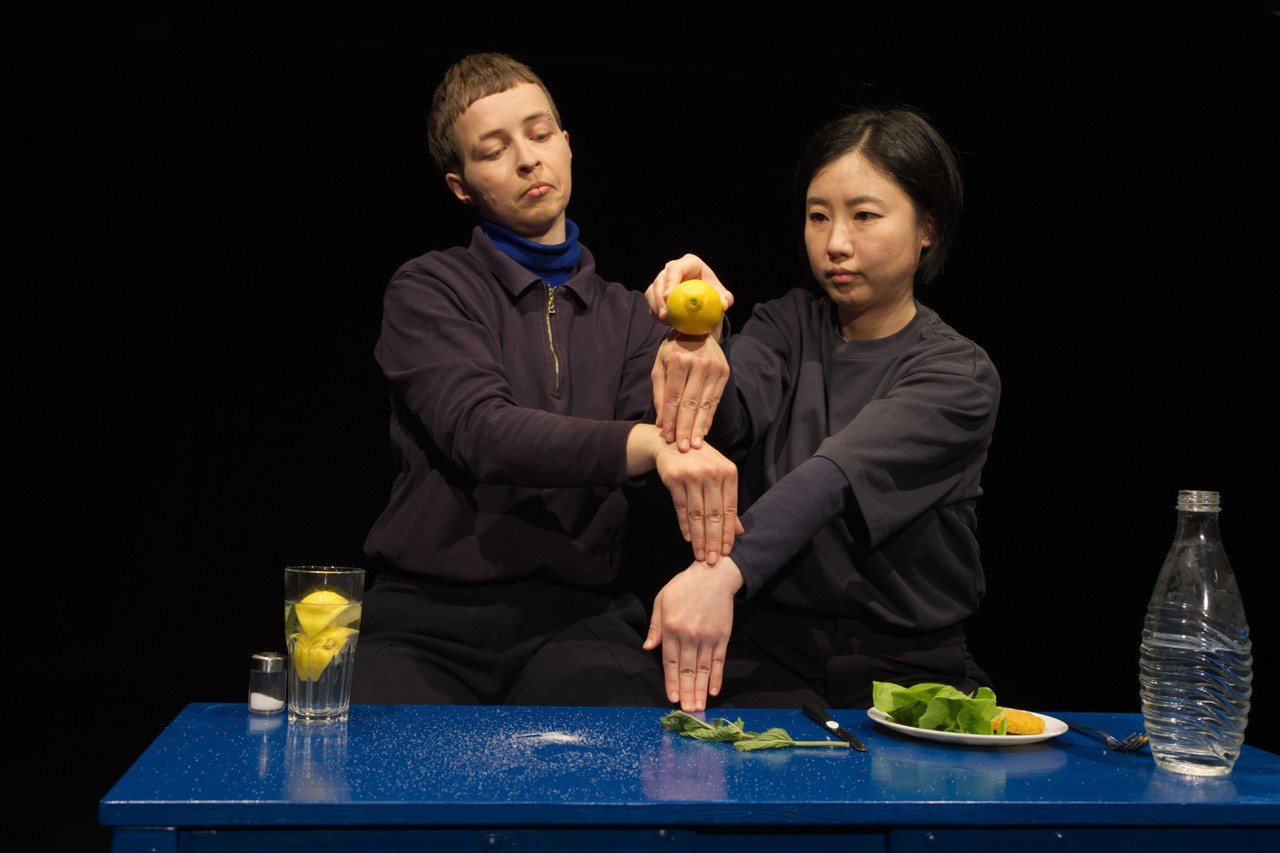
Q. The lemon on stage is an actual fruit, not a puppet with eyes or a mouth, yet it radiates a remarkable sense of life. As a performer, what do you focus on when bringing an object to life?
“Many people try to make objects look human by giving them eyes or depicting them in a human form. But what matters most to me is that an object does not try to become human. A lemon is simply a lemon. Instead, I focus on its sensory qualities: its yellow colour, refreshing scent, sharp taste, and the juice that spurts out when it is squeezed. I observe the object’s own characteristics with an open mind and play alongside it.
Above all, it is important that I, as a performer, do not hide behind a puppet or make a grand effort to imitate someone else. I stand on stage as myself, without pretence, and communicate and interact with the object as an equal. When I genuinely exchange energy with an object as myself, vivid sensations and emotions naturally emerge from within me. Because I build the performance around these ‘real sensations,’ I think genuine life can finally emerge from both the object and the stage.
Being able to exist as I am, interact with an object, and be accepted and loved just as I am gives me an enormous sense of freedom as a performer.
That is why being present in the moment is absolutely essential to object theatre. Especially when working at a table, you can never predict through calculation alone where a spark of life might emerge. You have to encounter the object directly on stage, keep experimenting, and interact with it until something comes to life.
During rehearsals, you might touch and move an object in different ways, and suddenly something unexpected happens. Chance always carries a potential for comedy. Even in a tragic situation, an unexpected coincidence can make people burst out laughing. The absurd, delightful moments that emerge spontaneously on stage came together to complete this performance.”
Q. Could you introduce the members of Babák-Kollektiv and tell us what each of you contributed to this production?
“In conventional theatre, the division of roles is usually quite clear: the director takes the lead and guides the process. In object theatre, however, everyone is often both a performer and a creator. Our roles and positions can also change flexibly from one project to another.
Sometimes, instead of listing ‘Direction’ in the credits, we use the term ‘Outside Eye’ (Außenblick). This person observes the overall picture and flow of the work from outside the stage. In the rehearsal room, the work can resemble directing, although the two terms are not exactly the same. Sometimes the difference lies in the degree of responsibility; sometimes the roles overlap, and sometimes they are clearly distinct.
Nóra Vermes, who directed this production, has a kind of authority that allows her to choose which ideas we should try first when the rehearsal room becomes chaotic with a constant stream of new ideas. Nóra originally trained in puppet-theatre stage design, but she also performs and builds sets whenever necessary. We all have areas we particularly enjoy and focus on, but we also work across disciplines.
Eva Mario Hasler, who has been developing this performance with me from the beginning, is not only a performer on stage but also takes care of a wide range of production-related tasks, including administration, publicity, and fundraising.
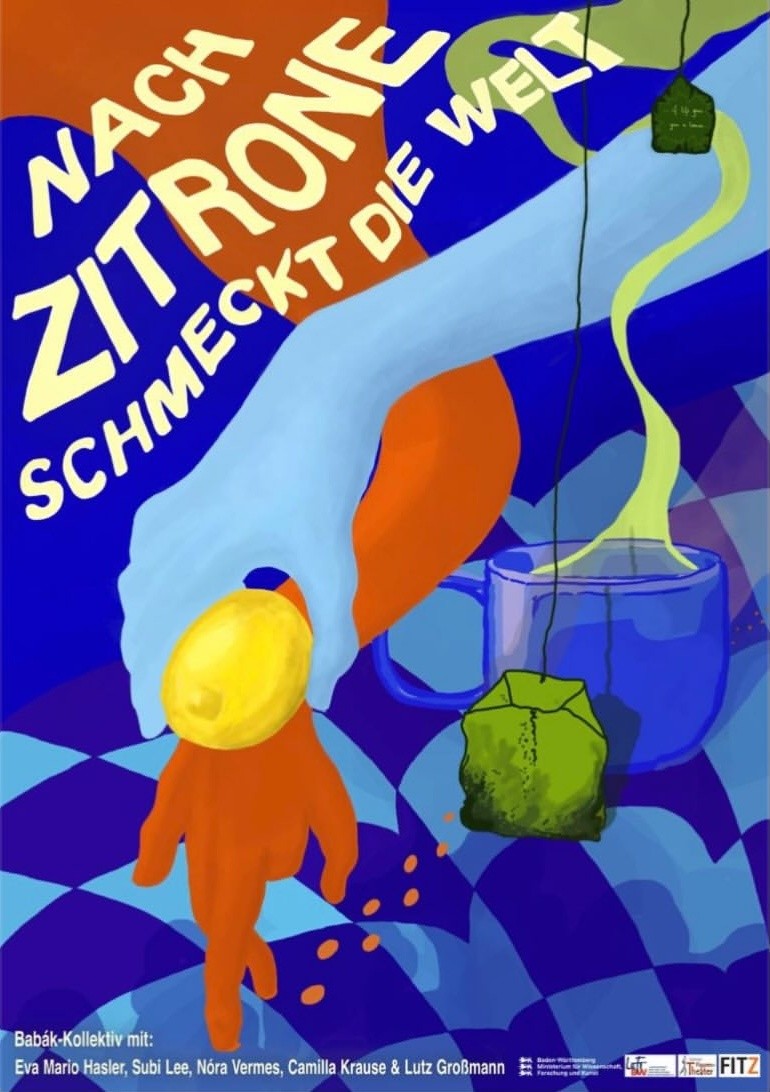
Camilla Krause, who is responsible for sound and dramaturgy, originally studied violin. For this production, she has taken on many roles, including sound, poster design, and composition. She even composed the closing song herself!
Being able to move beyond our usual roles and create a performance together is one of the healthiest driving forces behind our work.”
Beyond Words, Into the Body
The performing arts collective Ttwida was founded in 2001 by graduates of the School of Drama at the Korea National University of Arts and remained active until 2021. Working with puppets, masks, and physical theatre, the group persistently explored the materiality of the performer’s body and the vitality of objects. Based at Art Farm in Hwacheon, Gangwon Province, Ttwida also collaborated with local residents and organised workshops where artists from Korea and abroad could meet, exchange ideas, and explore the group’s methods together.
The 2014 movement workshop The Body as Object, the Object as Body was one such initiative. Drawing on Ttwida’s methods, the workshop explored the materiality of the performer’s body and the vitality of objects through puppets, masks, and physical expression. It became a turning point for Lee, allowing her to discover new theatrical possibilities.
After studying German and Chinese literature at Sungkyunkwan University, Lee had worked in theatre and on-screen acting since 2010. She joined the workshop by chance. At the time, she was familiar with theatre in which stories were conveyed primarily through dialogue and speech. Her first experience working with puppets, masks, and objects, however, revealed new possibilities for the body and objects on stage. She was deeply fascinated by the fact that audiences could be moved by breath, movement, and the sensory qualities of objects without having every situation explained in words.
That experience prompted her to leave Korea and move to Germany. Today, Lee continues to develop her own theatrical perspective while moving between Korea and Germany. We spoke with her about the journey that began when she discovered the theatrical possibilities emerging between the body and objects.
Q. After studying German and Chinese literature and working in theatre in Korea, you eventually decided to pursue your studies in Germany. Could you tell us more about how that happened?
“I had wanted to become an actor since I was very young. I wasn’t particularly interested in my university classes, so after graduating, I began working as an actor with theatre companies. I also tried screen acting, but I always preferred the stage.
Then, in 2014, I took part in a two-week residential workshop organised by Ttwida in Hwacheon. The theme was ‘The Body as Object, the Object as Body.’ That was my first encounter with masks, puppets, and objects, and it was a tremendous shock.
In conventional theatre, you have to explain every situation and a character’s entire backstory through dialogue. With puppets and masks, however, even when there is no change in facial expression, something happens when they meet the performer’s body and are given breath. The audience fills the resulting gaps with its own imagination.
I was completely captivated by this kind of theatre, where you don’t have to say everything in words, and by the way energy flows from the body rather than from the head. I wanted to study this form of theatre in depth, so I came all the way to Germany.”
Q. From your own experience, what makes contemporary German object theatre so distinctive and appealing?
“It’s the relationship between performers and objects, and the open space that allows the audience’s imagination to enter. Traditional puppetry conceals the performer and emphasises the puppet. In contemporary object theatre, by contrast, the performer does not hide behind the puppet. They stand on stage as themselves and interact with the object as an equal.
That creates a relationship between us—the performer and the object—and you, the audience. When performers and objects interact as equals and create an open space between them, audiences can bring their own life histories into that space and fill it with their imagination.
For example, a moment of interaction between a performer and an object might suddenly bring back an emotion someone experienced ten years ago. The audience then forms an active relationship with the performance. That, to me, is the unique appeal of object theatre.”
Asking Questions About Adult Life Through Children
When children fill a theatre with laughter at the absurd movements of everyday objects, the intuitive power of object theatre becomes unmistakable. Puppet theatre and theatre for children are often dismissed as lightweight genres intended only for young audiences. Lee, however, calls children the “final boss of audiences.” Their intuition cuts straight through unnecessary intellectual framing and gets to the heart of things; she believes this is one of the highest achievements theatre can reach.
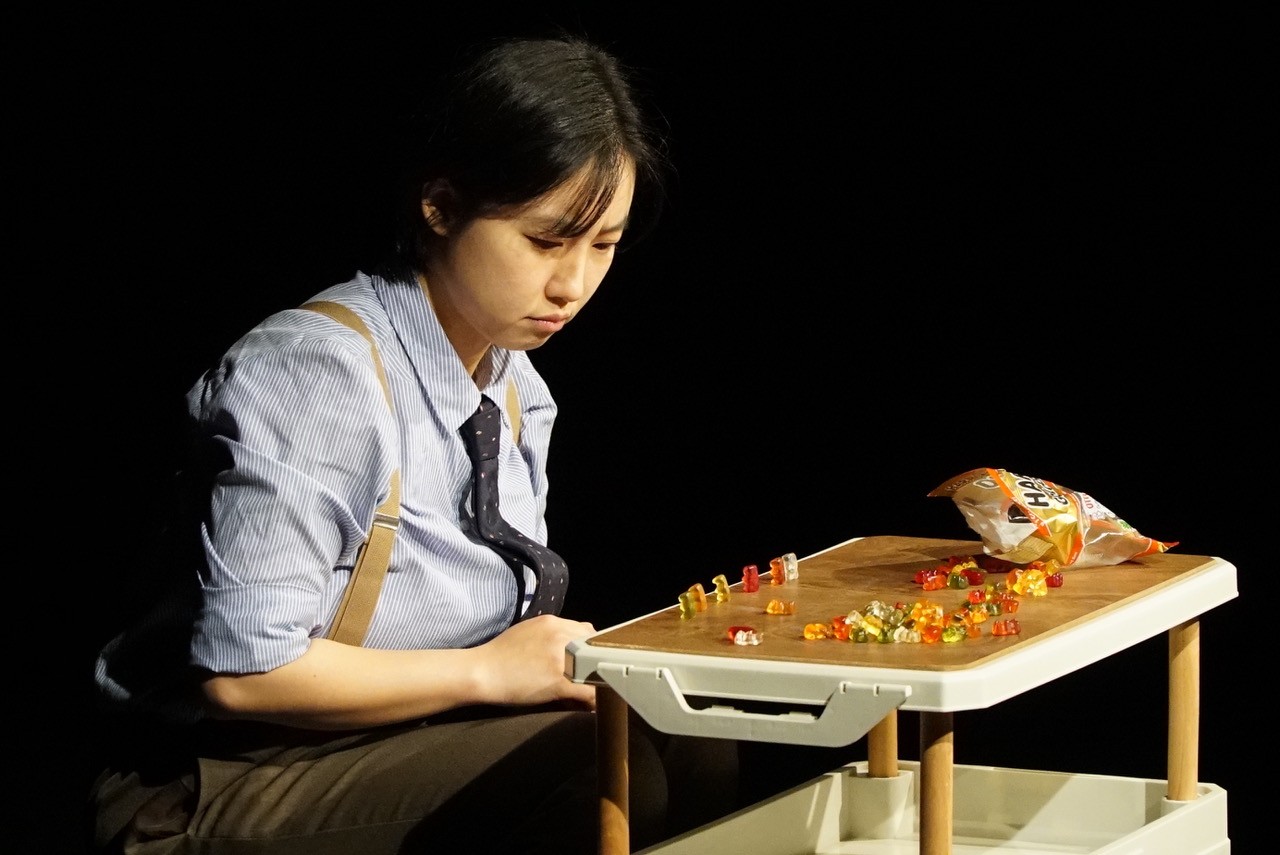
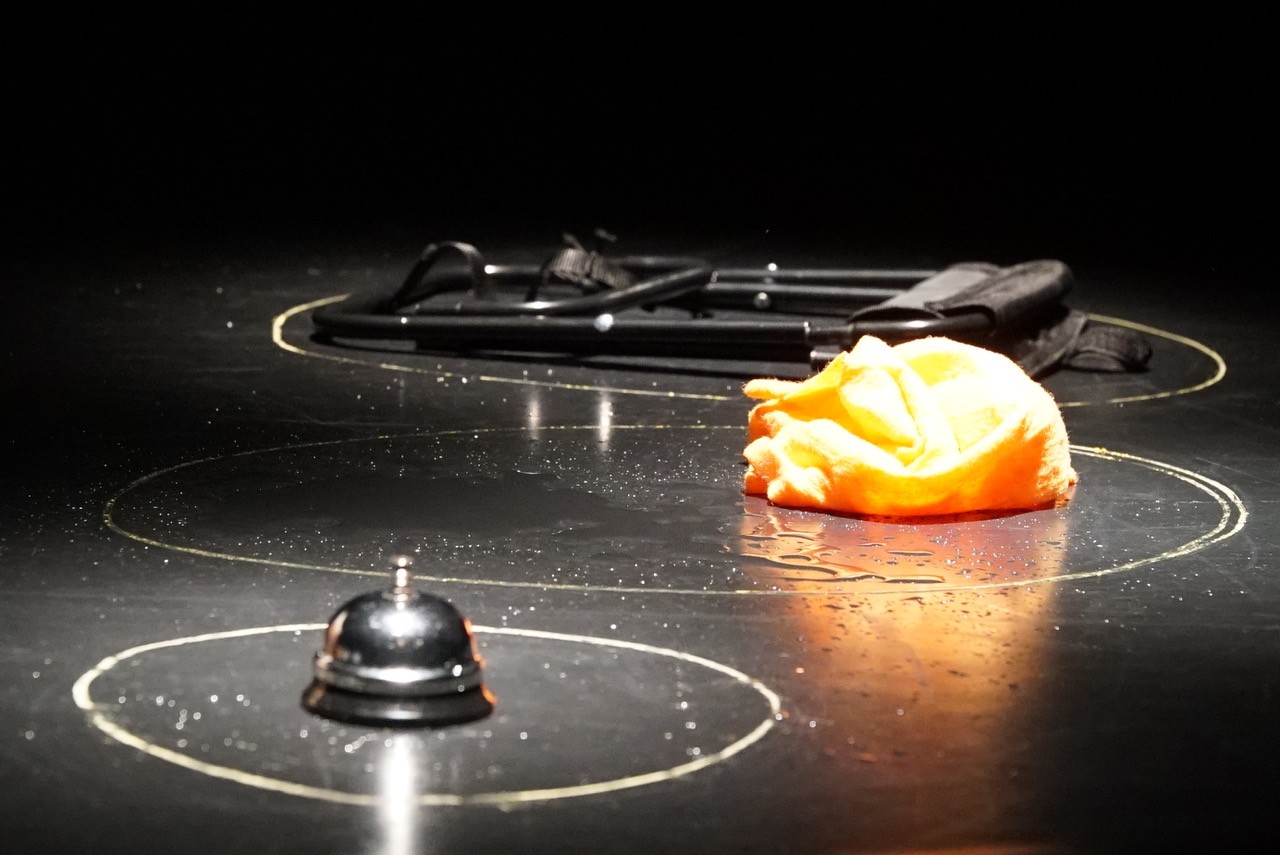
This idea is also at the heart of her graduation project and debut production, Alles Gute – K(l)eine Antworten auf eine große Frage (All the Best – (S)mall Answers to a Big Question). Described as “object theatre for grown-up children,” the work playfully asks what it means to be a good person and what a good life might look like, using everyday objects such as A4 paper, dishcloths, and gummy bears.
By bringing her understanding of object theatre to the stage across linguistic and cultural boundaries, Lee created a work that was invited to the International Figurentheater-Festival Erlangen in Germany in 2024, where it was performed eight times. In 2026, it was also nominated for the Grünschnabel award for emerging artists at Switzerland’s Figura Theatre Festival.
From the unfiltered intuition of children to questions about adult life, we spoke with Lee about the ideas behind her work and what this journey has meant to her.
Q. Puppet theatre and theatre for children are often assumed to be genres for a specific age group. Yet your performances bring together audiences of all ages, from children to adults, who laugh and become absorbed in the work together. What makes object theatre so compelling, and how does it transcend age boundaries?
“For me, children are not simply cute little guests in the audience. They are more like the ‘final boss of audiences.’ Adult spectators sometimes laugh out of politeness or maintain their social composure, but children don’t lie. Their reactions are incredibly intuitive and pure, and the insights that emerge from that intuition can be astonishingly sharp. That’s why I believe that if you can satisfy a child in the audience, you can satisfy any audience in the world.
That is also why I keep bringing the form of theatre for children onto the stage. I’m drawn to their unfiltered innocence. By innocence, I don’t mean something childish or lacking in depth. I mean the purest, most intuitive theatrical form, stripped of unnecessary intellectual framing, complicated backstories, and layers of calculation.
Children don’t go around things in circles. Their way of thinking can cut straight to the essence. I believe that the intuitive insight that awakens in that instant is one of the highest levels theatre can reach.”
Q. Your graduation project and debut production, Alles Gute – K(l)eine Antworten auf eine große Frage, grew out of a particular set of questions. What inspired you to make it?
“In a nutshell, I would call it ‘object theatre for grown-up children.’
After achieving my dream of becoming an actor, I asked myself, ‘What should my next dream be?’ The answer was ‘becoming a good person.’ I had vaguely told myself that I absolutely had to become a good person before I turned forty. Then one day, I looked at my age and realised I was already thirty-eight! When I realised I had only two years left, I started worrying: ‘I need to become a good person quickly… but what exactly does it mean to be a good person?’ That anxiety and those questions became the starting point for this work.
On the table stage, we use utterly ordinary objects such as paper, gummy bears, and dishcloths. Paper is crumpled and torn, changing its shape; gummy bears stage a protest; and a dishcloth becomes dirty and damp after cleaning. Following the movements of these objects, audiences encounter the question: ‘What does it really mean to live a good and righteous life?’
On the surface, the objects seem to be playing like children, bickering and fooling around. Yet the serious questions hidden within their intuitive actions can catch adult audiences off guard and leave them deeply moved.
A single moment of wonder witnessed in a theatre during childhood can become a guiding light throughout someone’s life. I want to give children their first sense of wonder about the world, and adults a moment of intuitive purity that refreshes their everyday lives. That is why I cannot give up object theatre; it is what I feel called to do.”
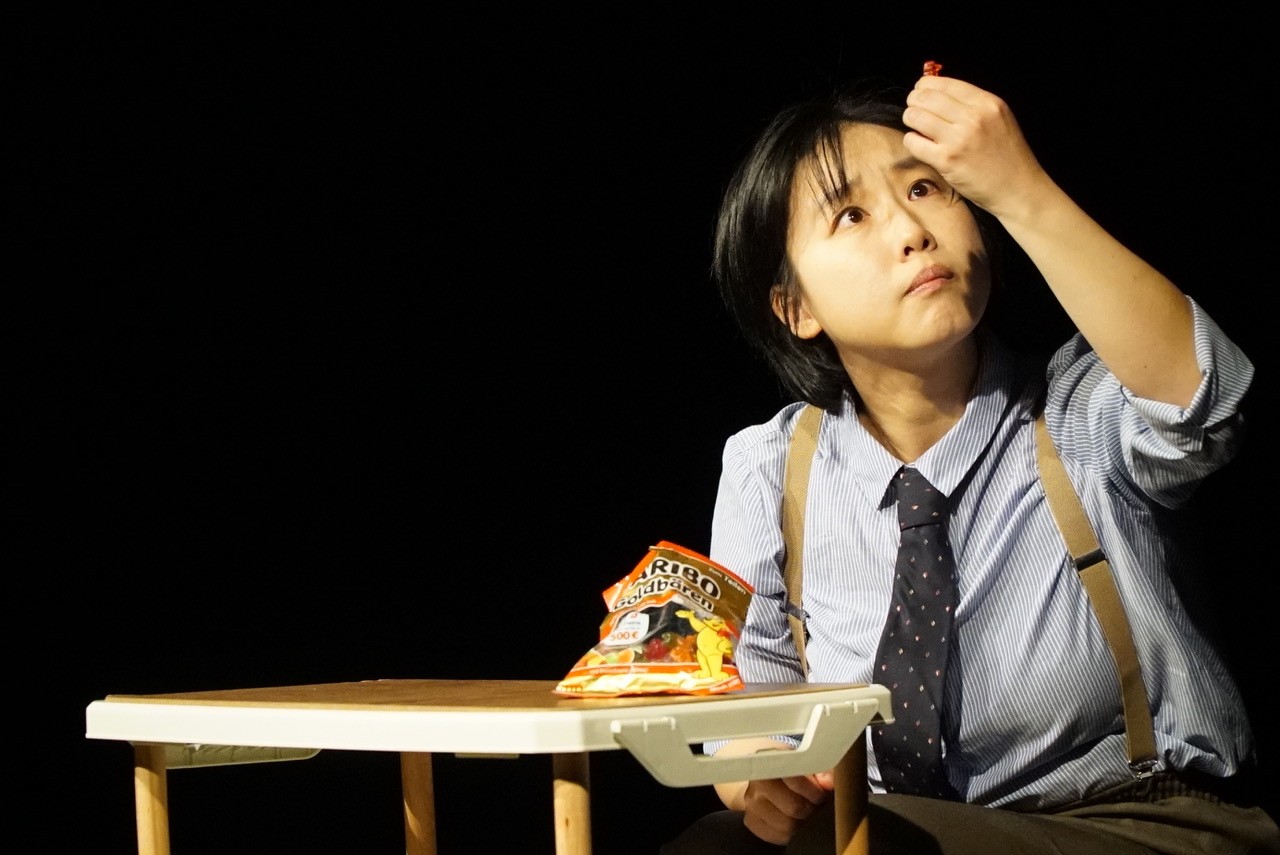
Q. The production was invited to the International Figurentheater-Festival Erlangen in Germany, where it was performed eight times, and was also nominated for the Grünschnabel award at Switzerland’s Figura Festival. What did these achievements mean to you?
“Toward the end of my studies in Germany, I was physically and emotionally exhausted by language and cultural barriers, as well as the loneliness of being an outsider. I knew very little about the local arts scene or festival system. I didn’t even have a website to introduce my work, let alone a professional network. So, for my graduation project, all I wanted was to pour everything into the essence of object theatre that I truly believed in, without calculation or compromise.
Fortunately, the artistic director of the Erlangen Festival, one of Germany’s leading international festivals for object theatre, came to see my graduation production and invited us on the spot. We went on to complete eight successful performances. I was also surprised when two local newspapers and Bayerischer Rundfunk (BR) introduced the work.
I felt both relief and joy. I realised that even when language and background differ, it is possible to connect deeply with a local audience through the interaction between objects and the body alone.
Later, through the connections I made there, I was nominated for the Grünschnabel award at Switzerland’s Figura Theatre Festival. It felt as though all the hardship I had endured melted away in an instant. As an Asian woman performer who had struggled through her studies abroad largely on her own, it was the most beautiful way to bring that chapter of my life to a close.
More than anything, I gained a profound sense of certainty that the path I had questioned and believed in was not wrong, and that I could keep walking it at my own pace. It also gave me a powerful motivation to remain on stage for the rest of my life.”
An Artist on the Border
In music, the instrument is the medium; in visual art, it is the artwork. In theatre, however, the performer’s own body and life become the language on stage. Living as an outsider at a school where there were no other Asian students, Lee encountered cultural differences and other people’s perceptions of her—experiences that became stories she needed to express on stage.
She explored the gap between how she defines herself and how others see her in the solo mask performance MICRO-Alien. Now, she is developing those once unfamiliar and uncomfortable experiences into a new work, Halsweh und Heiterkeit: eine Ode an das Missverständnis (Sore Throats and Mirth: An Ode to Misunderstanding), transforming even cultural misunderstandings into moments of laughter. We spoke with Lee about turning the experience of being an outsider into her own physical language and sense of comedy.
Q. Could you tell us about the cultural differences you experienced while studying performance as the only Asian student at your school, and how you explored those experiences in your solo mask performance, MICRO-Alien?
“There are many Korean students studying music or visual arts in Germany, but I was the only Asian student in the Figurentheater programme. Music has an instrument as its medium, and visual art has the artwork itself. Theatre, however, is a form in which the performer’s own body, emotions, and life experiences are placed directly on stage. When my colleagues and I discussed our work, we sometimes clashed because we came from different cultural contexts and held different values. We had to confront those differences and work through them intensely.
The gap between how I define myself and how other people see me, and the fractures in my sense of self that I felt under the gaze of another culture, became the subject of my solo mask performance MICRO-Alien, which I presented at FITZ theatre in 2023. I concealed my face behind a mask and used physical play and movement to explore loneliness and identity as someone living between boundaries.
Looking back, that unfamiliar and lonely period became a valuable asset. It helped me develop my own distinctive physical language and a deeper perspective on stage.”
Q. Your new production, Halsweh und Heiterkeit, which is set to premiere in early December, explores cultural misunderstandings and differences through comedy. What inspired you to develop the piece, and what can audiences expect?
“It’s a clowning and object-theatre production for adult audiences that I’m co-creating with fellow performer Jo Posenenske. I’ll give you a little spoiler: it will feature a karaoke machine, an object I’ve wanted to use on stage for a long time, and I think string or rope will also become one of our materials.
The central themes are misunderstanding and communication. As a foreigner living in Germany, I’ve kept a personal list of German words whose similar pronunciation has led to misunderstandings or awkward situations. When I showed the list to my collaborator, they found it fascinating and funny and suggested that we create scenes from it. That’s how the misunderstandings and differences I’ve experienced as a foreigner became wonderful material for the stage.
At the time, moments when I realised I had been misunderstood and felt I had to read the room and explain everything one by one could be upsetting or frustrating. But looking back, there is something absurd and delightful about them—a kind of ‘aesthetics of misunderstanding’ that we can laugh about together.
We’re planning to take misunderstandings, which can carry deep pain and anguish, and place them within the framework of comedy, presenting them in a playful and joyful way.”
Q. Finally, what would you like to say to younger Korean artists who dream of working in object theatre, and to readers who are still unfamiliar with the genre?
“If you want to study contemporary object theatre in Europe or Germany, I would strongly encourage you to go for it! It’s a genre that offers a very real artistic pleasure: you can freely explore your artistic impulses and pure ideas without restrictions.
Object theatre is still not widely established in Korea, so I often feel a real longing for more colleagues working in this field. If there are younger artists or fellow performers in Korea who want to try this genre or study it, I’d be delighted to help and support them, whether they need advice about entrance examinations or want to share their work. I’d love to tell them everything I know, from preparing for auditions to finding their way through studying abroad.
The genre may feel unfamiliar at first, but I hope people will open their minds and come along to enjoy this playful stage, where objects come alive and form relationships with us through our individual experiences.”
Imagination in the Space We Leave Open
The dialogue Lee shares with objects is never one-sided, nor does she try to overwhelm audiences with an exaggerated narrative. She simply reaches out to an object and creates a space between herself and it. Into that space come the audience’s individual imaginations, memories, and bursts of laughter.
Even amid life’s unexpected moments, which can arrive with a sharp, sour taste, the playfulness of object theatre cracks open the shells that have hardened within us. It is about accepting the physical qualities of objects as they are, standing on stage as oneself without pretence or imitation, and inviting the audience into the tender space that emerges between performer and object.
In this way, Lee shares the joy of being herself on stage and opens up new possibilities for communication between objects and people. That is why I am already looking forward to the next dialogue she will have with objects as she travels between Seoul and Europe.
One day, when the complicated language and excuses of everyday life leave your heart feeling hardened, try making your way quietly to one of her performances. Listen to the quirky, innocent greetings offered by teacups, yellow lemons, and gummy bears, and you may find yourself encountering a pure, forgotten kind of laughter.
So even if life tastes sour, let’s keep it up joyful!
