

I attended the K-Musical International Market, which ran from June 29 through July 3. The K-Musical International Market is a place of opportunity where a wide range of homegrown Korean productions can be previewed before they pursue overseas expansion or investment. On top of that, a series of lectures by industry professionals offered attendees a valuable chance to learn about all things musical theatre.
Among the various side events on offer, this editor attended the <Musical Showcase> program, where domestic original musicals were condensed into roughly forty-minute previews. The showcase was held at the Woori Bank Hall inside COEX Artium. Works selected through the program will go on to be staged in London. As someone who loves live performance, there was something deeply rewarding about imagining these homegrown productions captivating audiences overseas.
Having visited this venue many times to see various productions, I knew the way well — and I set off with a light, eager step,
full of anticipation.
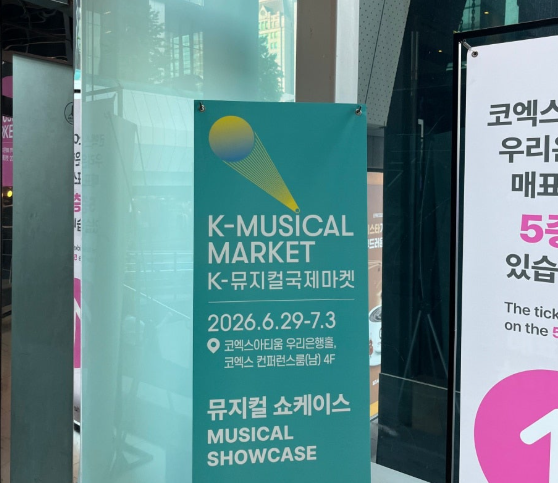
The path leading up to the venue. Photo by Jihyun Nam
COEX Mall sits directly below the venue, so I passed the waiting time browsing around without a dull moment. COEX is home to everything from the Starfield Library to various shopping outlets, a cinema, an aquarium, and more. If you ever have the chance to visit COEX Artium, I'd recommend taking a stroll through COEX Mall while you're at it.
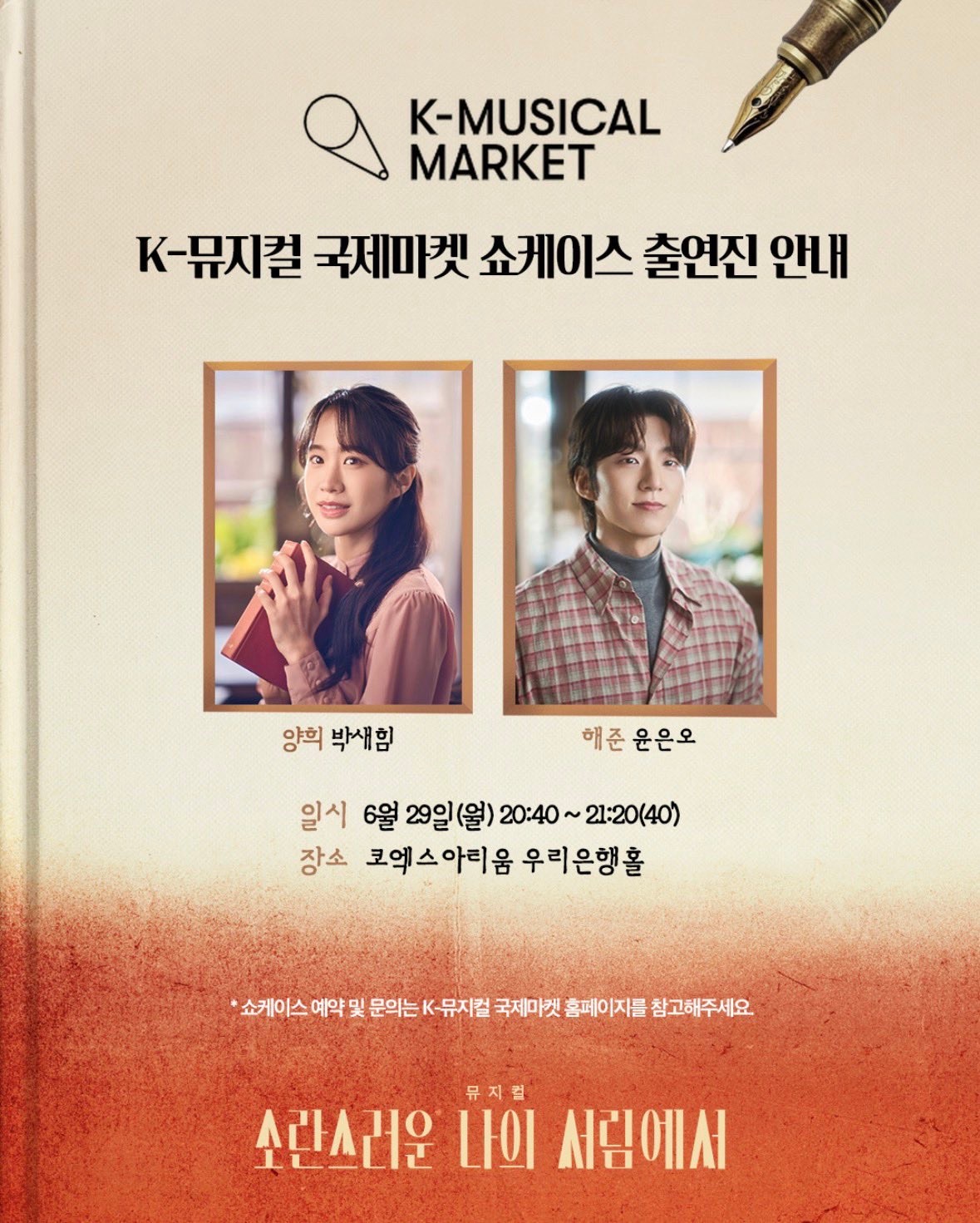
Casting board for musical <From My Noisy Bookshop>, Woori Bank Hall at COEX Artium, June 29, Emotional Theatre
After passing the time that way, I returned to the venue in time for the end of the first part. Doors opened ten minutes before the second part began.
Since all photography and video recording are prohibited inside the venue, I'll do my best to paint as detailed a picture as I can in words.
Upon entering, the first thing that commands your attention is a large screen that dominates the stage. It displayed backdrop imagery that set the overall mood of the production, and also ran a subtitling system for international audience members. The performance itself was presented in a reading format, with only the minimal props required by the story, two chairs, and — for <From My Noisy Bookshop> — two small tables positioned on either side of the stage.
Prologue of musical <From My Noisy Bookshop> (Reference: NOL Ticket website)
"My today is your tomorrow. Unmeasurable stretches of time flow between us, carried along by an old book, connecting us like day and night."
Yang-hee of 1940 and Hae-jun of 1980 — two people dreaming of freedom as they live through dark and oppressive times.
A chance discovery of a single book at "Asita Bookshop" brings them into communication with each other, and they come to realize that forty years stand between them.
Curious about each other's worlds, the two begin to build something together across time.
Then Hae-jun discovers that Yang-hee is about to take part in an uprising — one that history has recorded as a failure…
Characters
Yang-hee, 1940
She is the owner of "Asita Bookshop." Her dream is to write freely — without being suppressed for being a woman or for being Korean. Living under Japanese colonial rule and the cultural assimilation policies that forced people to recite imperial loyalty oaths and adopt Japanese names, she has renamed her bookshop in Japanese to evade the scrutiny of Japanese soldiers, all while secretly funneling funds to the independence movement.
One day, a book she stumbles upon in the shop leads her to Hae-jun, and through him she finds herself daring to dream of a free future once more.
Hae-jun, 1980
Hae-jun is a journalist — or rather, a man who dreams of being one. Having witnessed Nara die right before his eyes while crying out for freedom and standing against a dictatorship, he has since withdrawn from the world entirely.
A book he finds by chance in a bookshop leads him to Yang-hee, and through her he begins to look back on a life that had seemed utterly devoid of hope.
The bookshop ultimately becomes something like a secret hideout — a space where both characters can shed the weight of oppression and speak freely about their own stories.
Through the words written inside books, they each unfold what they want to say, and the audience is given a vivid window into the circumstances of those eras and the efforts of the people who lived through them.
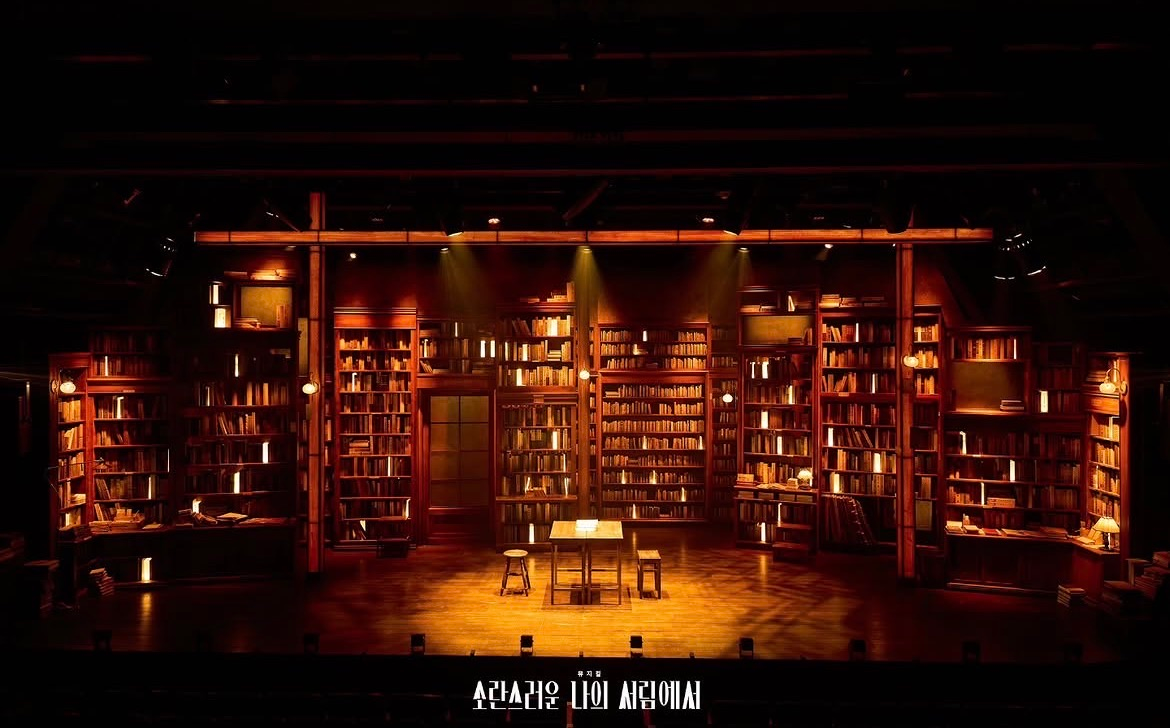
Production photo from musical <From My Noisy Bookshop>, et theatre 1, Emotional Theatre
The full production runs approximately ninety minutes, but given the showcase format, only select scenes were presented in a condensed forty-minute version. Even so, the story felt solid and well-structured, with a clear dramatic arc that gave the impression of having experienced the whole work. From the moment Yang-hee and Hae-jun each first step into the bookshop, to the scene where they first become aware of each other's existence, to the revelation that forty years separate them, to Hae-jun searching for a news article about a failed uprising only to discover it is connected to Yang-hee — and his attempt to change the course of history — right through to the ending the two of them reach together.
Perhaps because the backdrop of Yang-hee living under Japanese oppression in 1940 and Hae-jun living under government oppression in 1980 draws on events from Korean history that must never be forgotten, the blood, sweat, and tears of those who had to sacrifice and those who fought to preserve the truth felt genuinely woven into the fabric of the story. For some, these may be nothing more than episodes that drift by in the flow of history — but it is precisely because of the toil and courage of people like these that we are able to live in the era we do today.
Of all the scenes and numbers, the one that stayed with me most was <If You Do Nothing> — a scene in which Hae-jun, in a private monologue, passes a message to Yang-hee on the eve of a momentous and dangerous act, pleading with her not to go through with it. Both characters cry out the same words at the same time — "If you do nothing, nothing will happen" — yet the meaning each of them pours into those words is entirely different, and that gap was quietly devastating.
Hae-jun knows from the historical record that the uprising ended in failure, and so more than anything he wants to protect Yang-hee. Yang-hee, on the other hand, sets off to prepare for the uprising because she wants the people of the future to have a happy ending. In the end, each understands the other — and yet cannot. It was a scene that captured that contradiction with remarkable clarity.
Yang-hee ultimately steps out to join the uprising, only to be arrested in its aftermath and subjected to brutal torture before being imprisoned. The uprising may have ended in failure, but Hae-jun puts pen to paper to ensure that Yang-hee's sacrifice is properly recorded — and it is with the line "from my noisy bookshop" that the curtain falls.
It was a production that left a strong impression: two people living in different eras, communicating and understanding each other through the medium of books, drawing out a shared empathy for each other's pain.
It made me want to see the full production all the more. On an actual stage, with the bookshop fully realized, I imagine it would feel even closer and more immediate. I also mentioned earlier that subtitles were displayed on the screen in English, Chinese, and Japanese — and as someone who studied English, I found it genuinely interesting to listen to the dialogue and compare it against the subtitles, thinking, "So that's how they translated that line."
I believe this is a work that conveys, better than almost any other, the dedication and sacrifice of those who fought to protect this country — not only within Korea but beyond its borders. It is not simply a showcase for a domestic production; it is a work that powerfully reaffirms the importance of our own national history.
Covering the K-Musical International Market in person made me realize just how steadily the popularity of Korean performing arts is growing. What struck me most was the sheer number of international audience members in attendance.
I look forward to seeing many more works emerge that can captivate not only domestic audiences, but audiences around the world.
