
Punchdrunk's landmark immersive production finds a compelling new home in the heart of Chungmuro — and proves that the language of the body needs no translation.
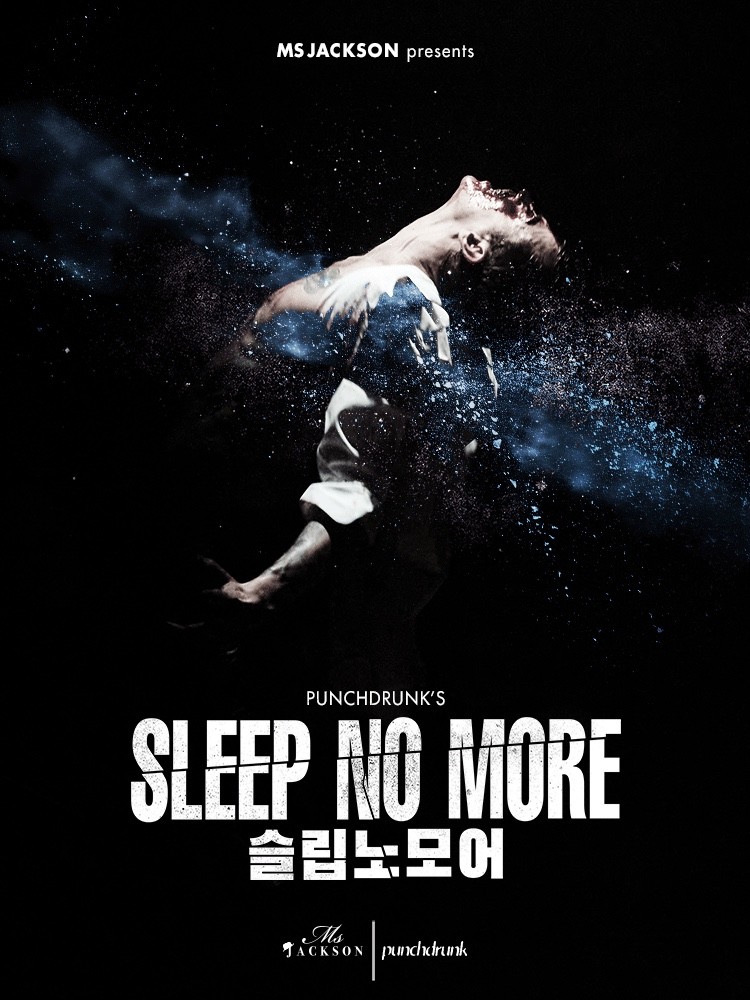
There is a particular kind of disorientation that settles over you the moment you step through the doors of what was once the Daehan Cinema in Chungmuro, Seoul. The building's silver-and-white checkered facade and glass frontage mark it as something conspicuous — a venue that makes no secret of itself, even as the world inside it conspires to make you forget where, and perhaps who, you are. The production transforms the historic former cinema into the McKithan Hotel, a sprawling, dimly lit labyrinth built exclusively for the show. What follows, for the next three hours, is something that resists easy categorization. It is theater, yes — but only barely. It is closer to inhabiting a waking nightmare.
Sleep No More, created by the British theater company Punchdrunk, adapts the story of Macbeth while being deprived of nearly all spoken dialogue and set primarily in a dimly lit, 1930s-era establishment. The production draws additional inspiration from classic noir films, particularly the works of Alfred Hitchcock, and takes its name from Macbeth's line: "Methought I heard a voice cry, 'Sleep no more: Macbeth does murder sleep.'" Since its 2003 London premiere, the show has accumulated a devoted following across Boston, New York, and Shanghai. The Seoul iteration, which opened officially on August 21, 2025, is its latest and perhaps most architecturally ambitious chapter.
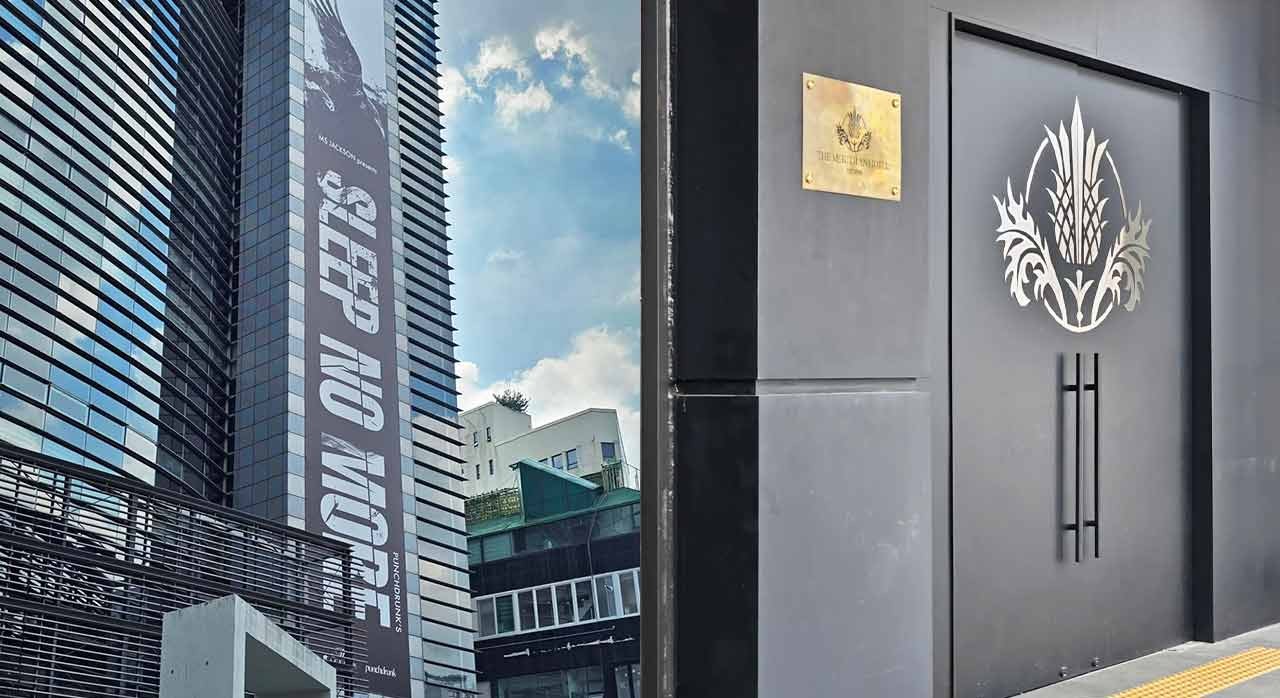
A Venue That Earns Its Place in the Story
Originally opened in 1958, the Daehan Theater is receiving a full Punchdrunk design makeover by the original creative team that produced Sleep No More in New York and Shanghai. The significance of that lineage is not incidental. Designer Livi Vaughan, one half of the Minns and Vaughan design duo responsible for Punchdrunk's signature aesthetic, has taken what might have been a liability — a large, prominent, purpose-built cinema — and transformed it into one of the production's greatest assets.
What is also brilliant about this production is that its source texts include Macbeth, but the show is also inspired by Alfred Hitchcock, film noir, and those incredible cinematic pieces. Putting those within an existing cinema came together quite beautifully. There is an elegant irony at work here: a building conceived for passive spectatorship, where audiences once sat still and watched stories unfold on a flat screen, has been rewired from the inside out to demand the opposite. You do not watch Sleep No More. You move through it.
A section of the Seoul production retains architectural traces of the former Daehan Cinema, including rakes from the historic movie theater. These deliberate preservations give the space a kind of palimpsest quality — layered histories pressing against each other beneath the surface. The show's world of 1930s Scotland coexists with the ghost of twentieth-century Korean cinema culture, and that tension, largely unspoken, lends the McKithan Hotel a density that no purpose-built set could fully manufacture.
The Grammar of Freedom
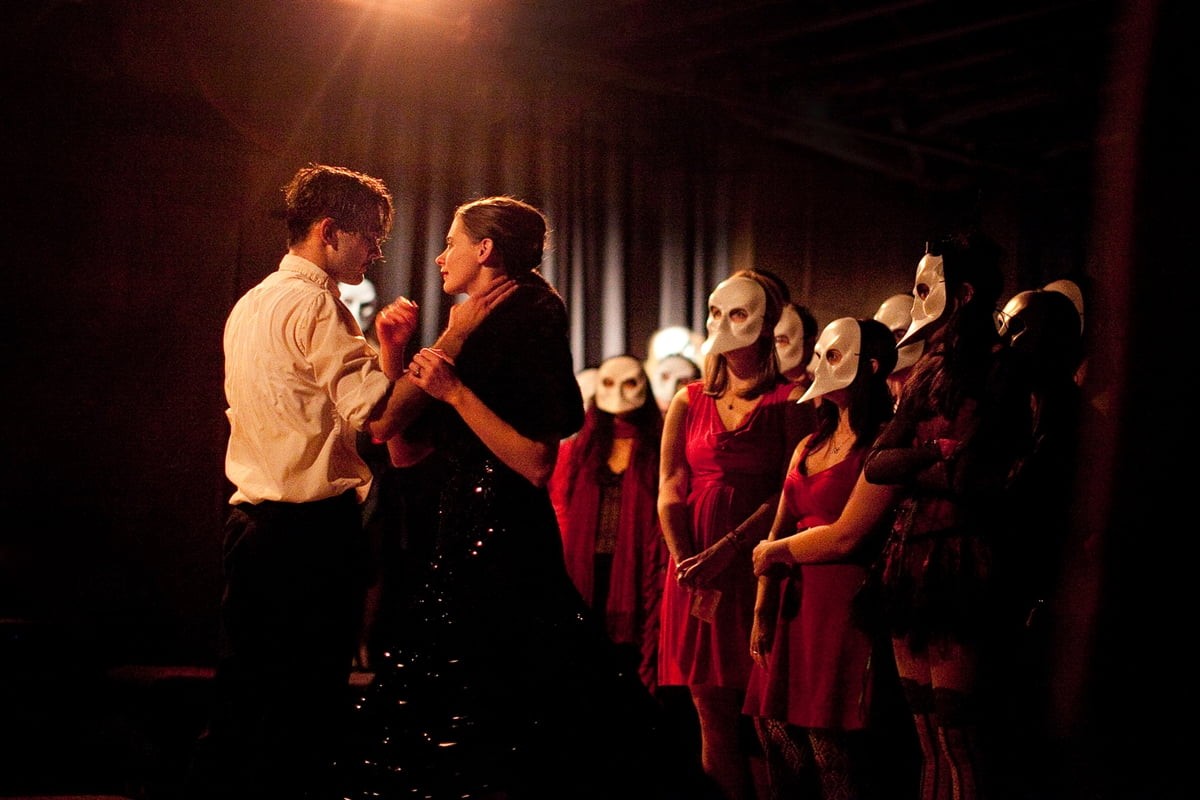
Audience members, required to wear white masks provided upon entry, are invited to wander through the hotel at will, free to follow different performers and explore scenes unfolding simultaneously across multiple floors and rooms. This is the show's central provocation. By placing a mask on every face in the room, Punchdrunk levels the social hierarchy of the theater — there are no premium seats, no better views, no privileged sight lines. Everyone is equally anonymous, equally responsible for their own experience.
The Seoul production features 23 performers who enact a complex web of secret subplots and interwoven narratives. On any given evening, a confrontation between Lady Macbeth and a shadowy figure plays out simultaneously with a tender, devastating duet elsewhere on another floor. You cannot see everything. That is, in fact, the point. The production is explicitly designed to exceed the capacity of a single visit, rewarding return audiences with new angles and overlooked corners.
What first-time guests might not realize as they wander the labyrinthine halls of the McKithan Hotel is how much the rooms themselves are built to tell stories, even in the absence of any performer at all. Vaughan's set design operates on the understanding that objects carry narrative weight — a bloodied bathtub, a drawer full of handwritten letters, a half-eaten meal abandoned in haste. These are not decorative choices. They are chapters in a story that the audience must assemble themselves.
What Seoul Brings to the Table
The Seoul production also features some exclusive site-specific elements, among them the Heath — an expansive, Scotland-inspired landscape. This addition speaks to how Punchdrunk has approached this production not merely as a replication of previous runs, but as a genuine reimagining shaped by its specific container. The seven-story McKittrick Hotel has been meticulously crafted to support this immersive experience, with the 25 billion won production cost going toward creating detailed rooms that evoke 1930s Scotland, complete with worn furniture, faded letters, and carefully placed props.
The vertical architecture of the building also introduces a dimension absent from earlier productions. Moving upward through the hotel — floor by floor, staircase by staircase — carries a dramatic weight of its own. Descent feels like returning from something. Ascent feels like transgression.
An Experience, Not a Performance
Co-director Felix Barrett stated during a press conference: "Immersive theater is not just a show. It's creating a world, and we plunge the audience into the epicenter of that world. Once they're in, it is a living, breathing environment where the narrative unfolds around them and the audience is free to explore it in any way they want." That statement could read as marketing language — and in lesser hands, it might be. Here, it is simply an accurate description of what happens.
Sleep No More Seoul is not without its challenges for first-time visitors. The freedom it grants can tip into paralysis. The impulse to follow the crowd, to chase the most visible performer, can lead you away from the show's quieter and often more haunting moments. Korean audiences during previews tended to gravitate toward the performers, often clustering around major characters from the Macbeth-inspired storyline, while the set and props offer just as much narrative. Learning to resist that instinct — to linger, to sit still in an empty room and let it speak — is half the art of experiencing this production well.
The Seoul production is open to audiences 19 and older, reflecting the mature themes and intense psychological elements woven throughout. That restriction feels apt. Sleep No More asks something of its audience that requires a certain willingness to be unsettled, to surrender the comfort of narrative explanation, and to sit with ambiguity. It rewards those who come not to consume a story, but to become, however briefly, part of one.
The McKithan Hotel stands now in Chungmuro, waiting. Whether you spend your time in its ballrooms or its basements, whether you follow Lady Macbeth to her fate or lose yourself entirely in a side corridor lined with photographs of strangers, you will not leave the same way you entered. That, perhaps, is the only review that truly matters.
