
The Insights : Inside the craft with HereWeAre's Industry core. Strategic insights and honest reflections from the leading voices shaping the ecosystem.
Roland Schimmelpfennig’s monumental epic, Anthropolis, relentlessly interrogates the origins of myth and the cyclical rise and fall of civilization. Traversing the founding of Thebes, the frantic intrusion of Dionysian frenzy, and the devastating blindfolds of tragic fate, the cycle reaches its fourth installment, Iokaste—the destructive apex where the leviathan of the state collapses into self-annihilation. Schimmelpfennig’s cruel reconfiguration resurrects Jocasta, who famously hanged herself in the preceding tragedy, denying her death and inflicting yet another sentence: survival. In Hamburg, Germany, the entire Anthropolis pentalogy was mounted as a marathon performance spanning three consecutive days. What a grueling ordeal it must have been to bear witness to a singular, sprawling tragedy from the birth of myth to the collapse of civilization without interruption. To endure the persistent repetition of human folly and ruin with one's whole body—perhaps that remains the only way to experience this pentalogy in its truest form.
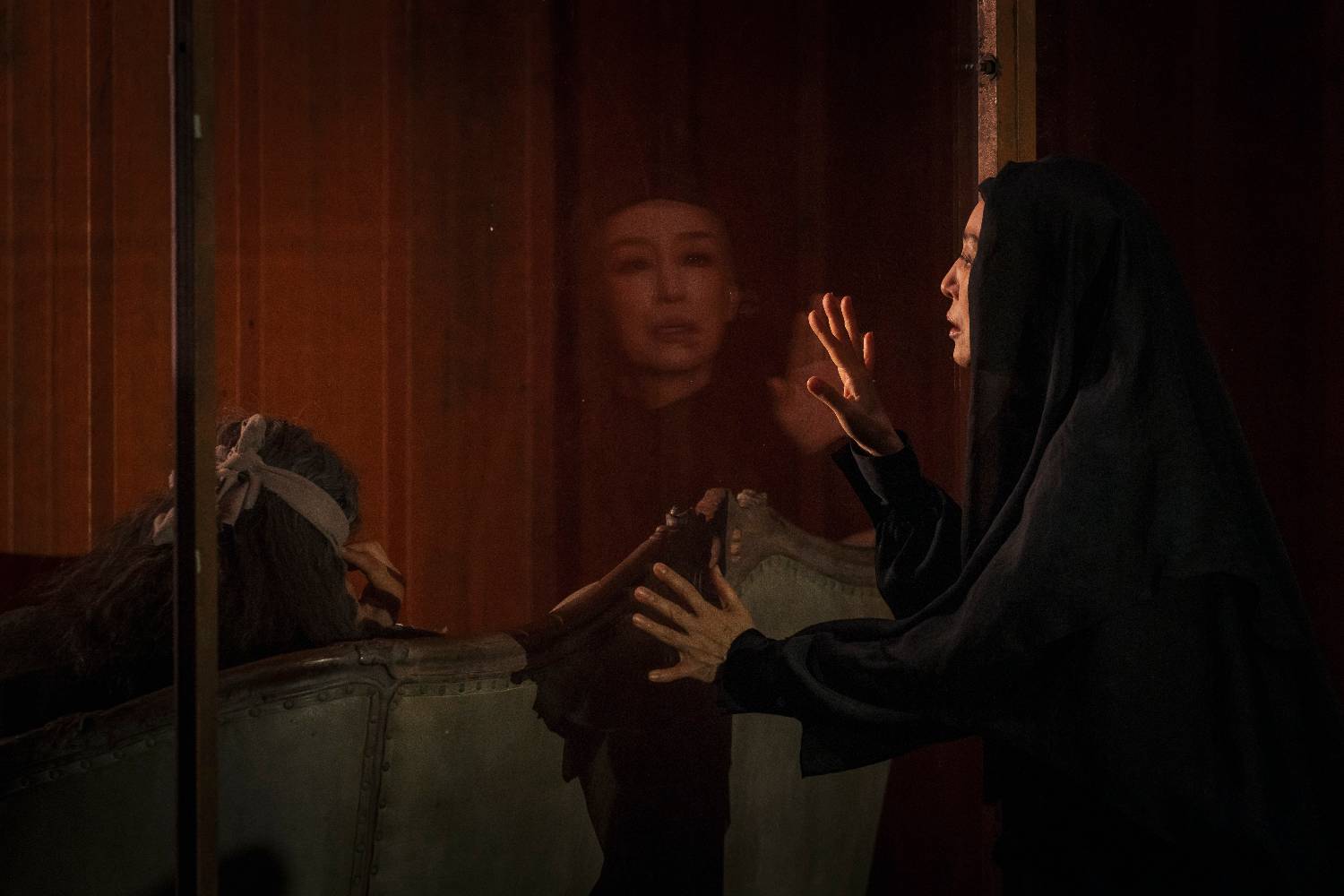
Director Jihye Seo noted that what captivated her most during the adaptation was that Iokaste’s long-silenced voice finally breaks through to claim the stage directly. As Schimmelpfennig observed, ancient tales are not ossified artifacts preserved in vitrines; they are living mirrors reflecting who we are today. Having survived Sophocles' tragedy, Jocasta watches her two sons and two daughters being swept toward another impending catastrophe fathered by Oedipus. Yet agency is scarcely granted to her. Watching her surrender all accountability to divine will and destiny while passively observing the downfall stirs profound unease in modern spectators.
Keeae Nam portrays an Iokaste who is fragile, delicate, and yet stubbornly unable to abandon hope. Confronted with the fratricidal war waged by Eteocles and Polynices over the throne, her mediation proves utterly powerless. Her maternal pleas and rhetoric of peace, directed at two sons blinded by ambition, have long since lost their persuasiveness. One is tempted to ask in frustration why she failed to intervene more resolutely, but the play promptly redirects that inquiry away from the individual and toward the structural machinery of state and power.
Amid the lingering remnants of power embodied by Creon, the sacrifice of Menoeceus, and the palpable dread of Antigone and Ismene, the state ultimately unmasks itself as a blood-soaked illusion. Mortals slaughter one another merely to seize territory that amounts to little more than soil, sand, and air. Such relentless obsession—waging self-destructive warfare for something so utterly trivial—leaves behind an exhaustion far deeper than mere emptiness. Dongjin Nam as Eteocles and Younggyu Cho as Polynices depict kings who resemble petulant, undisciplined siblings rather than dignified sovereigns. The survival of the polity and the welfare of its citizens are entirely absent from their calculus; all that remains is a petty, brutal squabble over who claims the throne. Had the collision between Eteocles and Polynices been explicitly rendered as the hostile symbiosis between real-world partisan factions that we witness daily, the hypocrisy of their professed causes and the sheer fiction of the "state" would have struck the audience with palpable immediacy. After all, sublime ideological divides are merely an alibi for power grabs, and there could have been no sharper theatrical device to expose the squabble for what it truly is: a self-destructive rush toward oblivion.
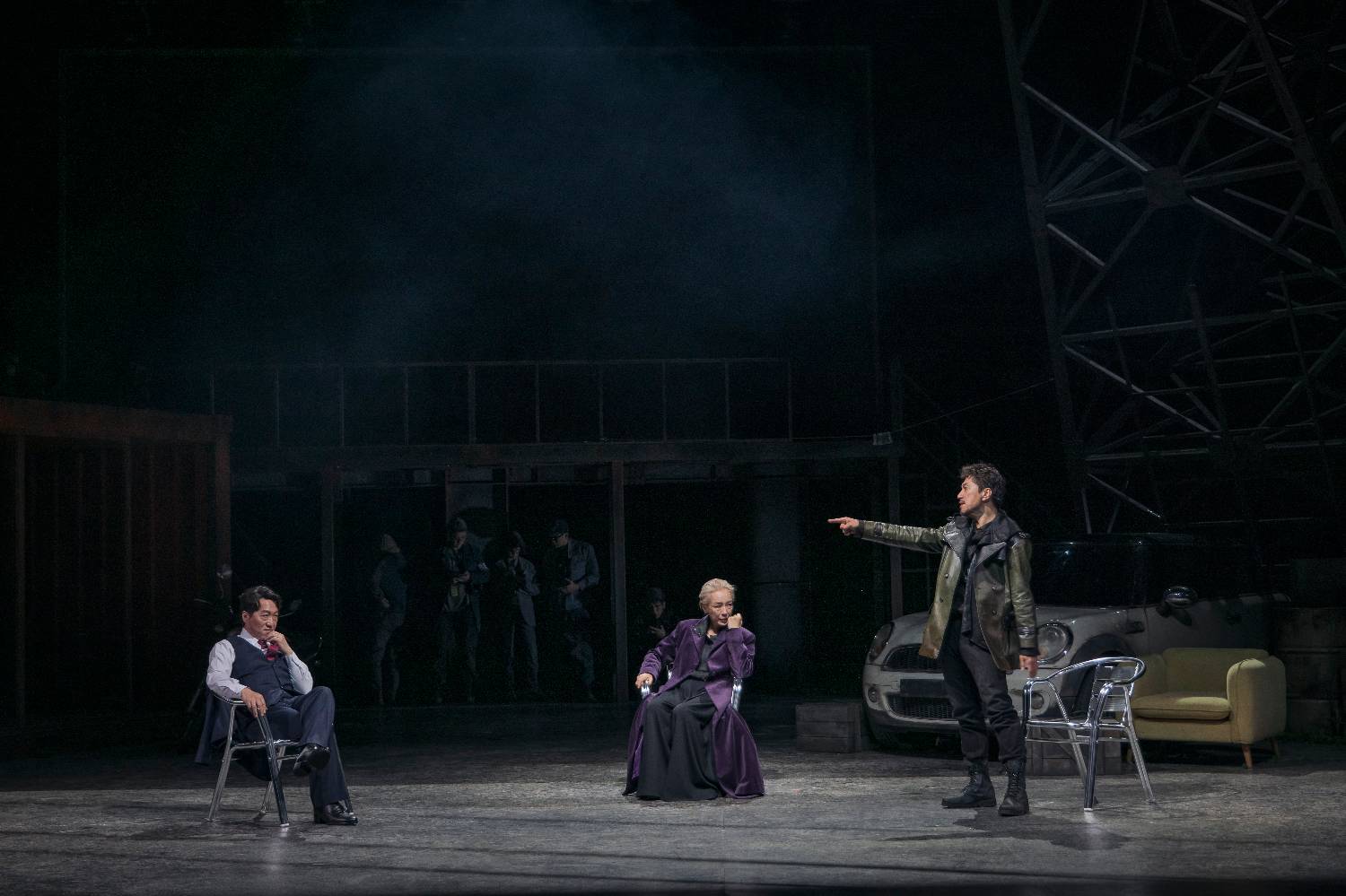
Right in the thick of this razor-sharp confrontation, the abrupt arrival of tour guides jolts the audience back to reality, deliberately severing dramatic immersion. The chorus ensemble—Seonmi Jeong, Yongseon Ko, Yudeok Seo, Eunho Park, Yunseo Kim, Hyunwoo Lee, and Seonghwan Jeon—articulates a sharply contemporary perspective alongside the ominous utterances of the seer Tiresias. Together, they guide us through the downfall of ancient Thebes while simultaneously reflecting our own gaze back at us: spectators comfortably seated in an auditorium, consuming distant wars and atrocities through a detached lens.
The most disquieting moment occurred when I caught myself letting out an involuntary chuckle at the absurd obstinacy of the two brothers. My attention had strayed from the agony of citizens crushed by artillery to the almost comical squabbling of snarling tyrants. Yet no sooner had that dry laughter escaped than it morphed into a cold discomfort. What is an existential matter of life and death to those on the ground had, for a viewer ensconced in the safety of an auditorium seat, briefly turned into a farce. Occupying the position of a bystander who can laugh while beholding a tragedy breeds a strange cocktail of humiliation and moral debt. Perhaps the sharpest question posed by this production is aimed not at the foolish kings on stage, but at those of us casually spectating their ruin.
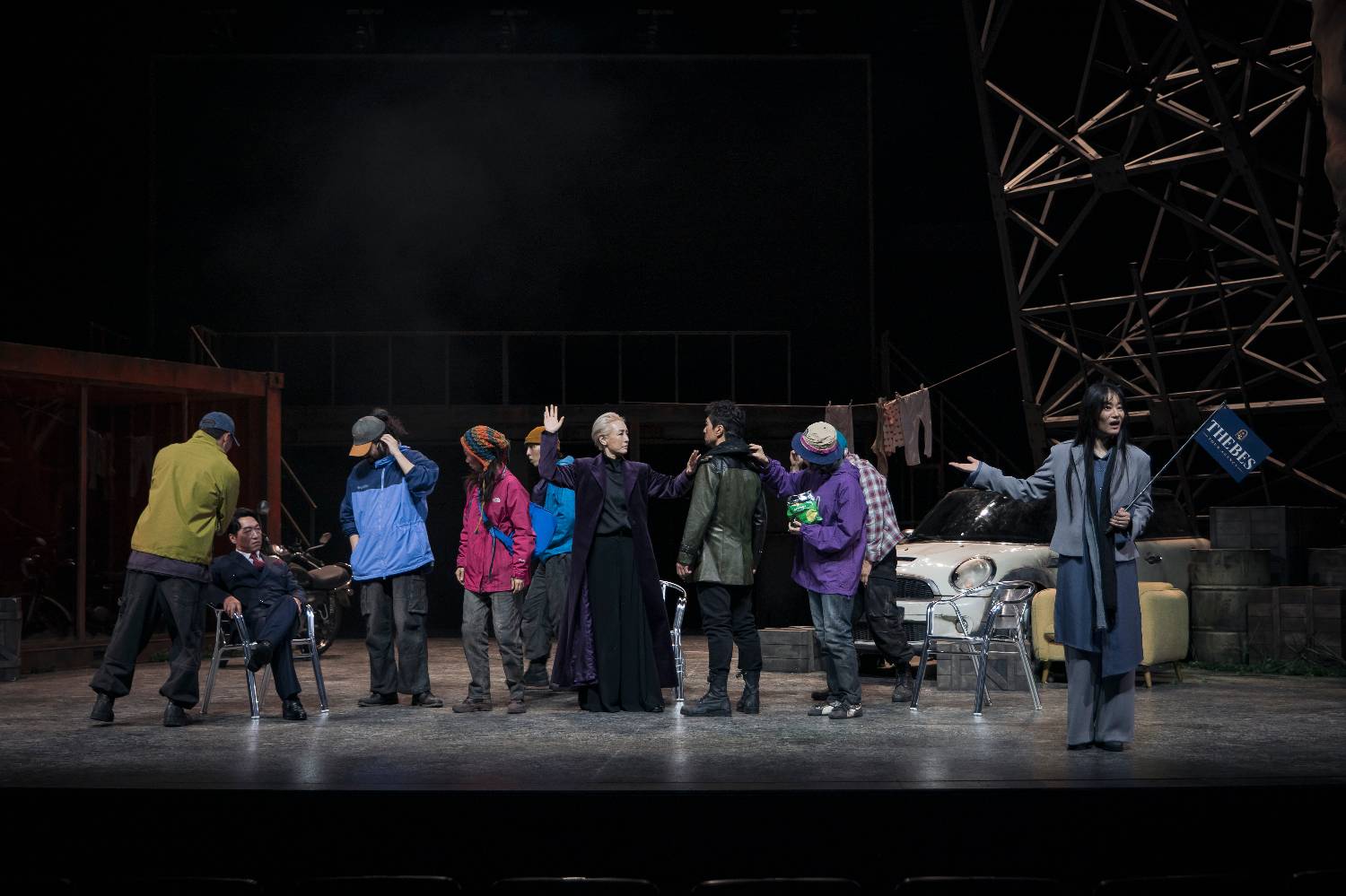
Among the cast, Mooin Choi delivers an undeniably commanding performance as the prophet Tiresias. Appearing in male guise, he anchors the entire stage with heavy vocal resonance and imposing physical authority. Even in scenes threatening to splinter into chaos, his formidable presence grounds the dramatic weight. The voice of a prophet who already foresees the impending doom feels all the more chilling precisely because it is powerless to alter a single outcome.
Through a bold collision of mythical and contemporary realms, director Jihye Seo erases the boundary between antiquity and our present day. Motifs evocative of modern civil conflict—missiles, snipers, the UN, and war correspondents—bleed across the scenery. Set designer Iljin Lim renders this landscape with a slaughtered cow carcass suspended mid-air, a towering electrical transmission pylon entangled in cables, an abandoned automobile, and shipping containers. Cloaked in thick, churning dust, the audience is plunged into a spatiotemporal disorientation where past and present blur, confronting the ongoing brutality of war and the raw visage of human avarice replaying across the globe at this very moment.
Yet the climactic descent into ruin leaves something to be desired in sheer impact. To rattle the desensitized faculties of modern spectators already saturated with graphic imagery of violence, stones strewn across the stage fail to carry the crushing gravity of the tragedy. For a resolution reached at the cost of relentless carnage and devastation, the finale feels somewhat arid and detached.
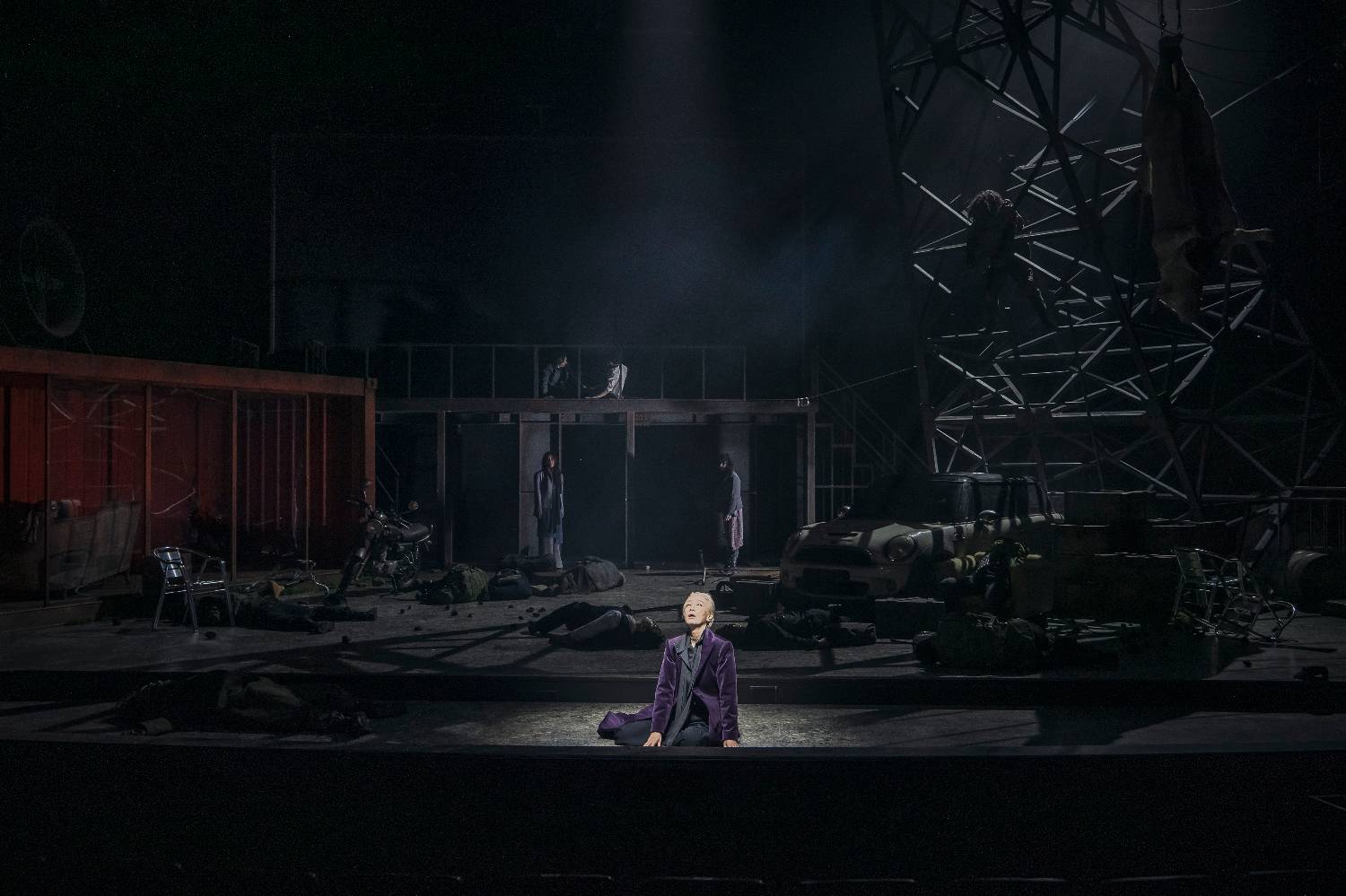
Then again, perhaps this very aridity constitutes the core question director Jihye Seo intended to pose: "Where is this unhalting civilization headed?" We routinely demand grand tragic sublimity or clear moral lessons from the aftermath of war, but actual warfare is never that cinematic. Nor does a mountain of corpses automatically yield meaning. The glory of victory and the nobility of sacrifice are mere rhetorical fictions draped over ruin by those who happen to survive.
At the end of war, there is no sublimity.
Only senseless debris, corpses, and the remnants of an unbraked civilization hurtling toward self-destruction.
production photo ⒸNational Theater Company of Korea
