
Inside the craft with HereWeAre's Industry core. Strategic insights and honest reflections from the leading voices shaping the ecosystem.
After the Death: What the Living Are Left to Face
Even after someone is gone, time keeps moving for those left behind. But that time is not always filled with mourning and understanding. Confronted with sudden loss, people search for reasons, demand explanations, and sometimes shift the weight of their grief onto others. The death of someone close, in particular, leaves the survivors with an endless stream of hypotheticals. Would things have turned out differently if a different choice had been made, if someone had noticed sooner, if someone had reached out a hand? The questions that can never be answered keep circling back — and eventually, they come to rest on a specific person.
Playwright Kyeongheon Lee, selected as a DAC Artist (Doosan Art Center Artist), writes about time, memory, and relationships with a finely tuned awareness of the world. The play No Empty Seats is the final work in a trilogy about those bereaved by suicide. It begins with the way the people left behind after a student's death look at one another, and from there examines the guilt and suspicion surrounding loss — and the violence carried out in the name of accountability.
Director Myungmin Shin, who collaborated with playwright Kyungheon Lee throughout the suicide bereavement trilogy, centers the work on the idea that there is no right way to grieve — that no one can absorb loss at the same pace as anyone else. From that premise, he brings the complex inner lives and shifting emotions of six characters onto the stage with quiet precision.
Those Who Demand an Explanation, and the One Who Can Only Stay Silent
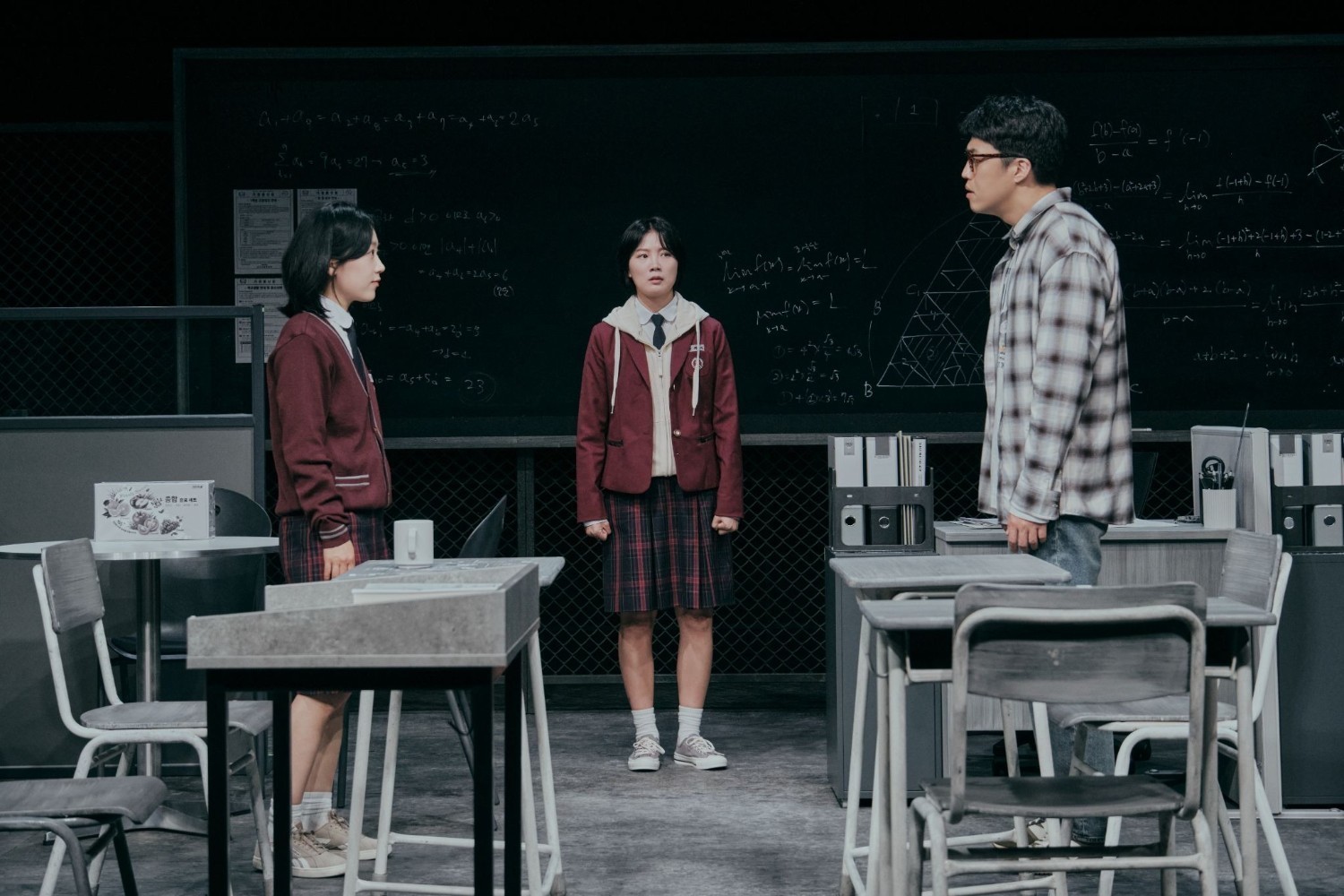
In No Empty Seats, Ju-eun is pressed for an explanation of the death simply because she was the person closest to Ye-ji. That closeness marks her as someone who should have understood Ye-ji — and perhaps as someone who bears more responsibility than anyone else. I-rim, who was Ye-ji's homeroom teacher, failed to recognize the warning signs before the suicide, and is then assigned, once again, as homeroom teacher to the surviving Ju-eun — this time on the grounds that she did not fulfill her role as a teacher even after the fact. Ye-ji is already gone, yet the people who remain carry the burden of having failed to protect her. But being close to someone does not mean knowing everything that was happening inside them. No one can ever fully know another person.
Even so, people demand answers about Ye-ji's choice. Ju-eun goes silent, and I-rim torments herself with thoughts of what might have been different if she had never been assigned as homeroom teacher. The impulse to blame oneself does not necessarily correspond to the actual degree of one's responsibility. Guilt has a way of pulling into its embrace even the things that were never within our control.
Haunted by visions of Ye-ji, Ju-eun plots revenge against the teachers who stood by while Ye-ji was driven to her death, telling them, "I want you to feel exactly what Ye-ji felt." But as she sets her plan in motion, she begins uncovering facts she herself never knew. Perhaps Ju-eun, too, was someone trying to reach the truth of Ye-ji's death without ever fully understanding it.
There is nothing inherently wrong with trying to understand the cause of a death. The problem lies in how the attempt to assign responsibility can so easily reduce a person to a single cause — erasing the complexity of their emotions and circumstances in the process. Blaming someone can be easier than sitting with uncertainty. But settling on a target for blame does not explain the meaning of a death, nor does it resolve the grief of those left behind.
The "Differentiated World" Inside the Classroom
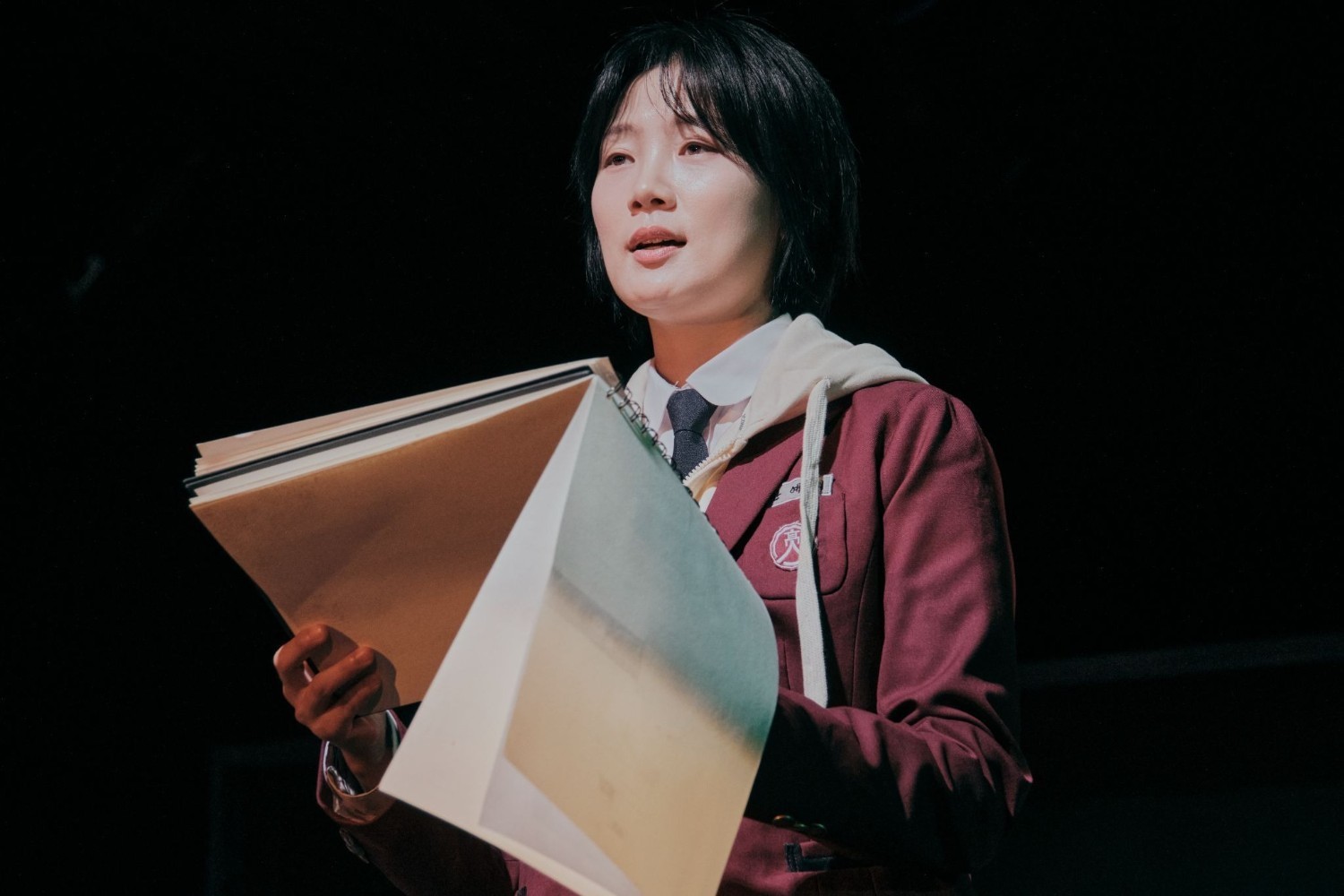
The "Differentiated World" — a reflection of Ye-ji's inner life — becomes a turning point in the play's unfolding. Within it are the feelings Ye-ji carried while adrift in the teachers' office, the counseling room, and the classroom: her longing to belong among her friends, her wish to receive help from her teachers. All of it is held inside her own creation, the "Differentiated World." Ye-ji needed just one person who would believe in her. When Ju-eun begins seeking revenge on her behalf, Ye-ji returns to the "Differentiated World" she and Ju-eun once read together in life. The moment Ye-ji trusts that Ju-eun is on her side, the "Differentiated World" transforms — the gray classroom fills with light of every color.
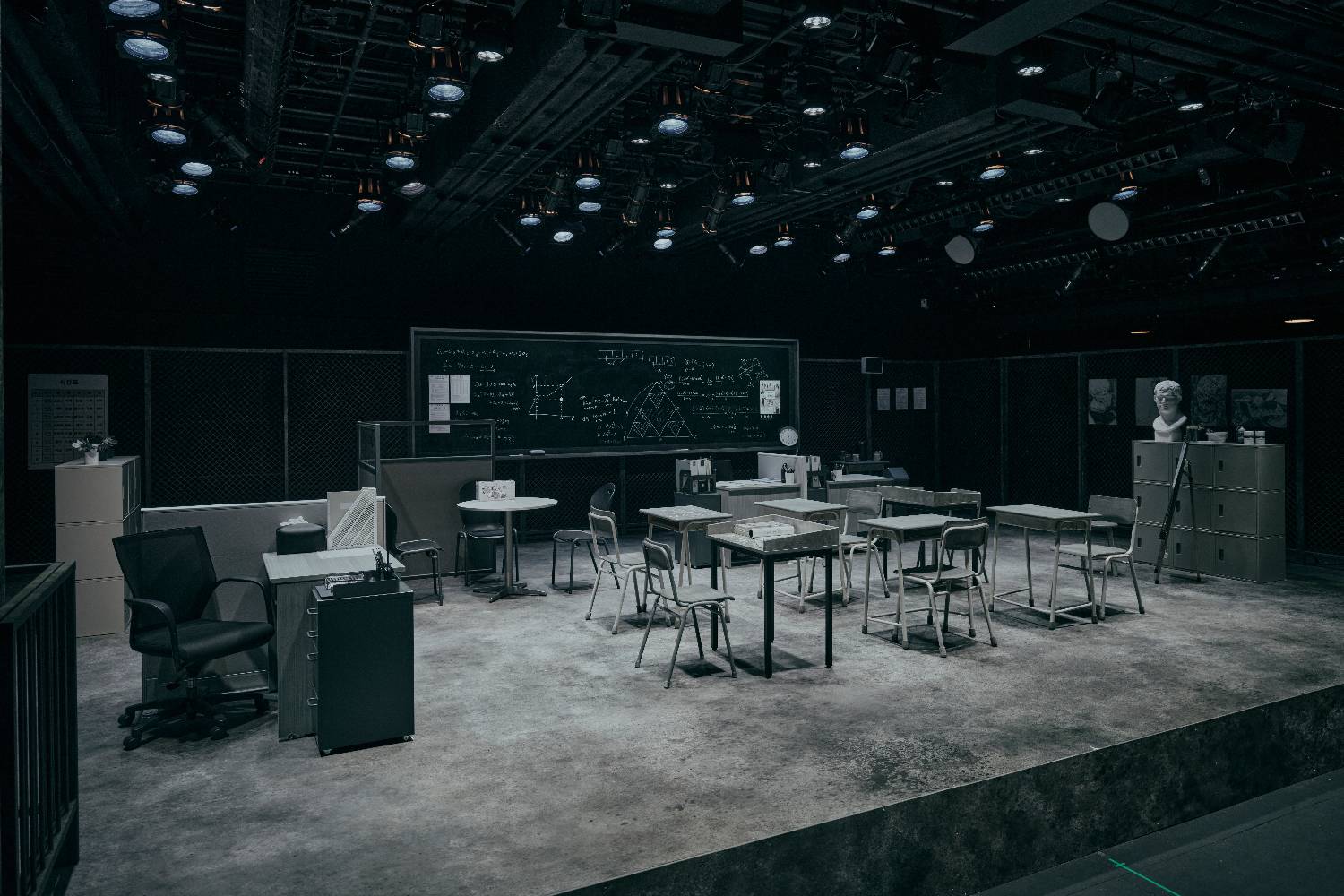
Within the small stage, the teachers' office, the counseling room, and the classroom are each conjured through a set of central objects. Desks and chairs — unremarkable anywhere in a school — become the focal point of the sharpest conflicts between characters. The scene in which Ye-ji carries her own desk and chair up to the rooftop, and the scene in which Ju-eun, after losing Ye-ji, moves a desk and chair from the classroom to the teachers' office, use the physical displacement of these objects to enact a displacement of space. Together, they show how both Ye-ji and Ju-eun came to be isolated from the community within the school.
Mourning May Not Be the Only Right Answer to Death
Seongyu Ko, a clinical psychologist who served as consultant and wrote the educational materials for this production, put it this way: "We want to understand the person who has died. For those who have lost someone to suicide, that desire is even more desperate." He added, "Grief is less about finally uncovering what cannot be known, and more about learning to bear the fact that something unknowable will always remain."
The empty space left by someone cannot be filled simply by placing another person there. Rather than arriving at a definitive reason for the death, No Empty Seats invites us to look at what people do to one another in their hunger to find that reason. And it asks: when faced with a loss we cannot comprehend, can we truly find an answer by holding someone responsible? Perhaps what is needed is something else — acknowledging that certain things will remain forever beyond our understanding, while still choosing to stay beside one another, unknowable parts and all.
The play No Empty Seats runs from 28 October to 15 November at Doosan Art Center Space111.
production photos ⓒDoosan Art Center
