
Lyon, one of France's foremost cultural cities, announces its identity the moment you lay eyes on its opera house. A semicircular glass vault rises above a nineteenth-century neoclassical façade; a sleek modern interior coexists with ornate classical chandeliers; and a subterranean auditorium evokes an ancient amphitheatre. Renovated between 1989 and 1993 by French architect Jean Nouvel (b. 1945), the building remains strikingly refined more than thirty years on — a fine example of past and present coexisting without either erasing the other.
The opera house's programming moves as freely between the classical and the contemporary, the traditional and the experimental, as its architecture does. Each season brings passionate investment in modern reinterpretations of canonical operas and in new productions, while the basement stage hosts performances under the banner "Opéra Underground" — jazz, world music, and other work that crosses genre boundaries.
The opening production of the Opéra de Lyon's 2026/27 season was Prokofiev's (1891–1953) The Love for Three Oranges(1919), directed by Laurent Pelly (b. 1962). Known for his French wit and visual imagination, Pelly — who came up through theatre — tends to treat singers as active physical performers. "I have a special attachment to The Love for Three Oranges," he said. "It's a work that shows the power laughter and comedy can exert on an audience and on theatre itself."
Fantasy, Dreams, Poetry, and Imagination
"An extravagantly fantastical play," as Pelly describes it, this opera is a strange fairy tale in which one impossible event follows another. A king, desperate to cure his son of the depression that has robbed him of all laughter, commands the jester Truffaldino to restore the prince's mirth. Nothing works — until the prince catches sight of the witch Fata Morgana, accidentally knocked over by Truffaldino, and bursts out laughing. The furious witch curses the prince to fall in love with three oranges; he sets off in search of them and, from the last orange, finds Princess Ninetta, with whom he lives happily ever after.
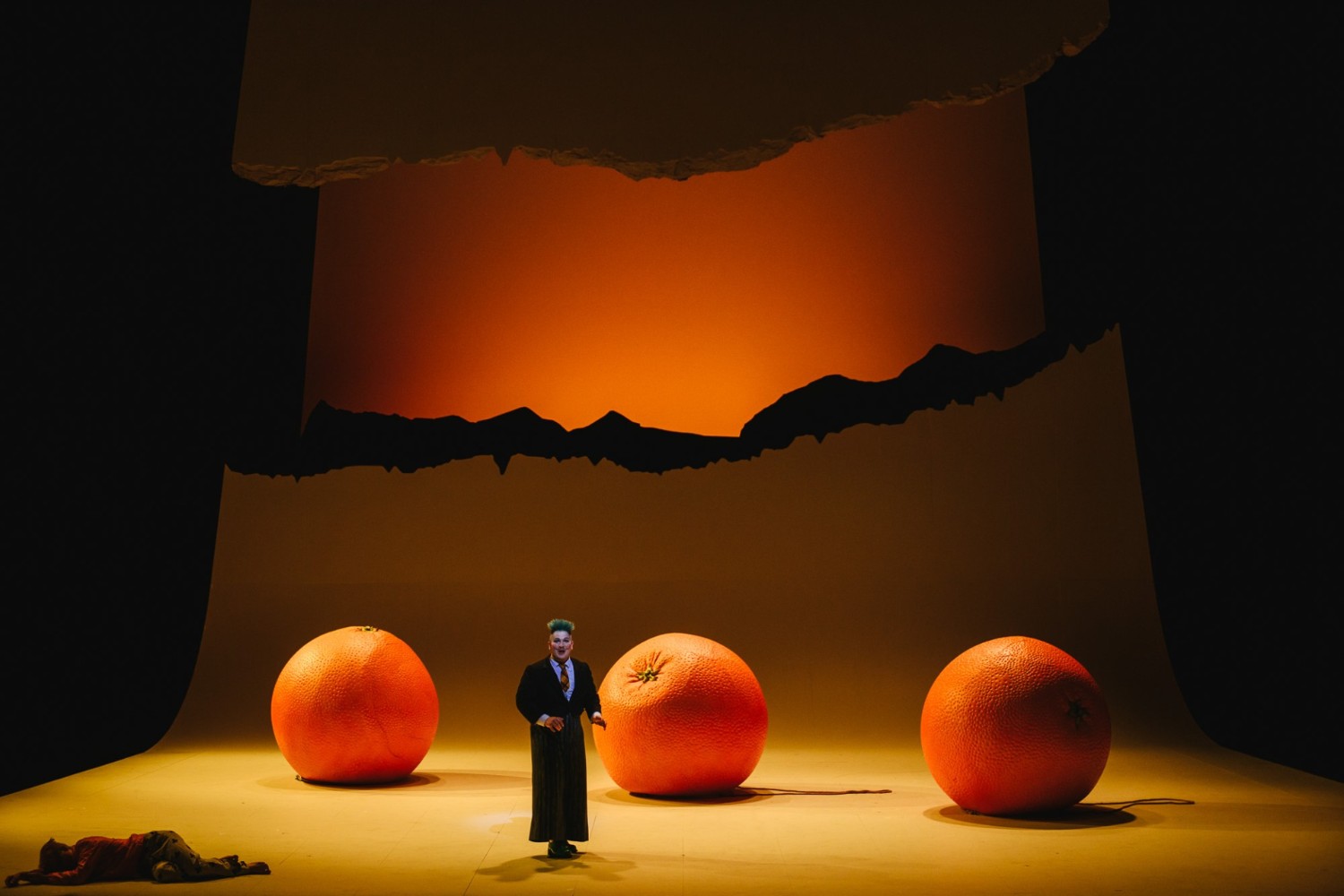
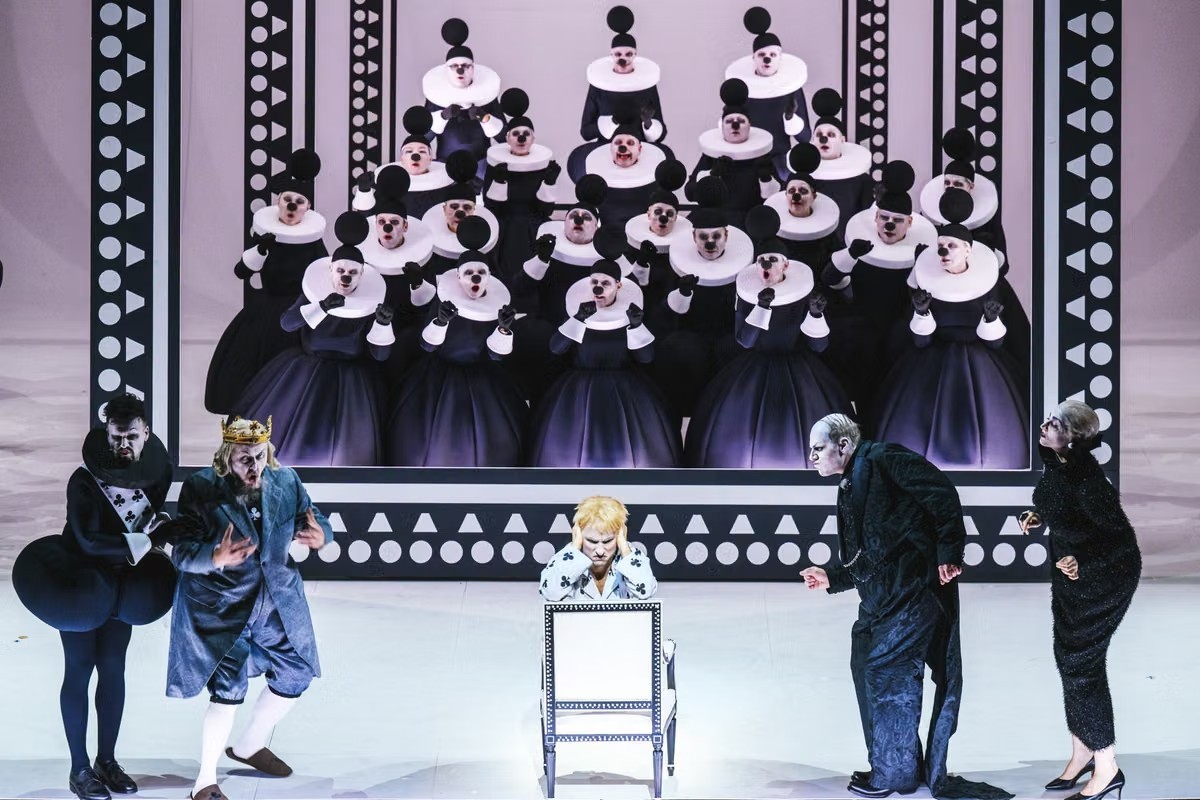
The source is an eighteenth-century play by Italian playwright Carlo Gozzi (1720–1806), who championed fantasy, masks, and improvisation against the realistic comedy and rationalist tendencies of his day. The Russian director Meyerhold (1874–1940), who reinterpreted the work in the twentieth century, similarly pushed back against the realism of Chekhov and Gorky, foregrounding the actor's physical movement and the artificiality of theatre. Prokofiev took the libretto that Meyerhold and his collaborators adapted and fashioned from it an opera dense with dissonance, sudden accents, and idiosyncratic rhythms. From the prologue onward — in which factions of Tragedians, Comedians, and Lyricists squabble over what kind of show they want to see — the opera satirizes operatic convention itself. Pelly unfurls the rebellious spirit of these artists across a vast white stage. Characters appear and vanish like figures in a painting through layer upon layer of drops; oversized playing cards and oranges, along with lighting in vivid complementary contrasts, build a fantastical world. A recurring clover motif consistently suggests that this story is nothing more than a card game governed by chance and deception. Timpani strikes and comical tuba lines, set against irregular rhythms, lock into the performers' exaggerated gestures. The chorus, dressed in black against the white stage, moves with the busy purposefulness of notes on a musical score.
A Production That Feels Like a Fantasy Film
The staging delivered the visual satisfaction of a Tim Burton film. Yet the emphasis on fairy-tale imagery came at a cost: the anti-conventional edge of the source material felt somewhat blunted. The collective argument in the prologue never registered sharply enough, and the satirical blade aimed at opera itself remained dull. From the perspective of "a good romp is its own reward," one might argue that the spirit of absurdist theatre was preserved — but the production's tendency to string together visual effects without going further was a missed opportunity.
Conductor Dmitry Matvienko (b. 1990) captured the work's buoyant rhythms and orchestral wit with skill, though he did not quite probe the anxiety beneath the music or its deeper dramatic undercurrents. The vocal cast left a strong impression above all through their physical acting — fitting, given the nature of the production. Tenor Linard Vrielink in the role of the Prince compensated for occasional unsteadiness in the upper register with commanding stage presence, while tenor Robert Lewis (b. 1996) as Truffaldino drove the action with deadpan comic ease. Bass-baritone Damien Pass maximized Léandre's absurd charm through deliberately sluggish movement. Bass Piotr Micinski (b. 1965) as the King delivered a restrained performance that convincingly conveyed a monarch helpless before his son's despair — a character in whom dignity and powerlessness continually cross.
The production is a co-production of the Opéra de Lyon, the Opéra Comique in Paris, the Opéra national de Reims, and the Royal Danish Opera. One practical advantage of this arrangement is that the elaborate scenic elements — the giant card set, the walk-in oranges, and other pieces requiring considerable labor to build — can be reused across multiple venues. Co-production has become an established model in recent years, making large-scale stagings possible at reasonable cost, though it does impose constraints on directors, who must account for the differing conditions of each participating house.
The World of the Opéra de Lyon, Unfolding Above and Below
What makes the Opéra de Lyon truly distinctive is the way it stacks different eras, genres, and functions — performance and production alike — vertically within a single building. Jean Nouvel preserved the nineteenth-century theatre's outer walls and its historic foyer while expanding upward by six floors and downward by five, reorganizing the whole into eighteen levels in total. Different periods of space have been inserted into the architecture both inside and out, above and below.
Passing through the stone arcade and following escalators, metal staircases, and bridges, you arrive at a theatre stripped of all ornament — entirely black. The auditorium is structurally suspended within the building to isolate it from external vibration. Unlike the traditional opera house with its gilded decoration and red velvet, the black walls and clean-lined balconies draw the audience's gaze directly and solely to the stage.
Yet pass through a short corridor at the rear of the auditorium and a nineteenth-century foyer opens before you, its chandeliers and decorative ceiling intact. Through glass panels on the corridor's sides, a contemporary lobby of metal and red light appears; straight ahead lies a classical space of ivory walls and golden ornament. Nouvel made no attempt to force the two eras into harmony — instead, he lets the audience pass through the boundary between them and feel it for themselves. The underground amphitheatre is yet another independent performance space within this historic city-centre opera house. Dance studios, rehearsal rooms, and offices occupy the upper floors beneath the semicircular glass roof. The Opéra de Lyon is also a producing house in the full sense, with a permanent orchestra, chorus, ballet company, and professional production organization. Below ground, rehearsal spaces comparable in scale to the main stage are provided. Particularly striking is a large lift capable of carrying scenic elements and equipment weighing up to eighteen tonnes — a piece of infrastructure that makes vertical use of the theatre's limited footprint while maximizing the efficiency of both performance and production. Underground performance spaces and production facilities, a grand auditorium in the middle, creative spaces above: the Opéra de Lyon is both a vessel for performance and a place where art is made, layer by layer. Jean Nouvel's architecture — preserving the historic exterior while realizing an entirely new performance experience and mode of production within — expands what a theatre can be.
Underground performance spaces and production facilities, a grand auditorium in the middle, creative spaces above: the Opéra de Lyon is both a vessel for performance and a place where art is made, layer by layer. Jean Nouvel's architecture — preserving the historic exterior while realizing an entirely new performance experience and mode of production within — expands what a theatre can be.
production photos © Lyon Opéra
Yoonhye Jeon
This article was originally published by
➼ Discover the full collection of issues with a print subscription.
➼ You can subscribe here.

