
An artist's obsession becomes a work of art. Phelin McDermott, who as a child listened to the same record over and over again countless times, grew up to become a director working alongside the very composer he had idolised. Tao of Glass begins from one artist's deeply personal memories of a lifelong love for a composer's music.
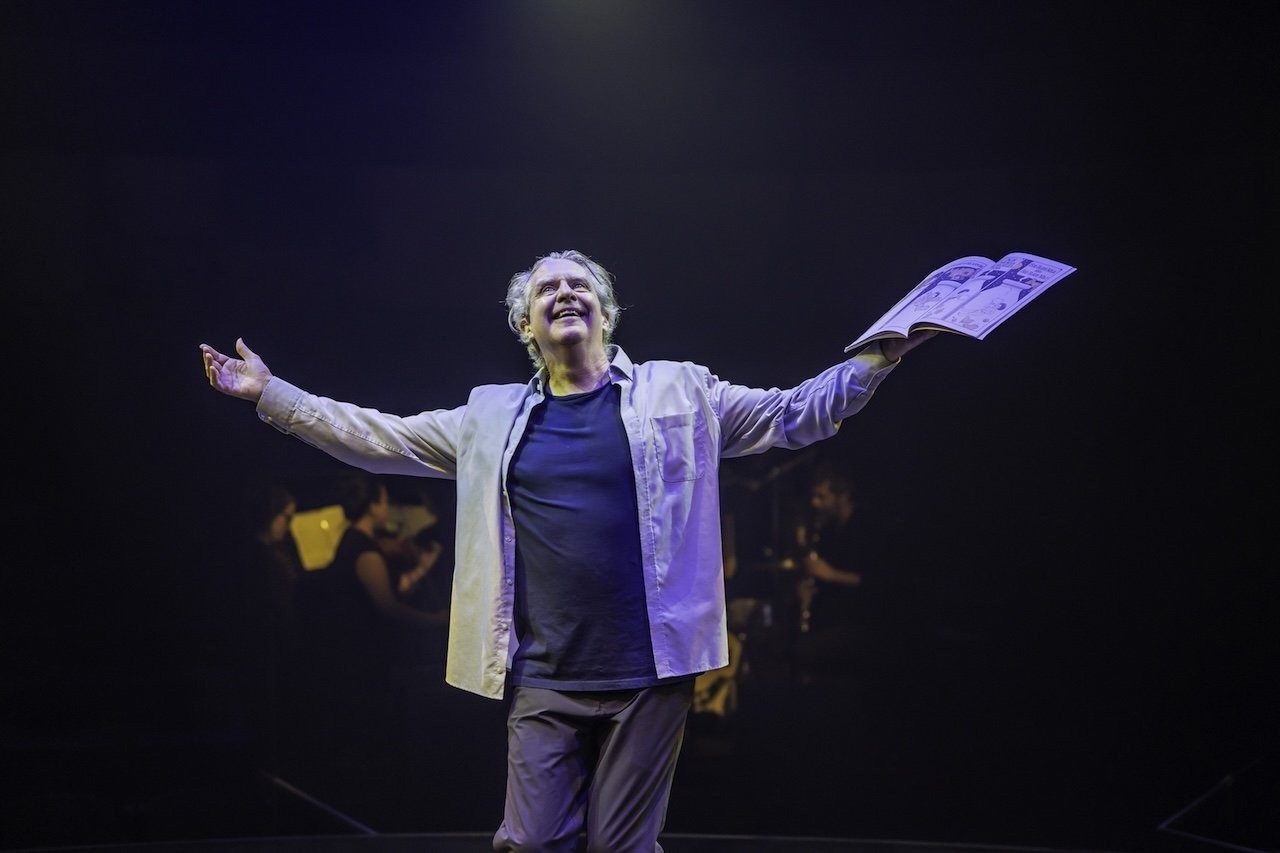
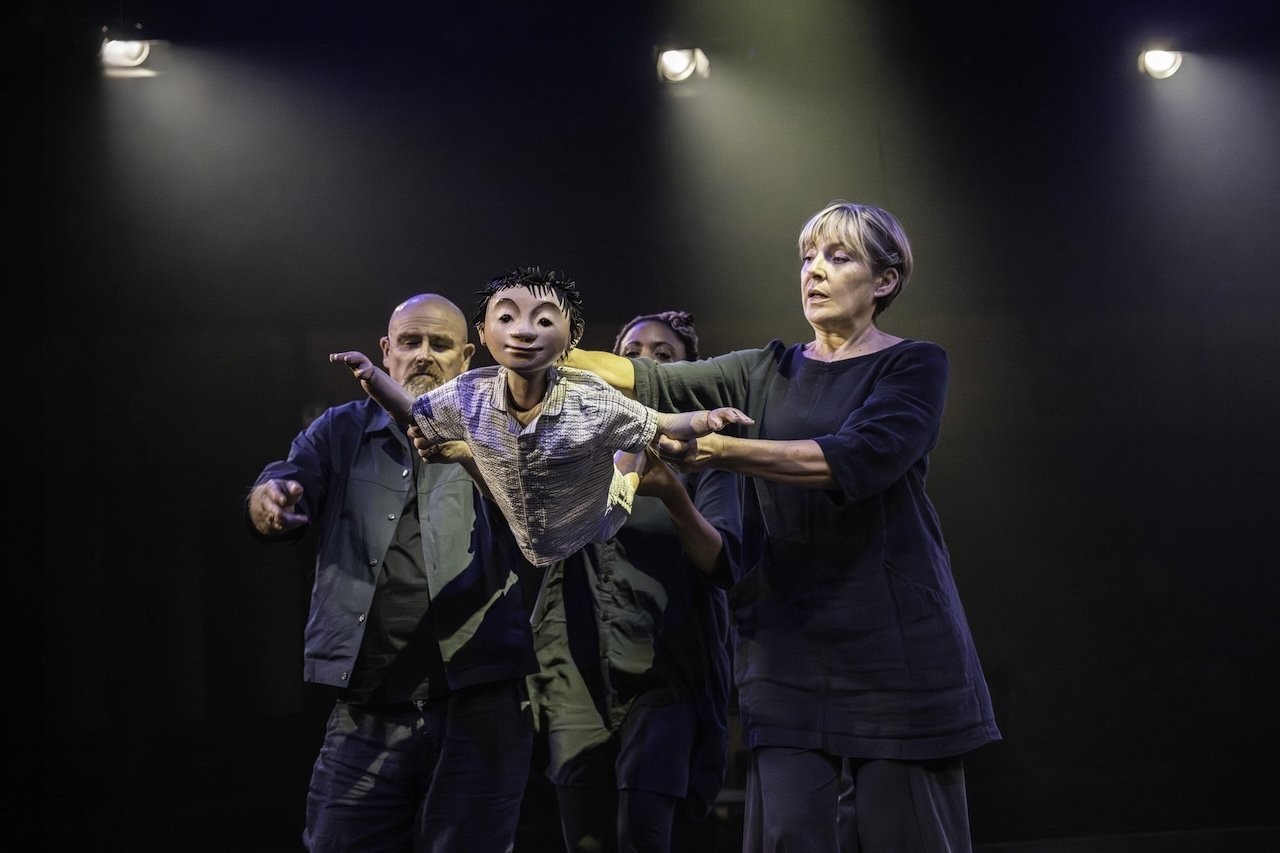
The 'Glass' in the title refers to Philip Glass, one of the defining figures of American contemporary music. Best known for his technique of layering subtle variations over repeating short musical phrases, he composed the opera Einstein on the Beach (1976) and the film score for The Hours (2002), among many others. Tao of Glass, which had its world premiere at the Manchester International Festival in 2019 and now arrived at London's Soho Place, is a work that places Glass's music at its centre while weaving together theatrical storytelling, live performance, and puppetry and object performance. It was written by McDermott — who won the 2023 Olivier Award for Best Director for his staging of My Neighbour Totoro (2022), the Royal Shakespeare Company's theatrical adaptation of the original animated film — and co-directed with Kirsty Housley. McDermott tells his own story on stage alongside three puppeteers (puppet design by Lyndie Wright). On one side of the stage, an ensemble of piano, violin, clarinet, and percussion performs live the ten pieces Glass composed specifically for this production.
Reshaping the Unfinished Fragment
The work grew out of a project that McDermott and Glass never managed to complete. The two had planned to bring a picture book by Maurice Sendak (1928–2012) to the stage together, but Sendak's death brought that collaboration to a halt. Yet an unfinished work does not simply vanish from a creator's life. Into that memory were folded childhood, dreams, life and death, Taoist thought, and Glass's music — and the scattered pieces of different ideas became the raw material for a new performance.
McDermott has said that Glass's music ran through his life like a river. Follow that river upstream and you find the young McDermott: a boy who played Glass's records on repeat, and who — as he confesses in the show — once secretly followed the composer he worshipped. What began as the relationship between a fan and an idol gradually transformed into the relationship between one creator and another. Working with Glass on opera, McDermott became the person who translated music he had loved for so long into the language of the stage. Tao of Glass is also a record of that process — two artists making work in different languages, exchanging ideas through the work itself. The composer offers new music; the director takes the images and thoughts that music conjures and returns them to the stage, handing them back.
The Taoist Thinking That Runs Through the Work
Tao of Glass begins almost like an autobiographical monologue, following McDermott's memories. He speaks of his childhood and the moment he first encountered Glass's music. You might expect the story of an artist's coming-of-age to unfold naturally from there — but the narrative gradually dissolves. In its place, the music stretches out at length, and fragments concerning puppets and shadows, dreams and life and death appear and disappear. Rather than one event driving the next, shards of memory and music, philosophy and image scatter themselves across the stage.
Here, the 'Tao' of the title becomes the key to understanding the work. 'Tao' means the Way — 道. Taoist thought, as represented by Laozi and Zhuangzi, prizes an attitude of accepting natural flow and change over any attempt to force or control. The narrative of Tao of Glass likewise moves freely rather than following a fixed direction, and at times it feels as though McDermott is simply unfolding onto the stage whatever thought has surfaced in that moment. The element of the 'Way' invites us to attend not so much to what the work is saying as to how it flows.
Another key to understanding the work is kintsugi (金継ぎ), the traditional Japanese practice of repairing broken ceramics. During the performance, McDermott speaks of this method: rather than concealing the cracks in a broken piece, the fragments are rejoined and the seams are highlighted in gold. The marks of breakage are accepted as part of a new beauty. Tao of Glass, too, makes no attempt to arrange childhood memories, an unfinished project, dreams and death, puppetry and music into a single smooth narrative. If the 'Way' shows us how the work flows, kintsugi shows us how those scattered materials come together to form a single piece.
From the Abstract to the Tangible
There are many moments of beauty — musical and visual alike — but the production moves at a decidedly slow pace. Following the narrative, you can find yourself losing the thread, and there are times when one image does not connect to the next. Even so, the moments when McDermott transforms abstract thought into theatrical image are striking (stage design by Fly Davis). As the movements of people and objects layer over Glass's music, what the ear hears expands into what the eye sees on stage.
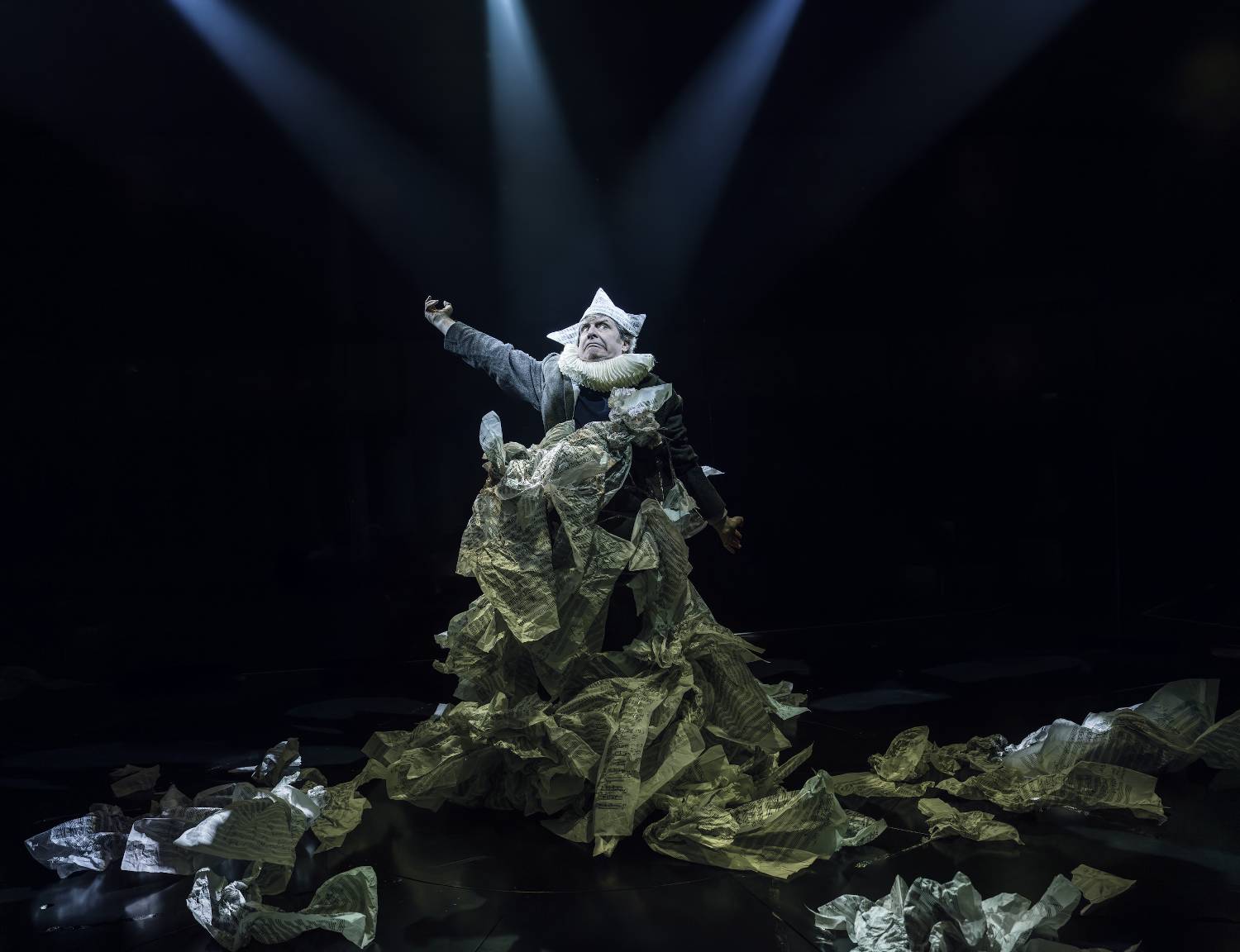
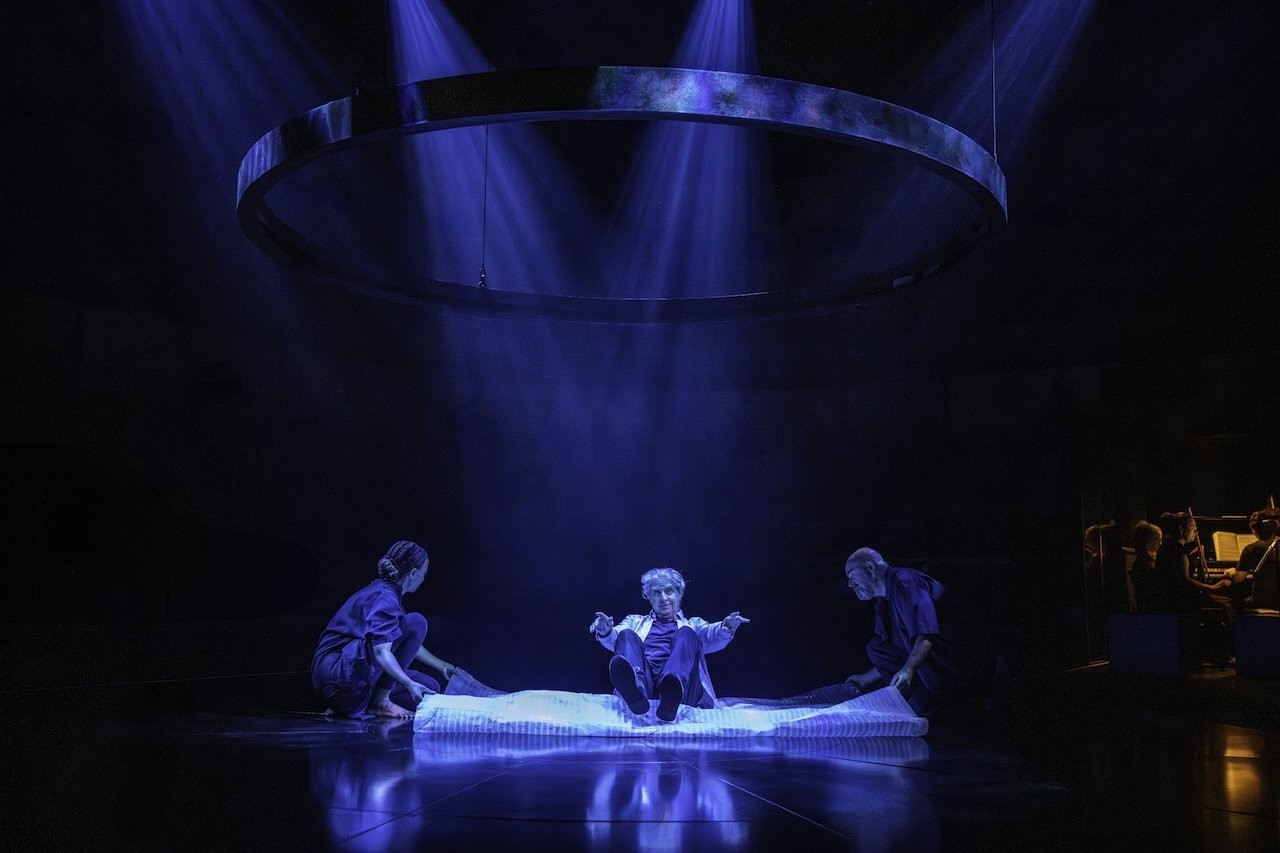
Large, thin sheets printed with musical scores cascade down onto the stage and scatter in every direction. The three puppeteers gather them one by one, hold them up, and shape them — and what had been scattered pages of notation becomes, in an instant, the figure of Glass seated at a piano. It is the moment when the paper that recorded the music gives form to the body of the person who made it. The hammers and internal structure of the piano become the New York skyline; paper and score, puppet and human body ceaselessly conjure new landscapes. The process of making is never hidden, yet the moment when the material in front of you transforms into something else entirely — that is where McDermott's theatrical imagination, which shone so brightly in My Neighbour Totoro, reveals itself once again. Just as scattered pages of score gather to form a new shape, this performance, too, was born from the many fragments that remain in McDermott's life.
For an artist, the memory of obsessively replaying Glass's music as a teenager, and a project that was never completed, are not wasted time. A long-held admiration led to a collaboration with the composer, work left unfinished became the material for something new. Like kintsugi — which preserves the traces of every broken piece while giving them a new form — McDermott has taken his memories, his obsessions, and his failures, rejoined them, and made them whole as a single performance.
production photos ©Johan Persson
Jaeeun Jung
This article was originally published by
➼ Discover the full collection of issues with a print subscription.
➼ You can subscribe here.

