
An Interview with Playwright Kyungheon Lee, DAC Artist, on No Empty Seats
There was a time when I wished the world were as clear-cut and orderly as a mathematical formula. Yet unlike the mathematical equation in which subtracting one from one yields precisely zero, the absence of someone who once existed so vividly in our lives can never be reduced to the neat nothingness of zero. The state of nothingness that precedes existence and the weight of an absence left behind by someone who once existed are fundamentally different.
Playwright Kyungheon Lee has brought pressing questions to contemporary theatre through his exploration of the precarious inner lives of people bereaved by suicide and those around them. Following Making the Study Marry and The Emotion Lab, he returns to the stage of Doosan Art Center’s Space111 with No Empty Seats, the final instalment in his trilogy exploring suicide and its aftermath. The world he creates, too, rests upon the discrepancy inherent in absence.
No Empty Seats follows Ju-eun in the aftermath of the sudden death of her closest friend, Ye-ji. In an attempt to forget the tragedy and preserve a semblance of normality, the adults hastily remove Ye-ji’s desk and chair from the classroom. Ju-eun, however, remains silent amid a multitude of unanswered questions, moving the desk herself in a quiet act of protest. Within the structural contradictions of a school that turns away from pain and obstructs genuine mourning, the play honestly captures how those left behind come to experience absence, even as they wound one another in the process.
Holding the weight of a grief and an absence that can never be explained through logic alone, we followed the words the playwright has brought forth.
Beyond the Blueprint of a Play: Writing as an Independent Literary Form
Before a theatrical production reaches the stage, a play script is often regarded as a tool for completing the performance or as an unfinished blueprint awaiting its realisation. Yet the texts written by Kyungheon Lee possess a literary texture, with their own rhythm and sense of completion, even before they become part of the physical space of the stage.
Since his literary debut with Rabbit Hunting, which won The Hankook Ilbo New Year's Literary Contest in 2023, Lee has developed a body of work through plays including Killing a Deer and The Emotion Lab, eventually being selected as a DAC Artist at Doosan Art Center. His creative journey has been one of preserving the place of the play script as literature while learning to leave space within the text, trusting the fellow artists who will bring it to life on stage.
“I try to position my identity closer to literature than to theatre. There must be a clear difference between writing within the category of literature and writing within the category of theatre. When I write a play, I want it to be a complete work in its own right, rather than a blueprint for creating a theatrical production. My approach is to pare back the text to the extent that other members of the creative team fill it out during the process of bringing it to the stage.
What has changed since my debut is that I have developed a more concrete sense of trust in the creative team. These days, I consciously try to create empty spaces even while writing a play, allowing that trust to guide me.”
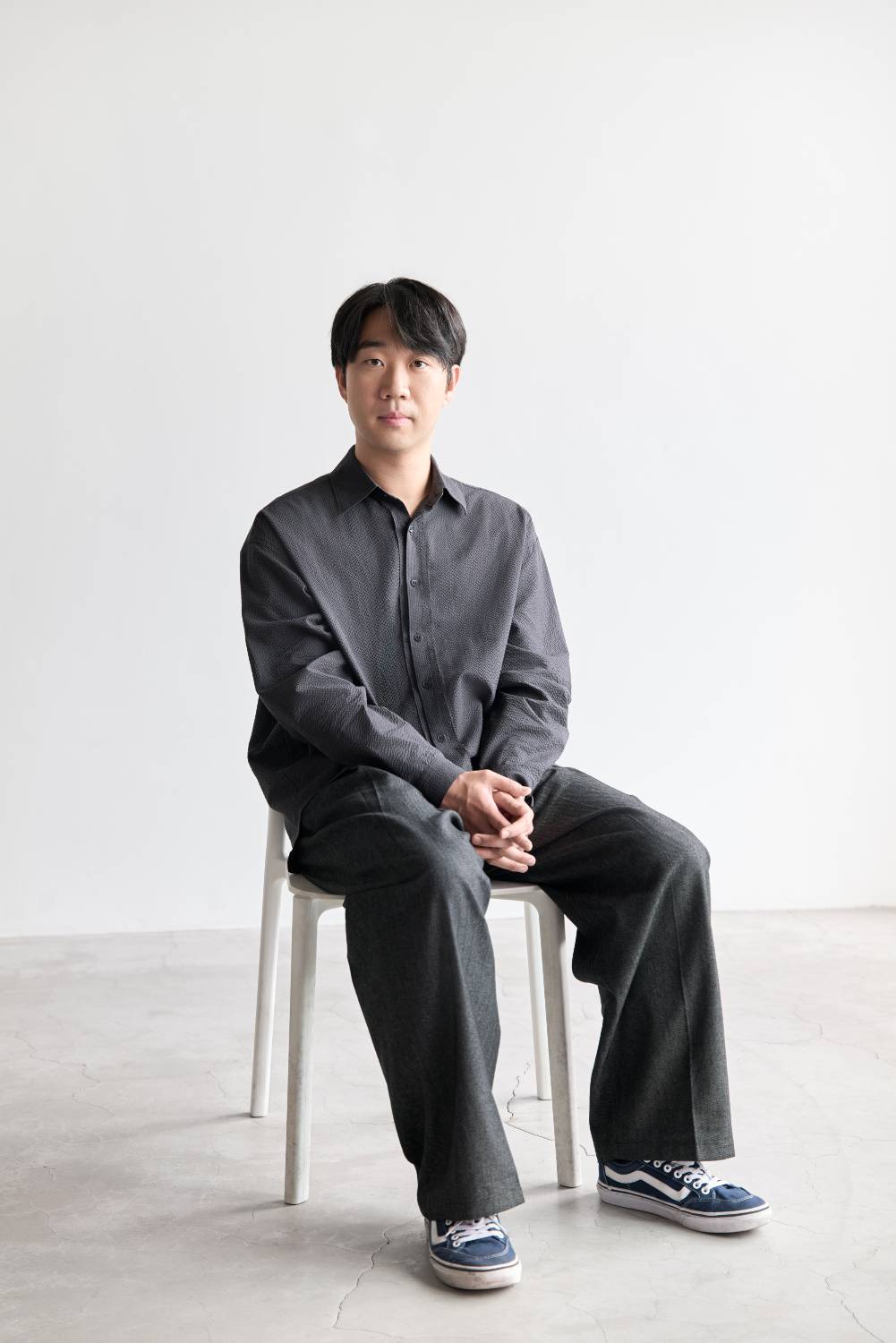
Words Gathering at the Boundary Between Memory and Record
In the teachers’ office in No Empty Seats, teachers Noh Hyun-hee and Im Yun-jun clash over two opposing values: “memory” and “record.” The question of how we should acknowledge and preserve a tragedy that has already passed is one that Lee also poses to himself.
The characteristic dryness and taut tension of his dialogue stem from his observation that human beings rarely reveal their true feelings in full. Beneath the surface of words, whether gentle or cold, lies an underlying intention that does not necessarily correspond to what is spoken. His painstaking and honest practice of collecting moments from everyday life becomes the fine-grained texture of his plays, inscribed on stage.
“I have a habit of keeping records. I write around thirty short notes every day, and one element is never missing from them: the time they were written. I think the moment at which a thought occurs to us is just as important as the thought itself. From that perspective, a play script seems close to a record of memory. When I write, I tend to try to incorporate the concerns I am grappling with in the present. When writing dialogue, I pay more attention to what lies beneath the surface than to the surface itself. The intention behind warm words can be cold, just as the intention behind cold words can be warm. I believe moments in which people express their feelings honestly are, in fact, quite rare.”
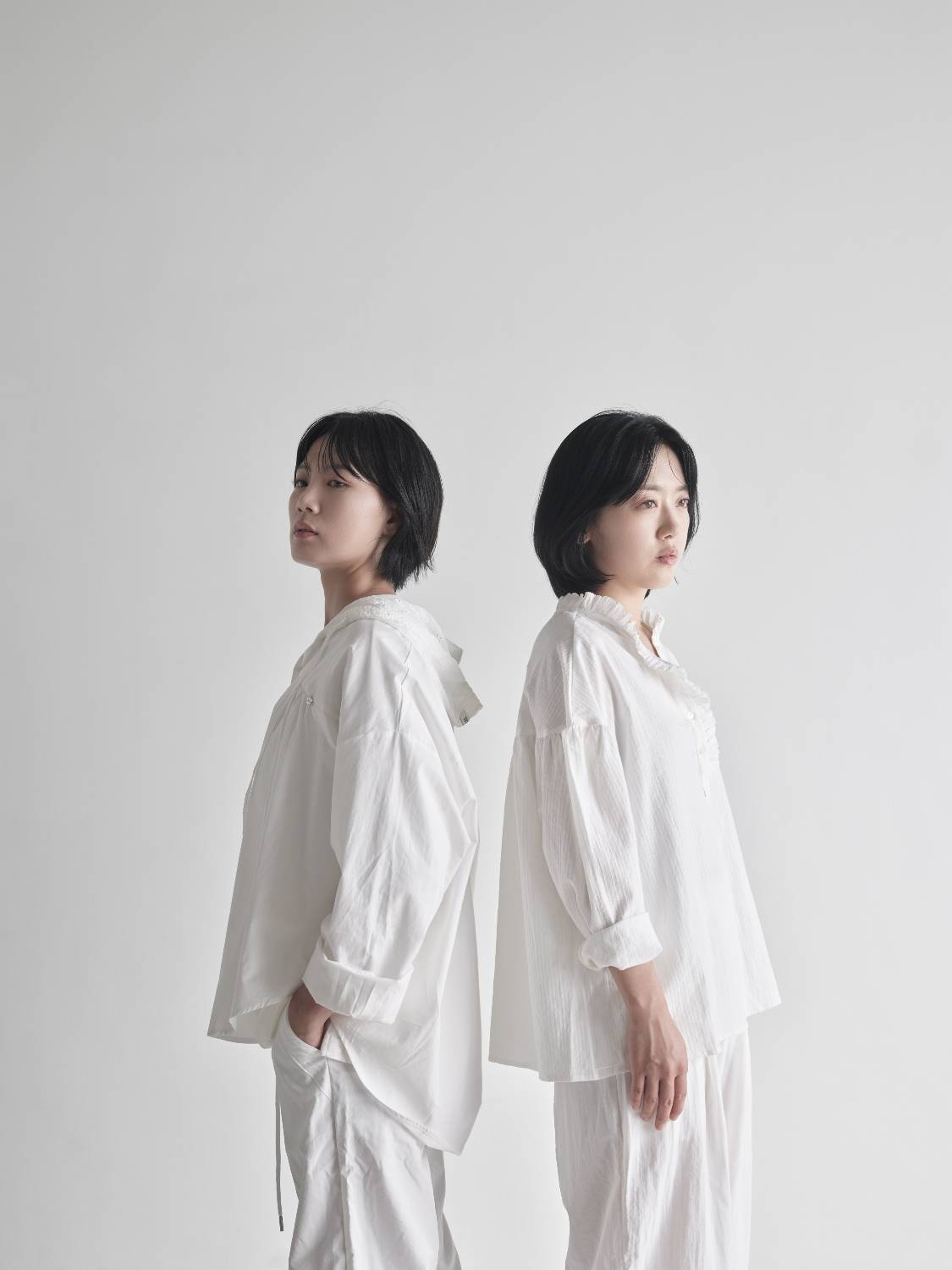
From Solidarity to Structural Contradictions: The Trilogy on Suicide and Its Aftermath
Rather than focusing on the tragedy of the loss itself, Lee’s work is driven by a desire to honestly capture the world inhabited by those left behind in the aftermath. From Making the Study Marry and The Emotion Lab to No Empty Seats, his trilogy exploring suicide and its aftermath has gradually broadened its perspective, following the texture of time as experienced by those who have been wounded by loss.
Lee approaches the task of bringing other people’s pain and sensitive tragedies to the stage with considerable caution and rigour. Wary of the arrogance of reaching premature conclusions, he continually cross-references objective materials and different perspectives. This practice serves as an anchor, helping him maintain his balance as a playwright dealing with the time that remains after tragedy.
“I have a habit of developing plays simultaneously that examine the same phenomenon from different perspectives. I know that my own perspective is limited, so I try not to become too attached to any single point of view. In Making the Study Marry and The Emotion Lab, I focused on discovering the possibility of solidarity in different circumstances, with Hyeon Seong-ju, a person bereaved by suicide, at the centre of both works. While writing the two plays, I began to reflect on the structural contradictions that prevent people bereaved by suicide from reaching a place where they can mourn. Rather than being a thematic variation on the earlier works, No Empty Seats feels closer to an expression of the concerns I was grappling with at that particular moment.
Unless I am in the process of developing a specific play, I tend to pick up books at random in bookshops or libraries and read whatever catches my attention. Sometimes, this leads me to a particular story. From there, I begin reading books related to the play I want to write. You could say that I use inductive and deductive methods in succession.When dealing with a sensitive subject such as the one in No Empty Seats, I try to include interviews with experts in my research. Relying solely on personal experience can be dangerous.
When telling stories about people left behind after an event, I hold two thoughts at once: that I must not be too cold towards them, and that I must not be too quick to offer warmth. I believe it is important to find a balance between the two.”
On Stage, Bringing the Work into Sharper Focus
In the play, mathematical concepts such as “the differentiated world” and “zero and limits” appear as symbolic motifs, alongside the line, “Even after you disappeared, I walked through a world of infinitesimals.” By using the language of mathematics, the most logical of languages, to explore emotions and the discrepancies of absence that logic can never fully explain, the play holds up a mirror to the arrogant judgements of adults who seek to simplify the world according to their own convenience.
These layers of the play come into sharper focus through the vision of director Shin Myung-min, with whom Lee has developed a long-standing creative partnership. Having worked closely together on The Emotion Lab and several other productions, the two have established a deep rapport between text and stage. Their partnership has become a vital force in translating the abstract sensibilities of the script onto the stage of Space111 with remarkable clarity and precision.
“While developing No Empty Seats, I often found myself thinking back to my high school years. I remember wishing, at the time, that the world could be as clear-cut as mathematics. There were so many things I wanted to understand but couldn't (and that is still the case…).
For example, in mathematics, 1 − 1 = 0. But in reality, 1 − 1 cannot equal 0. Something that never existed in the first place is not the same as something that once existed but is now absent. On another level, I think I also felt a resistance towards adults who tried to make sense of a complicated world as though it were mathematics. I wanted to express the discrepancies that arise when we interpret particular phenomena according to our own convenience.
Director Myung-min Shin always brings the concerns I grapple with while writing to the stage with greater clarity and precision. Whenever we work together, I find myself thinking that he understands the hearts of the characters I have written better than I do. Being able to see that understanding realised on stage is a great privilege for a playwright.
“When I was writing No Empty Seats, he told me to write freely without worrying about my limitations. That advice was a great help to me.”
“We Can Only Rise Again Where We Have Fallen”
Towards the end of the play, the characters finally create the “empty place” left by Ye-ji themselves, confronting what the adults had forcibly removed from the classroom in an attempt to forget the tragedy and maintain a sense of peace. Rather than turning away from absence or trying to erase it by force, they acknowledge the empty space for what it is and learn to embrace it. Lee suggests that although this may not be a universal answer, it is one possible way forward for those who must continue living in the aftermath of tragedy.
“Some memories disappear when we stop mentioning them. Others do not disappear, no matter how rarely we speak of them. If a memory is not going to disappear simply because we choose not to mention it, then I think we need to spend time facing it, however difficult that may be. There is a line from a novel I love: ‘We can only rise again where we have fallen.’ I think the moment No Empty Seats ends is not the end of Ju-eun’s story, but its beginning. I do not know what the right way forward is, either. But I believe the role of literature and theatre is not to deliver universal answers, but to present a possibility.”
Looking towards the places where others have been wounded means more than simply acknowledging our own pain. Only those who have quietly recognised the places where they themselves have fallen can begin to make room for the profound loneliness and the weight of what someone beside them may have endured. By offering a possibility rather than an answer, the playwright’s perspective becomes an invitation to make room in our hearts for someone else.
“I believe the willingness to give someone else a little room to move forward comes from being able to imagine the time they have lived through and the emotions they have experienced. I hope that No Empty Seats can broaden, even a little, the range of people whose inner lives we are able to imagine. Whether it is the desire to remember an empty place or the desire to let that place go, I hope we can come a little closer to the time each character has lived through.”
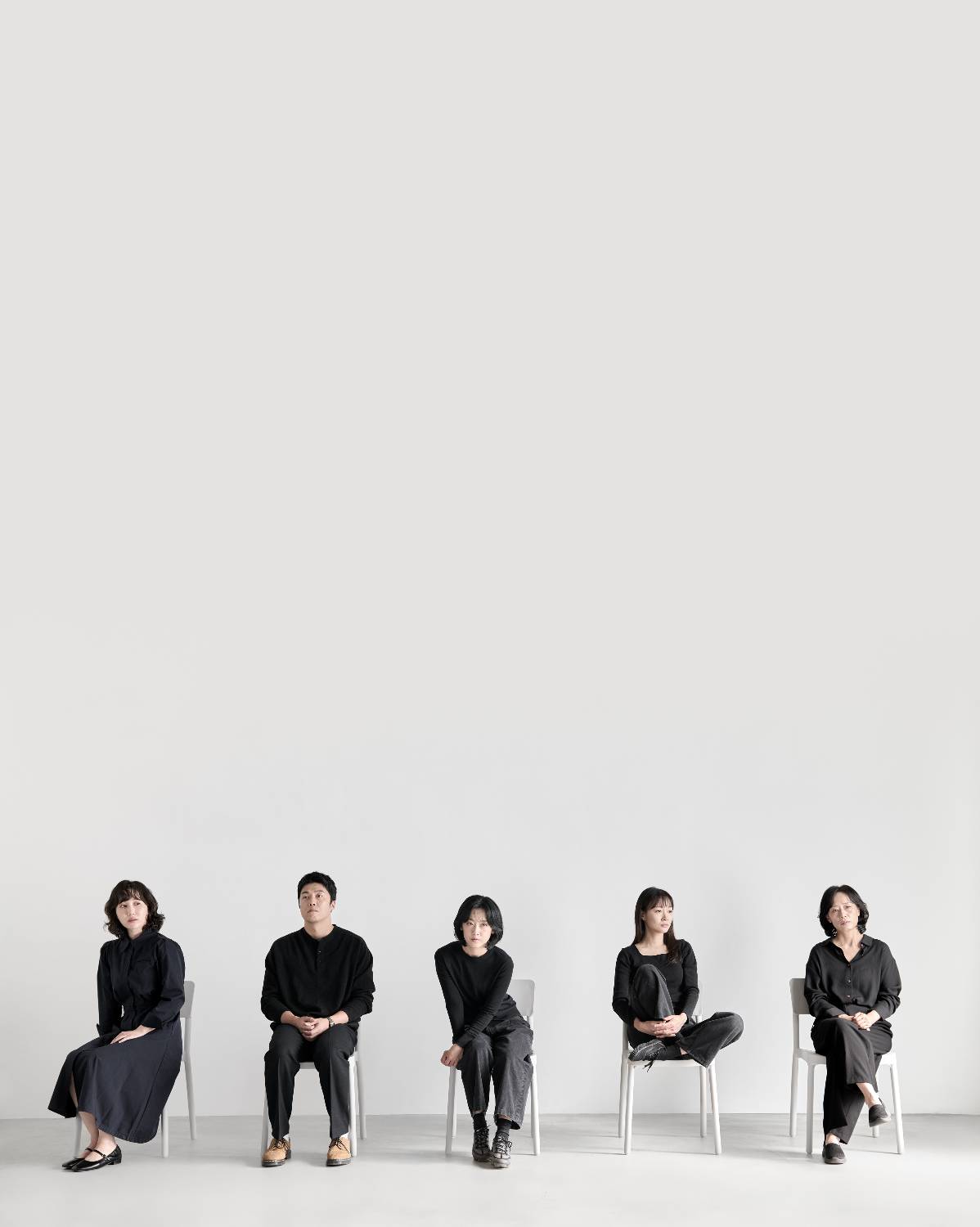
Only by Emptying Can We Begin
No Empty Seats does not offer a cathartic solution to grief or a neatly resolved ending. Instead, it gives us time to stand quietly in the place where tragedy has passed and look directly at the traces left behind in our hearts, traces that cannot simply be covered up or cleared away.
We often regard absence as a “lack” or a “wound that must be swiftly erased.” This is precisely what the adults in the play do when they forcibly remove the desk and chair of the student who has died from the classroom. Yet turning away from a wound or covering it up does not erase the weight of a memory or of a life that once existed. On the contrary, when we resist the urge to fill an empty place too quickly and allow it to remain empty, we can begin to remember the time lived by someone who is no longer in this world, as well as the depth of loneliness experienced by those left behind.
For the audience leaving the theatre after the lights have gone out, having faced the empty space left on stage, I hope that this space within their hearts will no longer remain a void or a wound they wish to avoid. As they quietly contemplate that empty place, some may find themselves returning to memories of the past, while others may begin, however tentatively, to let those feelings go. And at the end of these journeys through grief, perhaps we will be able to draw a little closer to one another, recognising each other's presence and the places we have travelled through.
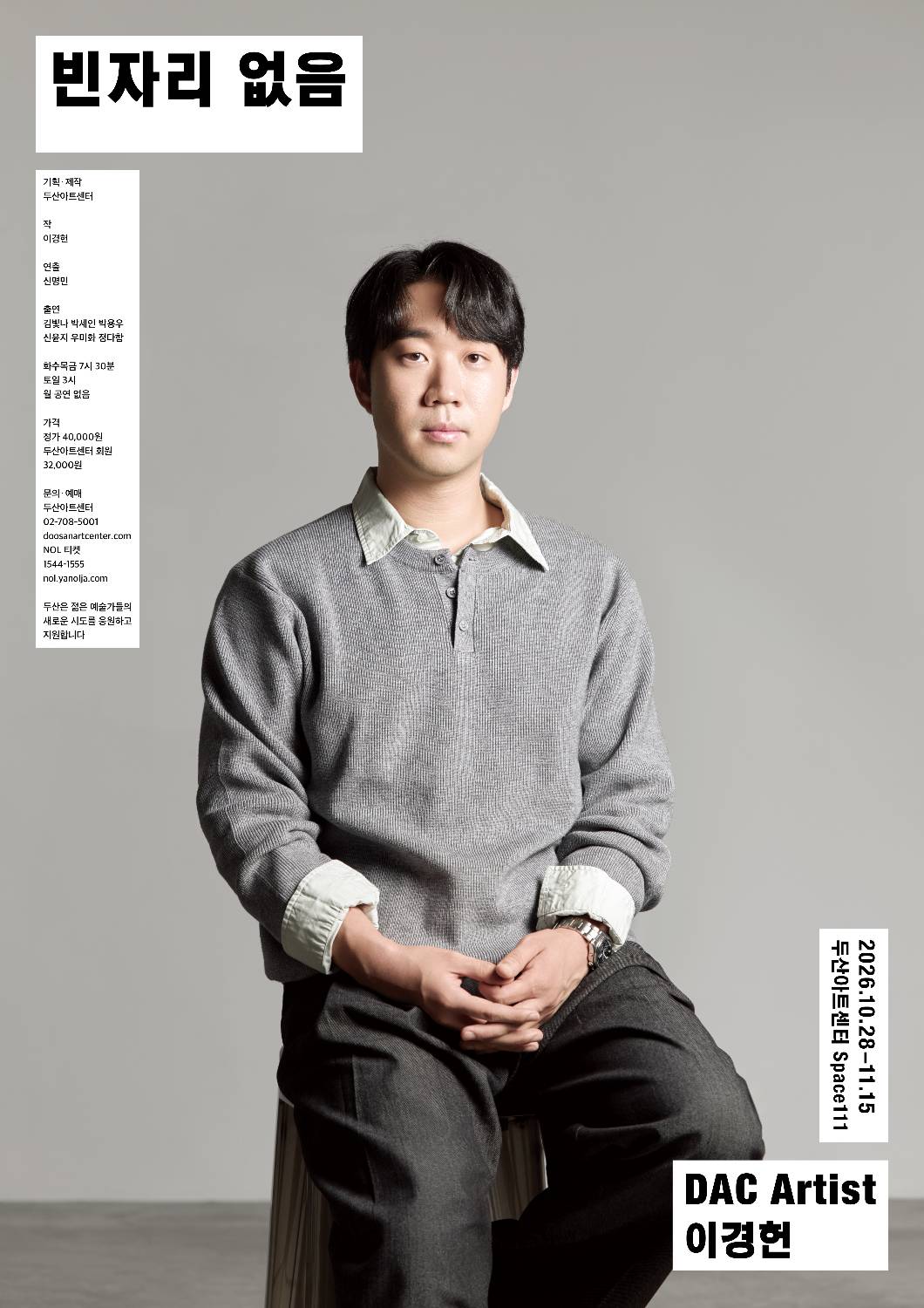
No Empty Seats runs at Doosan Art Center’s Space111 from 28 October to 15 November.
Photo © Doosan Art Center
