

Pink, Toilets, Closed Doors, and Video
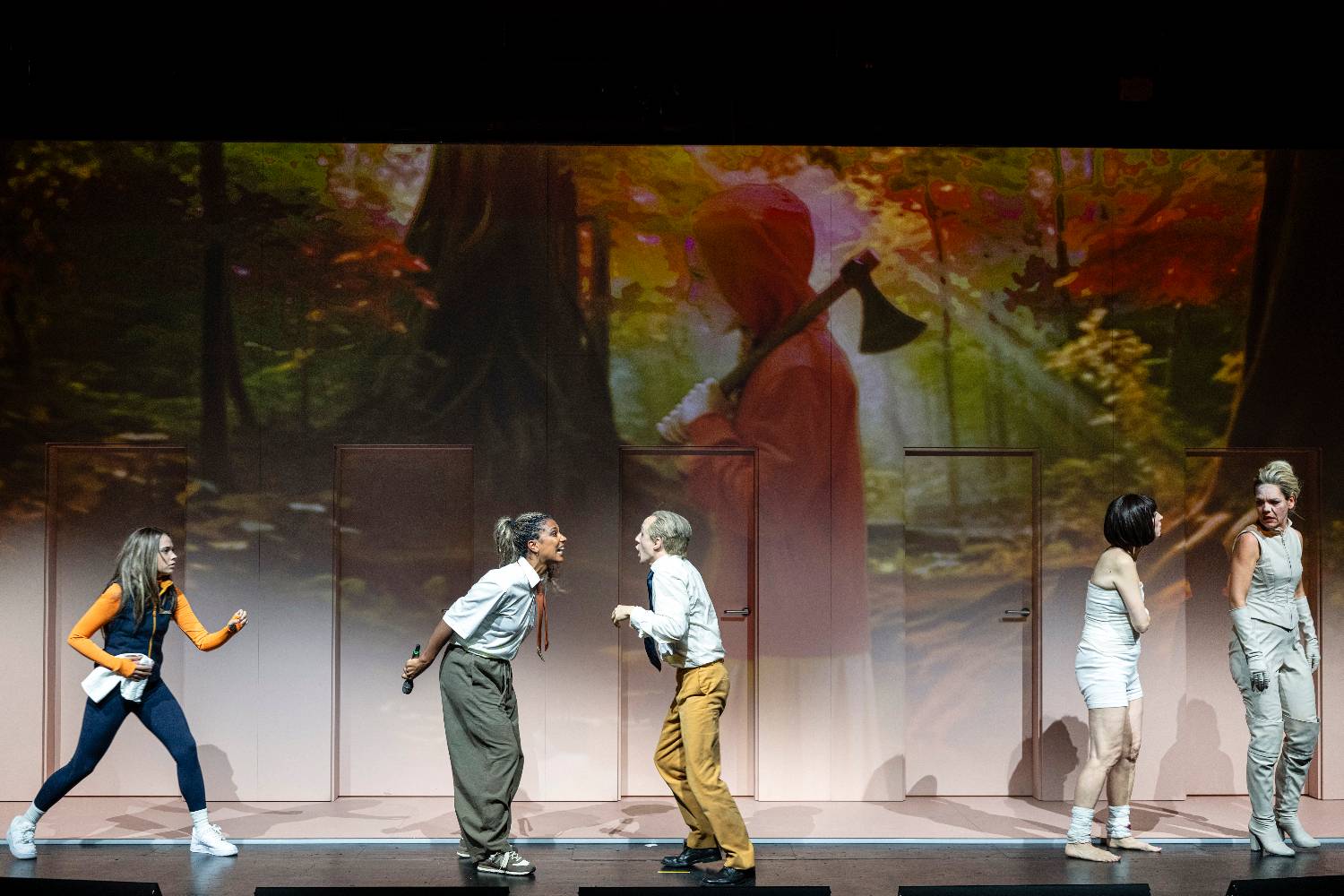
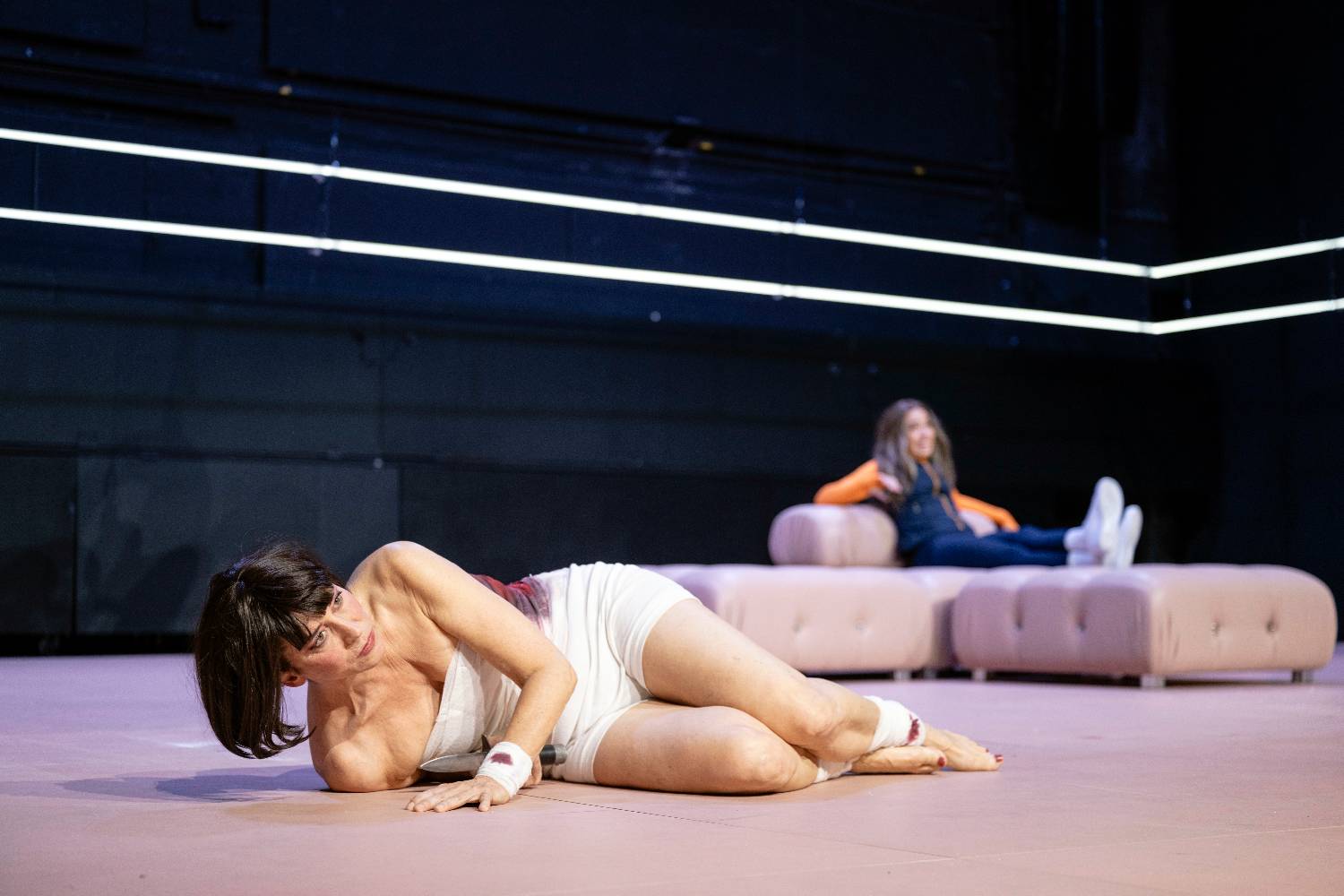
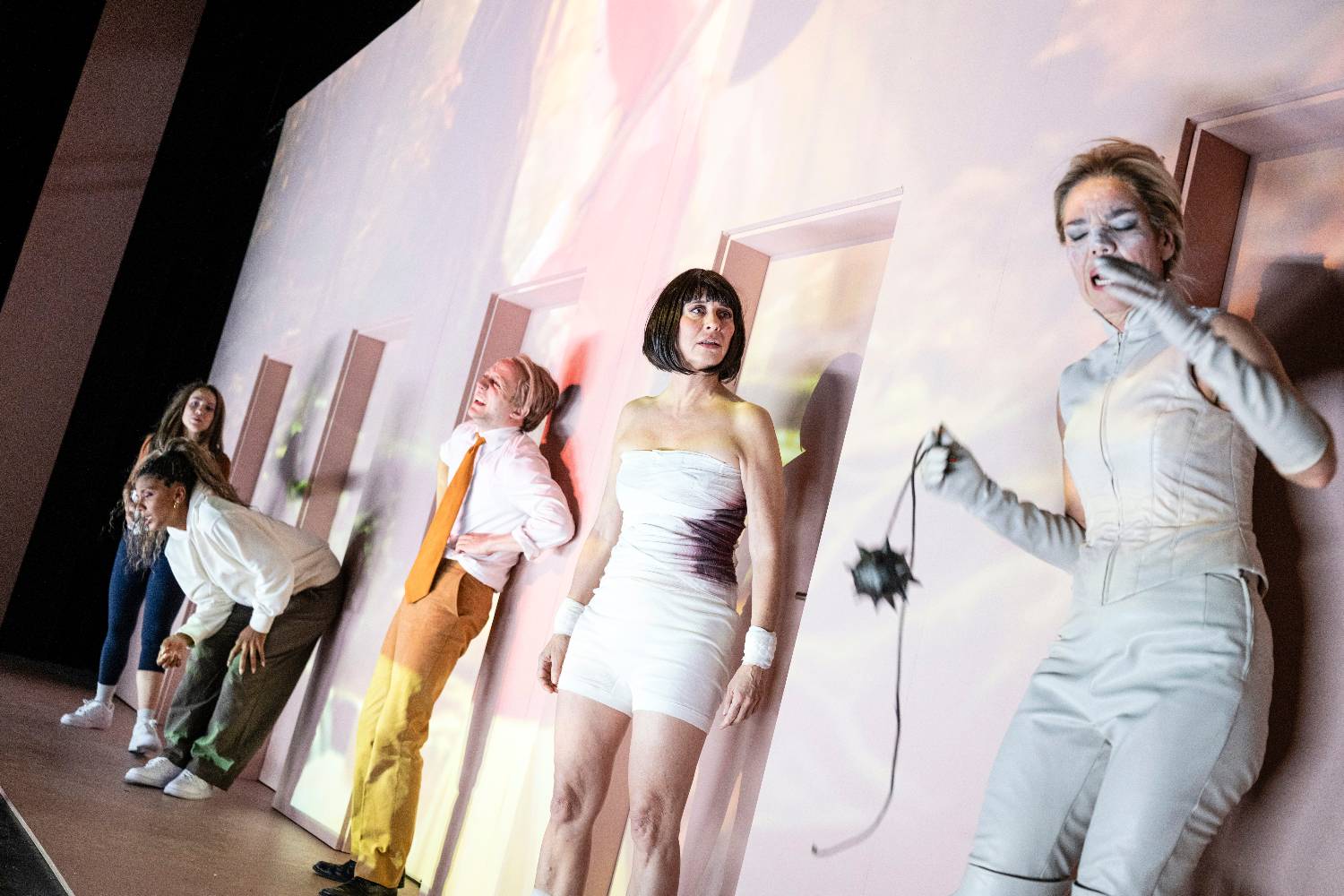
When the performance begins, the audience is greeted by a stylish pink bathroom set fitted with multiple doors. Its bright, polished interior immediately evokes the "eco-friendly" and "female-friendly" image marketed by modern feminine hygiene brands. Yet the moment those doors close, the space transforms into a deceptive landscape of perfect pinkwashing. The opening scene—in which the CEO and employees retreat behind separate doors to exchange lines from their isolated positions while media footage is projected across the panels—instantly establishes the strange aesthetic of this office farce. Here, even the bathroom, the most private of sanctuaries, becomes a site of corporate power struggles and surveillance.
The tension erupts when leaked footage surfaces showing the CEO, Franka (Jele Brückner), injuring an employee with a sword before firing them. The projections behind the doors seamlessly bring the characters’ secret schemes, CCTV surveillance, and the spectacle of TikTok Reels onto the stage, creating a vivid portrait of office brutality in an age of digital voyeurism. Shouts echoing from behind closed doors, coupled with the digital traces projected across the front of the stage, playfully expose the brutal reality of neoliberal workplaces where meaningful communication has become impossible.
From the very beginning, the play bluntly exposes, through the language of comedy, the petty and brutal power struggles lurking behind the polished rhetoric of “progressive innovation for women.” The physical realities of women’s bodies—menstrual blood, menstrual cups, and sweat—are concealed, while even the bathroom is wrapped in pretty pink packaging. The characters, meanwhile, obsess over the numerical games of innovative new products and market share. The result is an unsettling sense of estrangement that arrives immediately after the laughter.
Symbols and Glitch Feminism
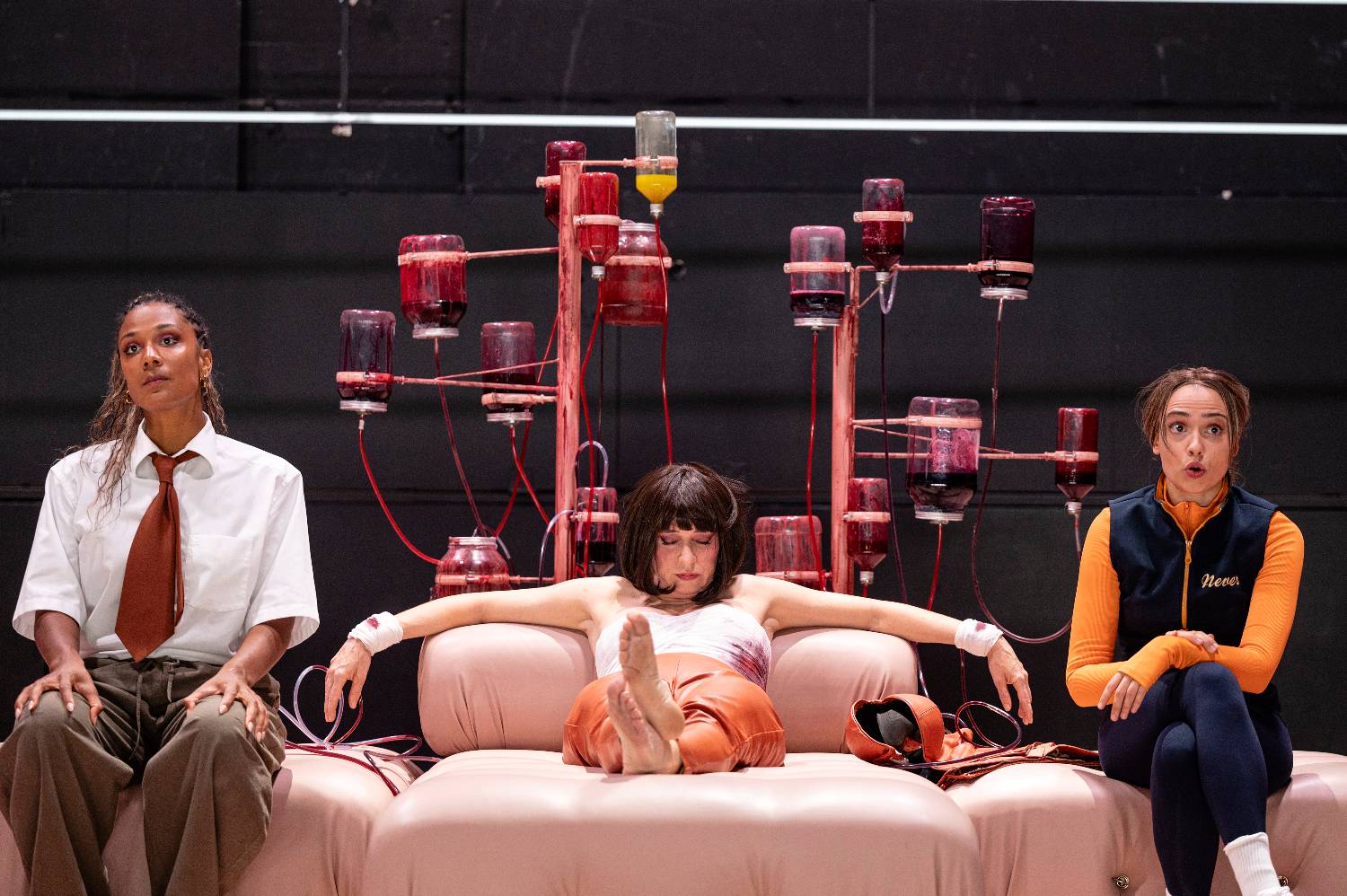
The title Liebling means “darling” or “favorite” in German. The characters in the play struggle to claim the position of someone’s "Liebling," while the companies themselves are desperate to be chosen by consumers as the one and only favorite brand in the market. Meanwhile, the names of the two rival companies, Never and Ever/Always, parody the marketing language that exaggerates the perfection of menstrual products. At the same time, they symbolize the extreme binary logic of a neoliberal competitive society, in which one must never show tears or weakness.
Like the Nietzsche quotation featured in the programme—“The most suffering animal invented laughter”—playwright Svenja Viola Bungarten has a remarkable ability to twist tragic realities into comedy. In Der Liebling, Bungarten theatrically enacts what might be called “Glitch Feminism”: using glitches within a system as a means of exposing and ultimately disrupting the system itself. By deliberately introducing the glitches of bloody slaughter and medieval weapons into the neatly packaged narrative of the successful female CEO, she sharply exposes how commercialized feminism and Hustle Culture can strip us of our political agency.
Director Tina Lanik, who studied political science and has campaigned to close the gender pay gap, likewise emphasizes that “reality today has already surpassed satire.” Her aim, she explains, is to bring “the madness of the lust for power and its tragicomic nature” onto the stage. Through meticulous physical direction and an exceptional use of video media, Lanik transforms Bungarten’s disruptive, glitch-like text into a precisely crafted and visually striking stage spectacle (designed by Stefan Hageneier).
The Illusion of the Female Company and the Backlash Signaled by TikTok’s “Tradwives”
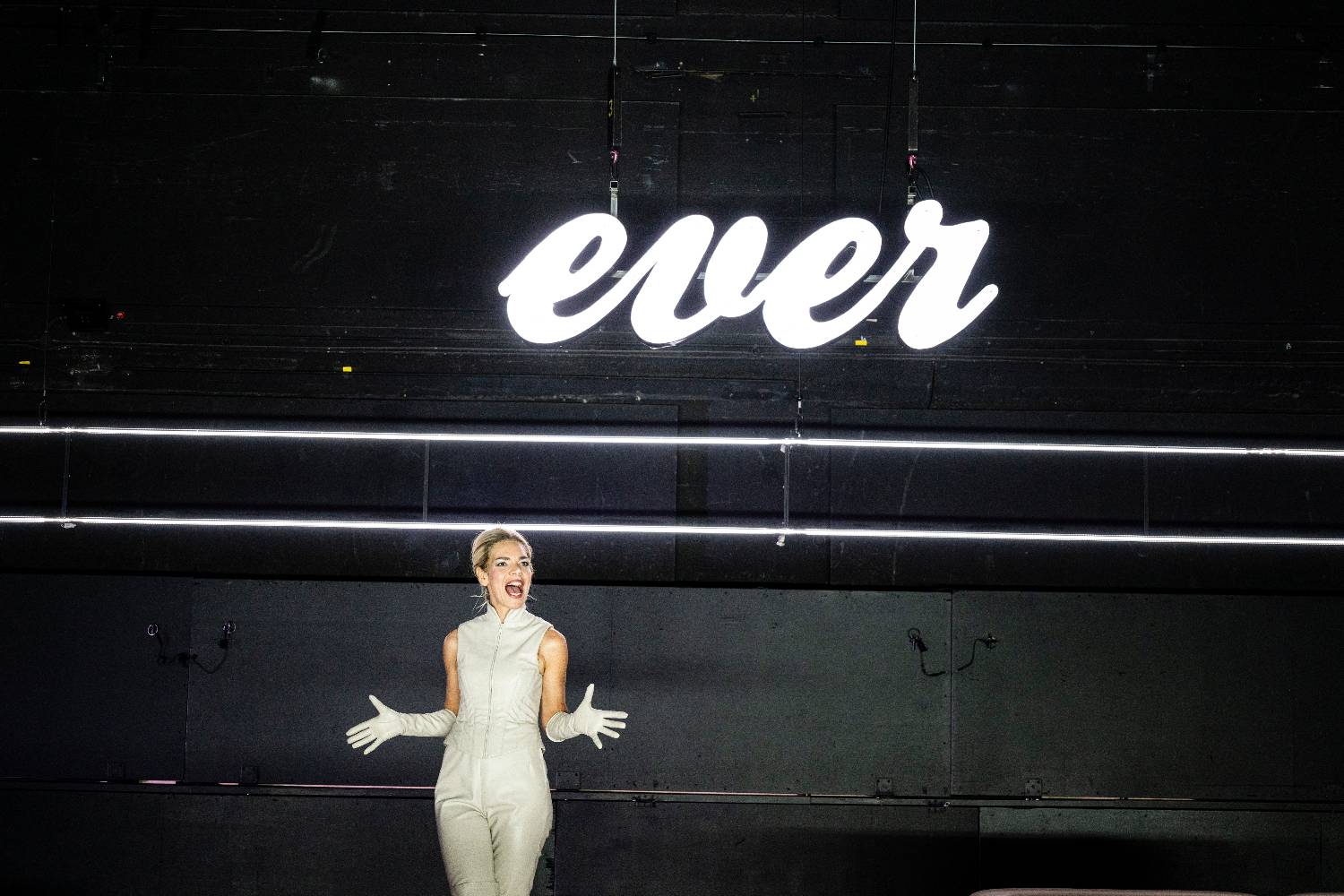
Never and Ever present themselves as companies “created by women and representing women.” Yet the layoffs, surveillance, corporate espionage, and violence that unfold within them reproduce the exact tactics of patriarchal corporate warfare historically driven by male-dominated structures. The fact that women have entered the upper echelons of power does not, in itself, make the system inherently progressive. Instead, the play brilliantly demonstrates how female executives, pushed to succeed within unforgiving neoliberal structures, can become highly effective reproducers of patriarchal violence themselves.
The character of Rebekka (Carla Richardsen)—the daughter of CEO Bettina (Karin Moog) who operates as a “Tradwife” influencer on TikTok—points to a particularly potent form of backlash in contemporary European society. Her character satirizes a generation of young women who, driven to exhaustion by the culture of relentless achievement and competitive labor embodied by their mothers, respond by rejecting paid work altogether. Instead, they reframe domestic labor and motherhood as a cozy, aesthetically pleasing lifestyle to be packaged and consumed online.

Once again, the ingenuity of the stage’s video design (Linda Verweyen) comes to the fore in this scene. A social media interface is projected across the front of the stage, intuitively revealing that Rebecca’s performance of traditional femininity is itself nothing more than another form of digital commodity. Beneath the repackaging of conservative values as “self-care” through social media algorithms lies the paradox of media capitalism, in which identity is sold for influence and profit, as well as the subtle infiltration of far-right values. Tradwife: A portmanteau of “traditional” and “wife,” referring to influencers and a broader social media trend in which traditional homemaking and motherhood are presented and shared on platforms such as TikTok and Instagram as an aesthetically appealing lifestyle.
Broken Solidarity and a Bloody Ending
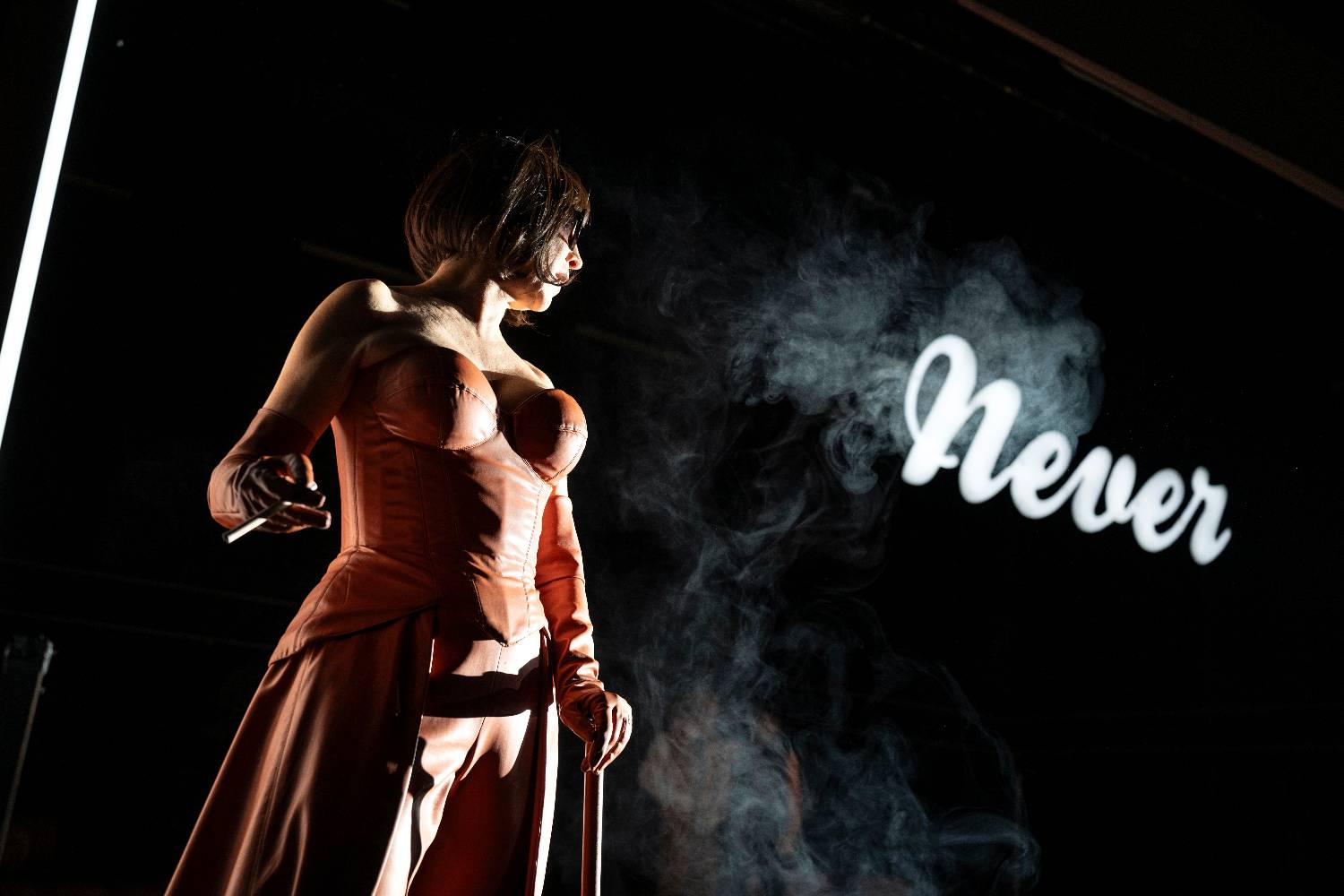
As the play approaches its conclusion, the polite façade of the office is completely stripped away, and the stage descends into a full-blown brawl. The female characters turn on one another, wielding swords, morning stars, and axes in a fight to the death. This bloody spectacle of schlocky slaughter is not presented as the result of individual characters’ moral depravity. Rather, it offers an extreme visualization of how far the brutality of a capitalist monopoly system—one in which survival depends on stabbing and trampling over one another—can push those caught within it.
Once the chaos is over, the characters, covered in blood, remove their sheet masks and wipe away their makeup. Only then do they begin to recognize that they are bound together by a network of female pain and wounds passed down across generations. Having become conscious of the pain stored within their cells, they attempt to withdraw the legal charges they have brought against one another and consider alternatives such as returning their assets to society or seeking a way to coexist.
Yet the play does not neatly resolve its message in the comforting fulfillment of sisterhood. What truly lingers in the theatre is not a hopeful anthem of solidarity, but the sound of swords that dominated the stage only moments before, along with the pressure of the external system that continues to drive endless competition. By presenting this tragic dynamic—where the pain of others can only finally be recognized at the very edge of blood-soaked violence—the play ironically asks just how precarious the promise of solidarity is within the zero-sum game of the market.
Beyond Feminism as Packaging: Into the Real Arena of Struggle
At the heart of Der Liebling lies a sharp critique of the current state of commercialized feminism, where empowerment is co-opted for corporate profitability and brand marketing through pinkwashing. The play relentlessly exposes how the rhetoric of liberation and progress has been hollowed out—reduced from a genuine force for social transformation into decorative window dressing designed to polish corporate image and drive consumption. Much like the pink bathroom set onstage, the capitalist market eagerly sells the progressive slogan of the “girlboss,” while leaving the underlying structural exploitation and mechanisms of endless competition entirely untouched.
The play takes precise aim at several concrete pathologies of contemporary society: neoliberal working environments that demand endless achievement; the way far-right backlash is repackaged through social media as an emotionally appealing lifestyle; and the reality of individuals gradually losing their capacity for solidarity within a competitive structure of divide et impera—divide and rule. Ultimately, even though genuine female solidarity is rendered structurally impossible within a winner-takes-all free market, the capitalist machinery continues to urge women to buy into the myth of the "girlboss."
Ultimately, the question Der Liebling leaves with both its audience and its creators reaches beyond the curtain call and into the textures of everyday life. Once the pink bathroom doors close, we must return to the real arena of our workplaces and society. Will we continue to consume even feminism as a polished commercial product, settling for a relentless competition where we cut one another down? Or will we tear apart the pink packaging and move toward a form of genuine critical solidarity—imperfect, perhaps, but capable of creating cracks in the contradictions of the system? The question left behind by the play follows us out of the theatre, asking each of us to decide what kind of life we are ultimately prepared to choose.
production photos © Isabel Machado Rios
