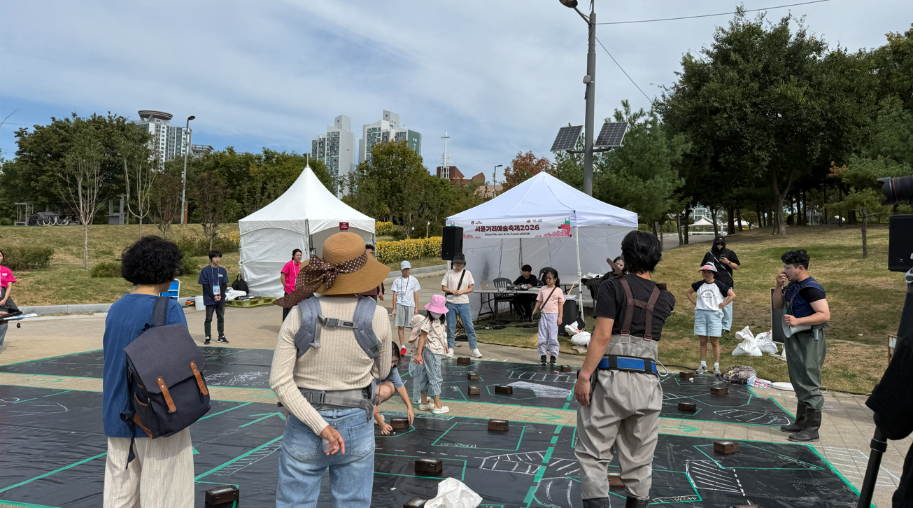

Autumn stirs a peculiar kind of anticipation. Every year, the Seoul Street Arts Festival has woven art into the everyday lives of citizens, weaving through Seoul Plaza and the city's forest of high-rises. This year, however, the festival moved to somewhere a little more special. Having long centered on the heart of the city — Seoul Plaza, Cheonggyecheon Stream, and the like — the festival this year claimed Ttukseom Hangang Park and Seoul Forest as its stage in their entirety. Over two days, September 19 and 20, performances unfolded across open riverbanks, breezes, and stretches of grass, transforming the familiar cityscape into something strange and new. Art moved into the empty margins of the city, and an ordinary walking path became, almost without anyone noticing, a vast performance venue.
This year's festival was filled with works selected through domestic and international open calls, alongside three invited productions from France. Each piece approached the relationships between everyday life, the city, and its people in its own distinct way — and within the open expanse of the Han River and Seoul Forest, those works met their audiences with all the more freedom.
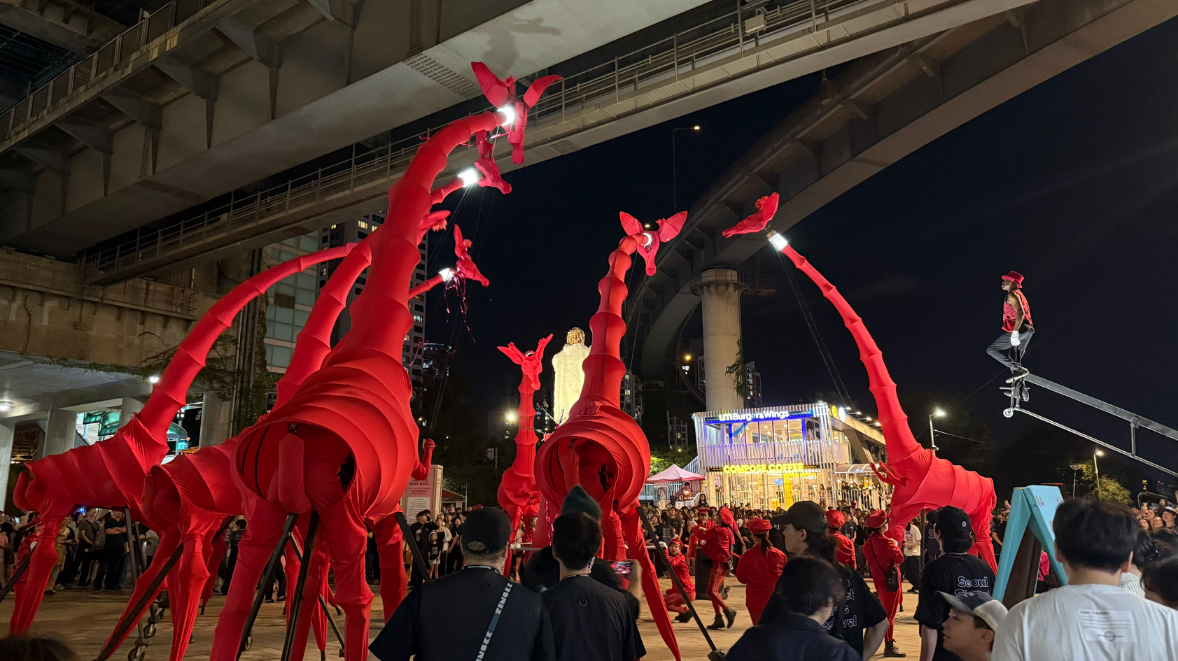
The work that most unmistakably captured the public's gaze was Les Girafes, Opérette animalière by Compagnie Off. Seven enormous red giraffes, each standing eight meters tall, moved slowly along the banks of the Han River. As the towering creatures shifted, so did the eyes of everyone around them; with a diva's operatic melody and fire performances layered on top, an ordinary Han River evening was transformed into an otherworldly fantasy theater. Children ran after the giraffes; adults reached for their phones. The sight of these immense beings drifting serenely through the landscape of Ttukseom was, in itself, an event. With the boundary between performance and audience, the everyday and the extraordinary, blurred beyond recognition, the festival's energy swept through every corner of Ttukseom — quite literally.
Ktha Compagnie's On Veut drew citizens into the very center of the performance. One hundred citizen-performers, selected through a prior open call, took the stage to speak about what they want. Every statement begins with the same phrase: "We want." For some, it might be a deeply personal wish; for others, a voice directed at society. In the moment when people of all different backgrounds gather in one place to speak their desires and hopes aloud, the performance space ceases to belong only to certain performers — it becomes a place where everyone's voice circulates.
G. Bistaki's Tancarville likewise expanded a familiar act of daily life into an unfamiliar landscape. Drawing on the ordinary act of doing laundry to portray the storms that everyday life can generate, the work transformed a commonplace space into a sensory and visually overwhelming scene.
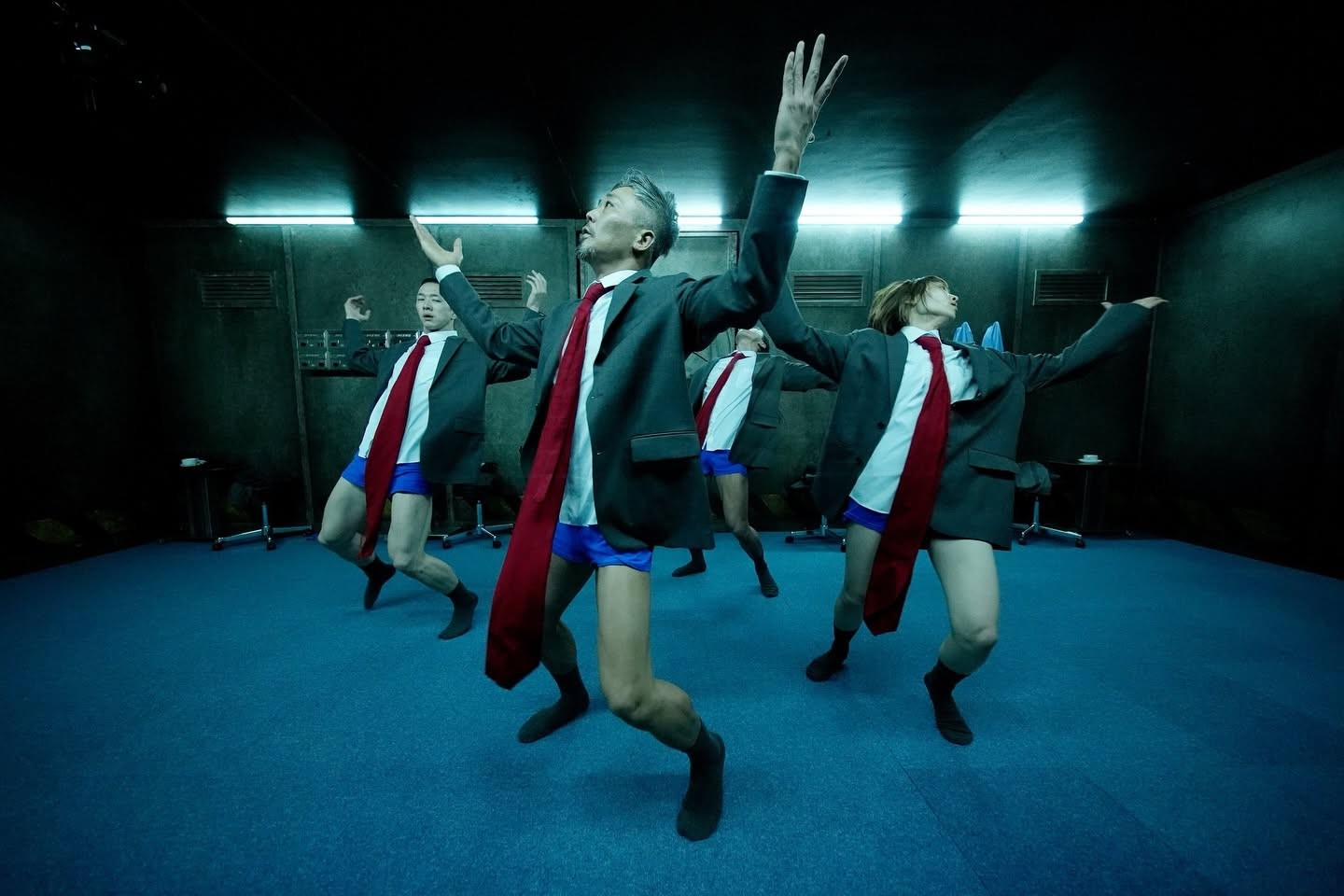
Liquid Sound'sVocal Space 조각눈— a company with a history of invitation to the Avignon Festival in France — along with Unspoken Duties (Momuro Salon), 52Hz (Korea Traditional Performing Arts Troupe “The GWANGDAE”), and 231's Sketchbook (231show) each explored the relationships and daily lives of contemporary people through a range of sensory approaches, set against the open backdrop of the Han River and the city.
What makes street art as a form particularly compelling is precisely that the work is never confined to a specific theater. Rather than sitting in an assigned seat and waiting for a performance to begin, audiences discover a work mid-stroll, linger for a while, and then return to their own lives. Someone who came specifically to see a performance and someone who stumbled upon it entirely by chance share the same moment. That quality of accident may be the most singular thing street art creates.
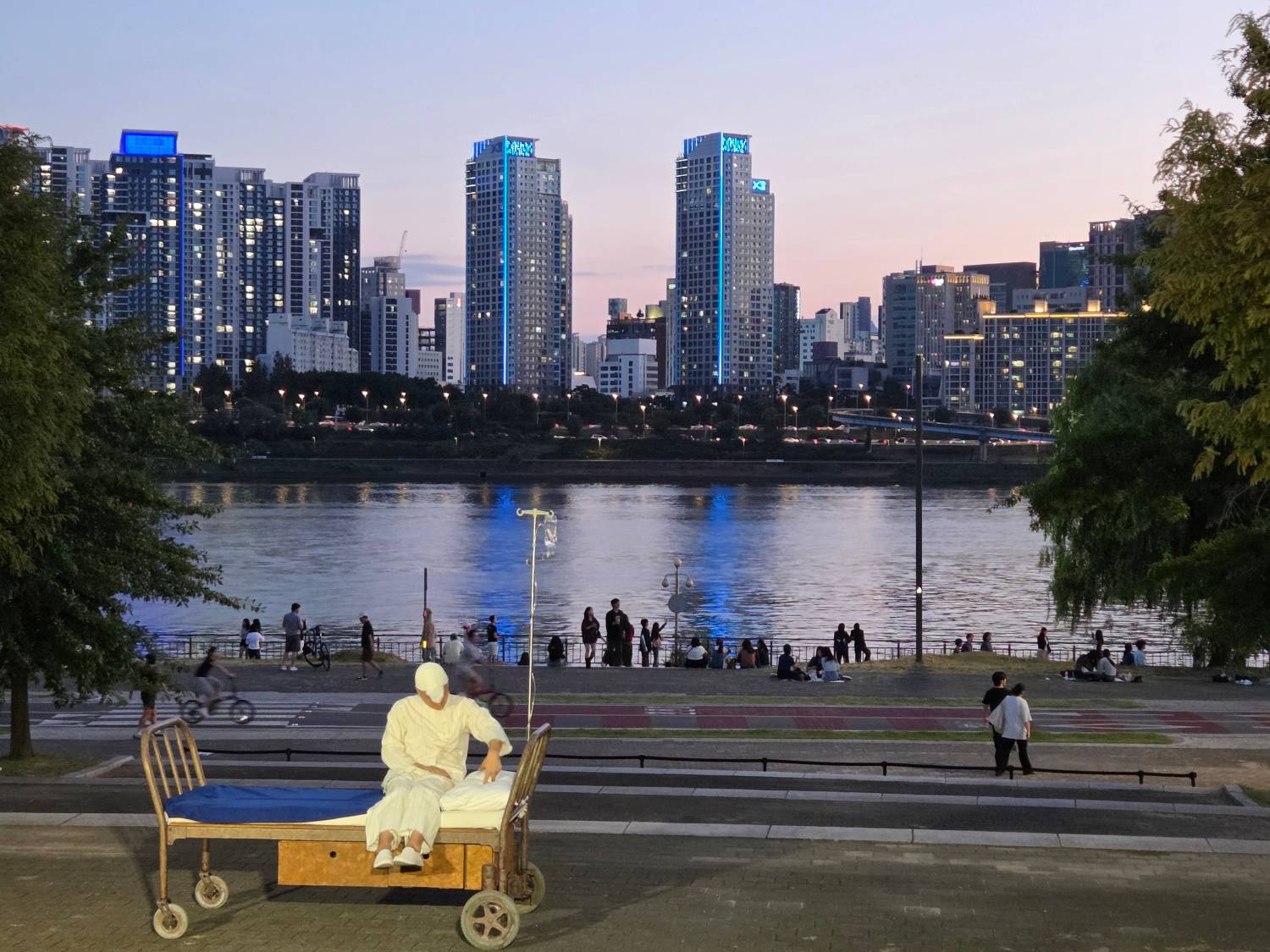
Most striking of all was the absence, across every performance, of any curtain dividing stage from audience. A local resident out for a walk, eyes lighting up as they asked, "What's going on here?" A family sitting on the grass, waiting for a show to begin. International artists wearing their artist lanyards, blending naturally among the crowd, cheering on performances by other companies. Moments arose everywhere in which it became easy to forget who had come as an audience member and who had come as an artist.
The Seoul Street Arts Festival at Ttukseom Hangang Park showed what kind of landscape art can create when it steps outside the theater. Art did not stay confined to spaces reserved for a select few — it entered the walking paths, the lawns, the riverbanks, and the middle of everyday life.
In the place where the binary of artist-on-stage and citizen-in-the-seats dissolved, everyone who paused their step became part of the festival, and even a single scene encountered by chance became a performance in its own right.
What the Seoul Street Arts Festival created this autumn was not simply a new performance venue. It was a new way of seeing — one that made a familiar city feel, for a moment, slightly strange — and an experience that briefly erased the boundary that had always existed between everyday life and art. Perhaps the most beautiful moment in street art is not when a performance begins, but that precise instant when an ordinary day suddenly, without warning, becomes art.