

What Remains After AGING, AGAIN
Synopsis
In a communal kitchen run by young entrepreneurs struggling to stay afloat amid financial difficulties,
people from different generations, each shaped by their own era, come together to prepare food.
Pi-young, who left her job in a school cafeteria to start her own business, is diagnosed with premature menopause and finds herself confronting the changes in her own body.
One day, her grandfather suddenly appears. Refusing to take responsibility for his care,
Pi-young becomes embroiled in a conflict with her mother, Geum-ok, over the industrial accident compensation money he has brought with him.
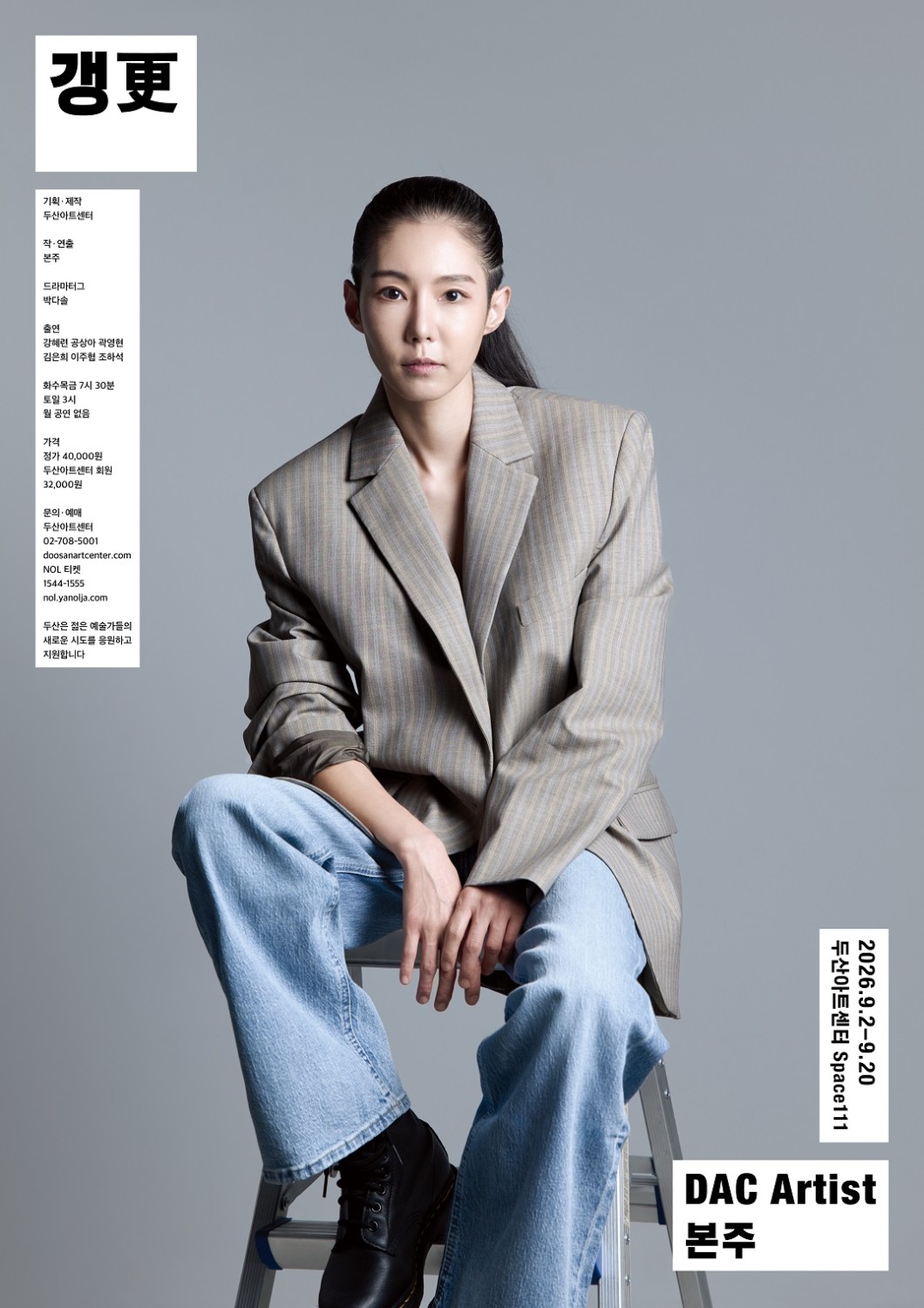
I went to see AGING, AGAIN expecting a story about little more than conflict within a family and between generations.
The play completely overturned that assumption.
I have always thought of theatre as an art form that takes a fragment of reality and magnifies it,
bringing to the stage stories that exist somewhere in the world but that audiences might not otherwise encounter so directly in their everyday lives.
AGING, AGAIN embodied this idea precisely.
And yet, its sheer realism also left me with an unsettling sense of dread: the feeling that something like this could be happening somewhere in South Korea in 2026, right now.
I have experienced the full range of emotions in a theatre: crying, laughing, becoming completely absorbed in a performance.
But I had never before felt so strongly that the story unfolding onstage was not simply communicating a particular theme or message,
but was itself intimately connected to my own life as someone living in South Korea in the twenty-first century.
AGING, AGAIN made me think that this could just as easily be my story, or that I might already have experienced some part of it myself.
For that reason alone, I felt that choosing to see the play was absolutely worthwhile.
When a work of art is set in contemporary South Korea, whether it is a play, a book, a television drama or a film,
its proximity to the audience’s everyday experience can make even the smallest details feel awkward or inauthentic.
A character’s actions, dialogue or even the tone of their voice can easily ring false.
Yet every actor in AGING, AGAIN delivered such a compelling performance that I never once felt that anything was awkward or out of place.
It made for a thoroughly engaging theatrical experience.
Turning to the substance of the play,
I found that it explored the relationship between humans and nature, and the logic of eating and being eaten,
in a far more direct way than I had anticipated.
As the synopsis suggests, the work encompasses a remarkable range of subjects:
generational differences, the communal kitchen as a setting, entrepreneurship as an alternative to conventional employment, ageing, money, caregiving and the struggle to survive.
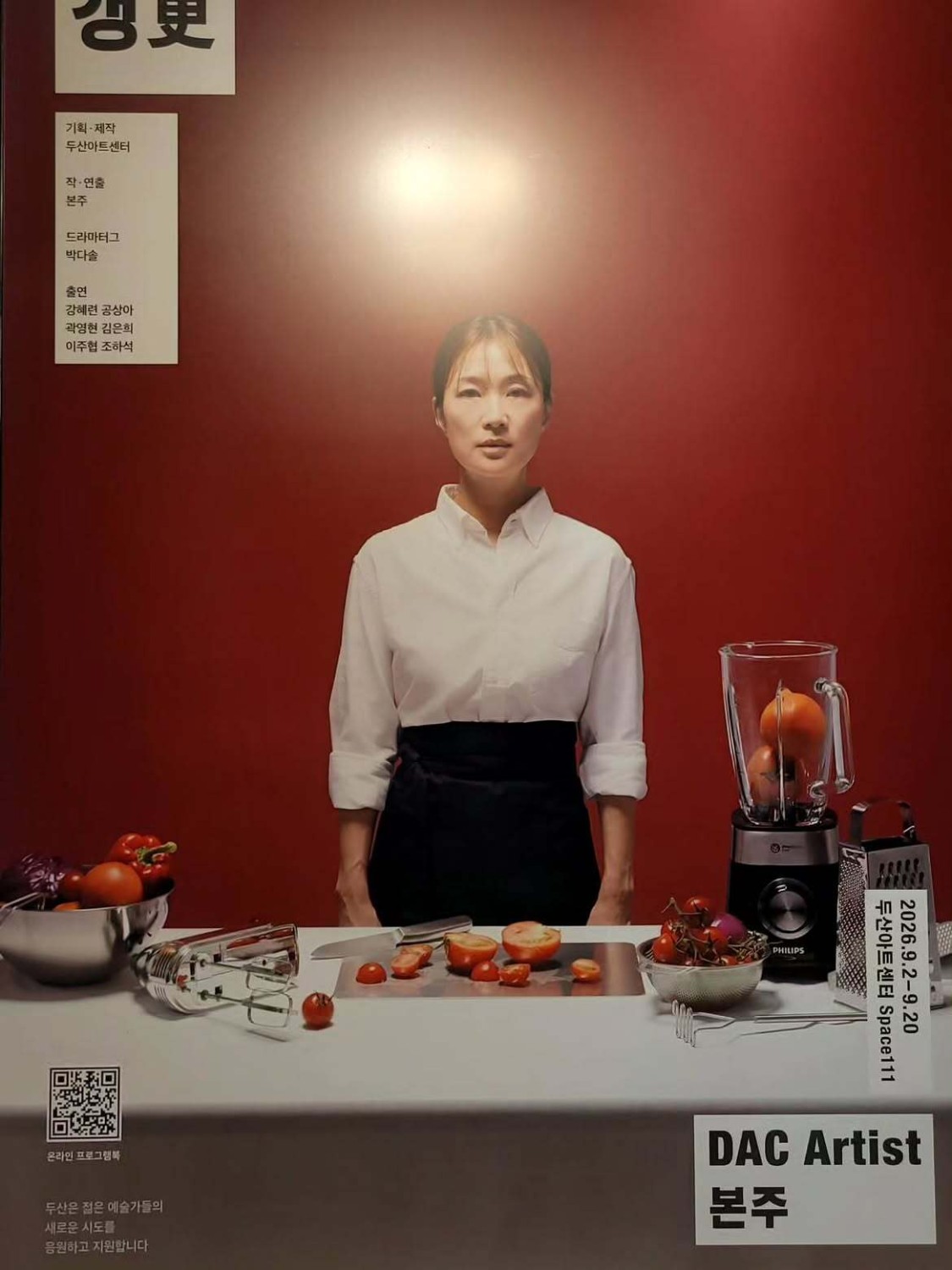
The most striking scene was undoubtedly the one in which an ageing body was pushed into a giant cooking pot, dismembered, boiled and prepared as food, before being consumed.
By transforming human beings into food within the very setting of a kitchen, the play delivered its message with startling directness.
The sight was genuinely shocking. Watching human body parts assigned prices,
then sold as part of a world that continues to function through their exchange, I felt an almost unbearable weight settle over me.
The scene left a profound impression.
The brutal logic of nature dictates that one human being must consume another,
that one living creature must chew up and swallow another in order to survive.
I find this reality cruel and difficult to accept.
What makes it even more distressing, perhaps, is that there seems to be no escaping this cycle for as long as we live—and, in a sense, not even after death.
After witnessing a play that confronts us so mercilessly with this truth, returning to the world outside the theatre feels different.
Having seen all of this, I found myself feeling physically queasy, with any desire to eat suddenly disappearing.
And yet, life goes on. There is something almost horrifying about that fact. Perhaps this, too, is part of the essence of being alive.
And then, even as I sank into these bleak thoughts, other questions began to emerge.
Is this why animals gather in groups, because it is so difficult to survive alone?
Do we live together because we must consume others to survive, while others must consume us in turn?
If I find this reality so repulsive, where, then, does the dignity of being alive reside?
And am I even entitled to regard this fundamental condition of existence so negatively?
After all, every living creature survives by drawing nourishment from something else.
In the final scene, Pi-young puts death back into her mouth and swallows it once more.
In a way, this seemed to embody the idea of beginning again, evoked by the title AGING, AGAIN.
Despite everything, life continues.
I felt that I, too, would need time to revisit the questions the play had raised, to turn them over in my mind and slowly digest them.
Another moment that stayed with me came after the incident,
when a line was spoken to the effect of: “We have ignored too many things that were inevitable to call this an accident.”
I cannot remember the precise wording, but the thought behind the line struck me deeply.
Before the incident occurred, there had been so many warning signs, and the audience had been able to see them clearly.
A grandfather with nowhere to go, boundaries that had never been properly established,
care and employment that had never been clearly distinguished from one another—all these things had been overlooked until something finally happened.
At that point, could what happened really be called an accident?
That question resonated with me. It also made me think that perhaps many of the incidents we witness in the world follow a similar pattern.
The saying “It is only after losing the cow that we repair the barn” has been passed down for generations, reflecting how often people regret their inaction and begin to reflect only after it is too late. I found myself wondering whether there will ever come a time when such preventable tragedies no longer occur under the guise of coincidence.
Finally, the play left me thinking about ageing and the chain of assumptions that so often accompanies it:
growing old means becoming unnecessary; becoming unnecessary means becoming an inconvenience;
and becoming an inconvenience means being pushed to the margins of society.
In this context, I wondered whether extending the retirement age—the idea that people can remain useful and continue working as they grow older,
and that they should be allowed to work for longer—could ever truly provide a complete solution.
I admit that I am still trying to understand the complexities of labour, money and retirement myself.
In a capitalist society, money is essential to survival, and employment is one of the primary means through which people earn it.
Extending the retirement age therefore seems to offer a way of expanding people’s opportunities to continue earning a living. In that sense, it could certainly be part of the answer.
But perhaps a truly complete answer would require something more fundamental:
respecting ageing not as a sign of uselessness, but as the passage of time;
respecting diversity in all its forms;
and respecting older people as part of our own past—the people who once sustained us and who also represent the future we ourselves will one day inhabit.
And yet, I could not help feeling saddened by the question of whether this society will ever truly become one so full of empathy and respect.
Written by · Ye-eun Kang (Member of Here We Are Theatre Club)
