

A Lonely Boy's Letter: The Musical Dear Evan Hansen
Adolescence is a uniquely lonely time for everyone.
The world keeps expanding beyond any hope of control, and within that vast universe, the ground beneath your own feet feels like it's dissolving. Almost everyone has, at some point, been consumed by the question: "If I disappeared tomorrow, would anyone even notice?"
The musical Dear Evan Hansen is the story of a boy standing at the very center of that universal loneliness: Evan Hansen.
Scored by Benj Pasek and Justin Paul — the songwriting duo behind La La Land and The Greatest Showman — the show swept six Tony Awards, and after its Korean premiere in 2024, it has returned to audiences with a 2026 revival at the Chungmu Arts Center's main theater.
In the show, high schooler Evan Hansen lives with social anxiety disorder, unable to hold eye contact or carry an ordinary conversation with ease. A letter he wrote to himself as part of his therapy ends up in the hands of his classmate Connor Murphy. Days later, Connor takes his own life, and the letter is mistaken for his suicide note. Unable to bring himself to shatter the grieving Murphy family's fragile hope, Evan invents a secret friendship with Connor and a memory of an apple orchard that never existed.

A Utopia Built from Modern Loneliness and Lies
In the show's signature number, "Waving Through a Window," Evan waves his hand against the glass and asks: "Is anyone waving back at me?"
On the first day of the new school year, Evan holds out a clean white cast that no one has signed, reaching out to people with quiet desperation — but no one looks his way.
Yet this isolation doesn't belong to Evan alone. Jared hides his loneliness behind jokes and bravado; Alana, obsessed with résumés and extracurriculars, confesses she knows exactly "what it feels like to be invisible." Every character on stage is fighting loneliness in their own way.
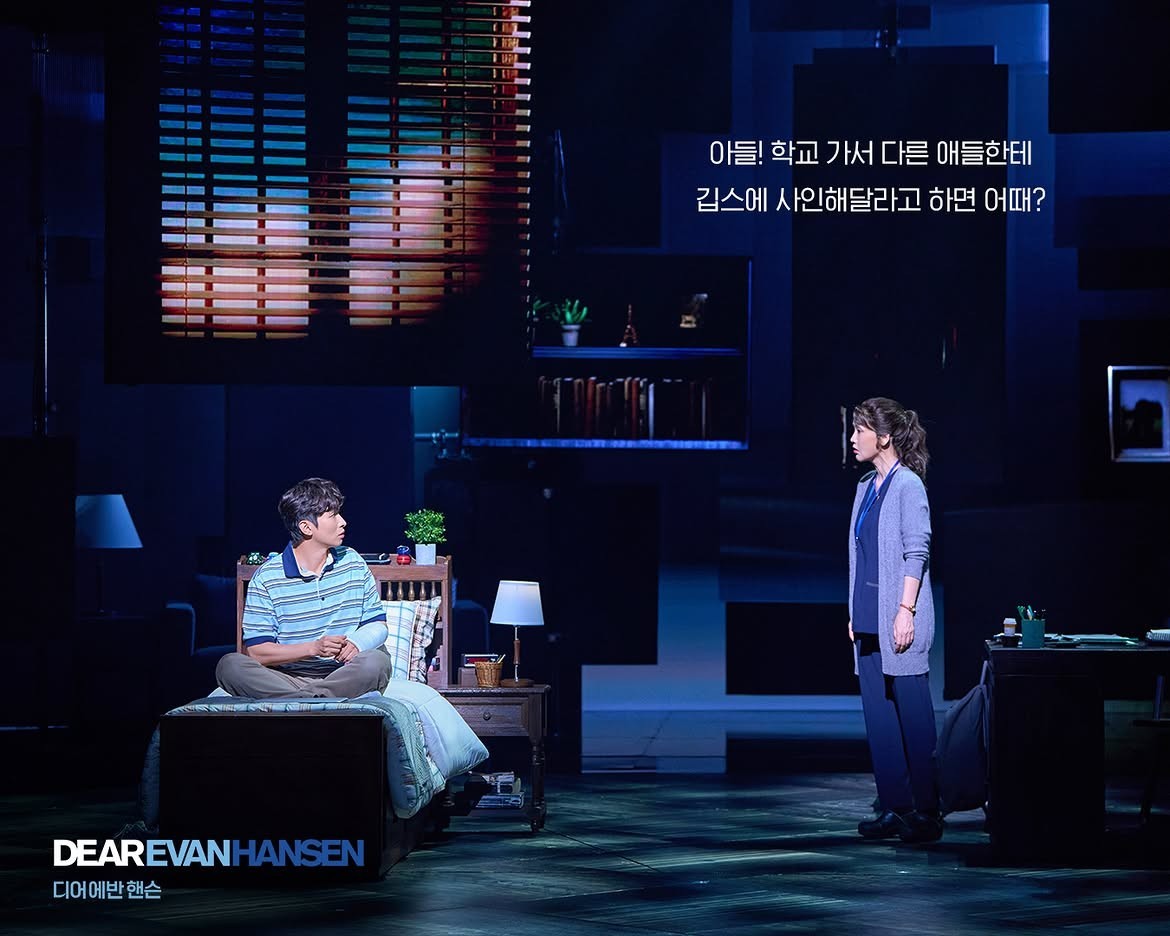
Watching the multi-layered LED panels that fill the stage, and hearing the endless chime of social-media "like" notifications, paradoxically makes the isolation feel even more acute than ever. Followers, view counts, donation totals for a campaign — countless digital signals suggest connection to the world, yet none of them manage to show who we really are. It's a portrait of all of us, living in this era.
In a world that only appears connected, Evan could never say what he truly felt to anyone. And somewhere in that gap, the boy begins a lie he never needed to tell.
What makes it so painful is that Evan's lie never came from malice. In truth, the day he fell from the tree and broke his arm, he had climbed forty feet up an oak tree and lain alone on the ground for ten minutes, murmuring,
"Someone will come. Someone will come save me" — a moment in which he was trying to let go of his own life.
But in "For Forever," Evan transforms that moment of despair into "a perfect summer day spent in the sunlight of an apple orchard with his best friend in the world."
That apple orchard — where no one falls from a tree, no one lets go of another's hand, no one gets hurt — was Evan's own sad and beautiful utopia.
Before long, that summer's-day story earned a name — "The Connor Project" — and spread far beyond the school, out into the online world.

In "You Will Be Found," the climax of Act One, Evan's memorial speech spreads across social media in an instant, and countless strangers join a chorus declaring, "You are not alone."
It's a paradox that this vast wave of solidarity and comfort began with a lie — and yet the yearning for warmth that reached across the digital screen toward one another was never, for a moment, false.
Even if the fence around it was built from lies, we can never blame a lonely boy — one who had been overlooked his whole life — for wanting to lean on the warmth he was finally being offered. Like the scene "Words Fail," where he sobs out the truth even knowing the ruin that awaits him once the lie is exposed, the boy was already breaking apart, tormented by his own wrongdoing, long before anyone else confronted him.
We live in a cold era, one where other people's weaknesses are judged with ease, and misunderstanding and contempt spread like a fad, like a contagion. In a world this quick to harshly condemn and brand someone for their mistakes and their struggle to survive, the show turns a question back on us:
What other choice did that lonely boy have, besides clinging to a fence built of lies, just to survive?
Have we ever, even once, reached out first with a warm hand to the countless "Evans" curled up like invisible ghosts around us?
Isn't it possible that what we should truly be ashamed of isn't the boy's lie, but our own indifference and inaction — the very thing that drove him to the edge?
Only Us
The saddest paradox of this show is this: in the very act of hiding his true feelings and telling a lie, Evan finally comes face to face with the genuine love and family warmth he had been longing for all along.
Evan, who could never love himself and so had to constantly prove his worth to everyone else, is told by Zoe — through the song "Only Us" — that none of it matters: not his past pain, not any grand proof. All she says is, "You alone are enough. Only us."
Just as heartbreaking is "To Break in a Glove," where Larry, Connor's father, teaches Evan — a boy who grew up without a father — how to break in a baseball glove, giving him his time and his care.
We understand, watching it, that the tenderness Evan experienced inside the fence of his lie genuinely filled the empty places in his heart with warmth.
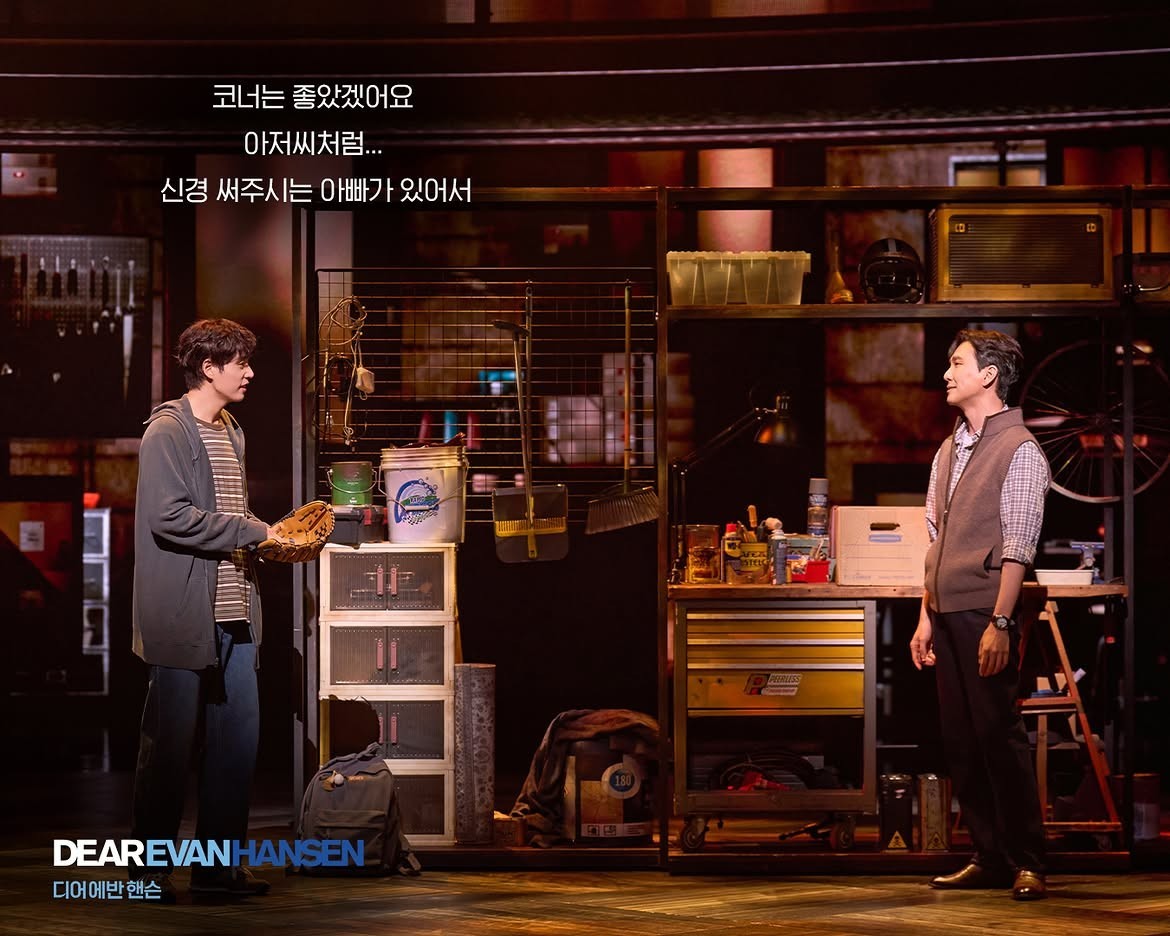
Watching Evan quietly solidify his own world within that fence, a strange sense of guilt settles in.
Must love only ever be given to a person's perfect, honest self — the version stripped of every illusion?
Even if a relationship began in fantasy and misunderstanding, if the comfort I felt in that moment, and the warm eyes turned toward me, were real — then isn't that warmth itself, however imperfect and messy, reason enough to keep living?
Perhaps what keeps us alive isn't the flawless truthfulness of a relationship, but the sincerity of the tenderness carried within it.
The show tells us that the key to breaking this painful chain of loneliness and contempt isn't some grand, sweeping perfection.
Like the moment Cynthia quietly hands the trembling Evan her own son Connor's necktie — what truly improves the world, and a single person's life, is a small, unconditional kindness.
This truth is most powerfully felt in the scene where Evan and Heidi finally see each other's hearts.
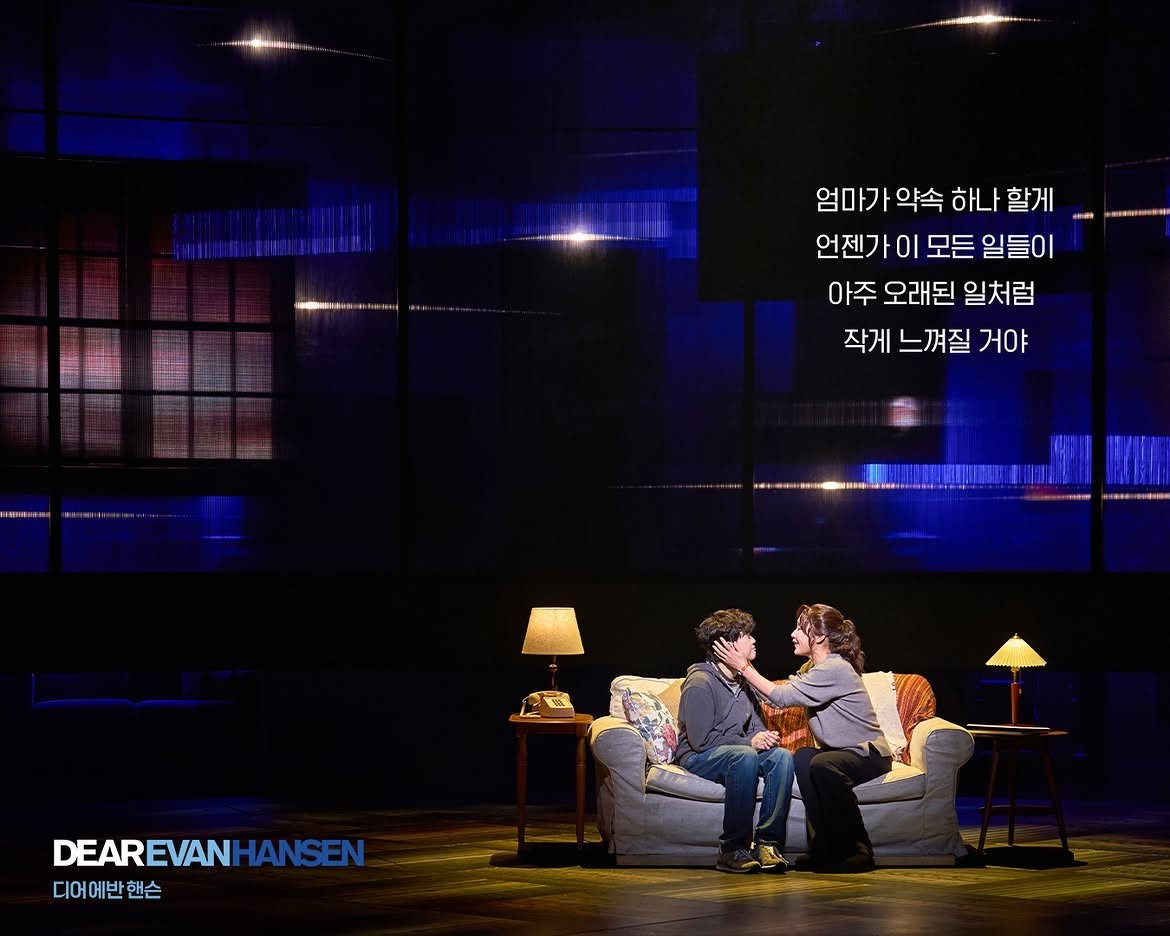
When the fence of lies collapses and Evan is again standing at the edge, breaking down and saying, "If you knew who I really am, how broken I really am, you'd hate me too" — Heidi answers with a solemn vow in "So Big / So Small": "Whoever you are, I love you. I will never leave. I will always be by your side."
This belief — that even at your absolute worst, even completely undone,
there is someone who will love the person you actually are — is exactly what leads Evan out of his refuge of lies and back into the real world.
End of May or early June, Dear my Evan
The person who introduced me to this story is an actor I have kept my eye on steadily for the past ten years.
An actor who has taken on countless roles in his own way, with a face like a blank canvas and a voice with a distinctly youthful quality.
The reason I keep returning to his stage is clear enough: even in the same scene, the same song, I discover slightly different emotions and expressions each time.
To explain who that person is, I have to start with the story of before this show ever came to Korea.
I first learned of the musical Dear Evan Hansen one day in 2018. I counted down the days until this work, which had shaken Broadway, would finally set foot on Korean soil. Even while traveling to the UK or Canada, I kept listening to the original numbers so I could follow along. Then in 2021, I heard that a musical film starring the original actor, Ben Platt, was going to be released. What struck me just as much was seeing a promotional clip from that time, of actor Kang-hyun Park singing “You Will Be Found.”
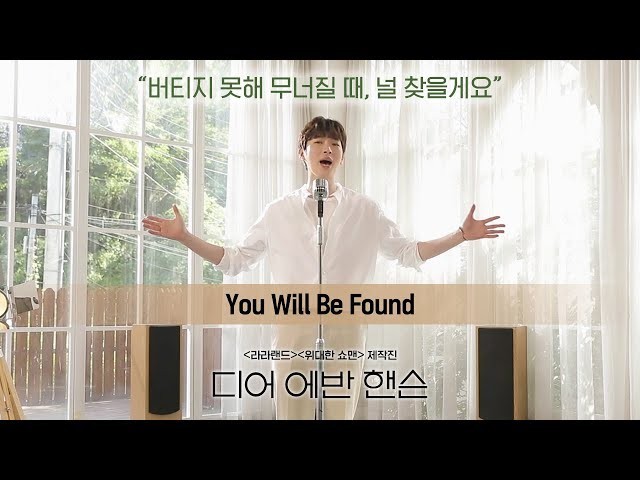
He had only just begun to receive the spotlight after his debut, mostly appearing in new, first-run productions, so it never occurred to me that he could end up in “the work I was waiting for.”
But from then on, I began to hope: could I possibly meet him on the Korean stage too? And three years later, in 2024, he took on the role of Evan in the Korean premiere, and in the 2026 revival, he stepped onto the stage as Evan once again.
Having watched his stage work for ten years, I would say Park Kang-hyun’s Evan is “transparent.” Not transparent in the sense of being so unrefined that everything shows through, but transparent in the way that, whatever character he takes on, he absorbs it entirely into his own color — almost like magic. Though the question of age comes up, the boyishness he brings to Evan is something age alone cannot fully explain.
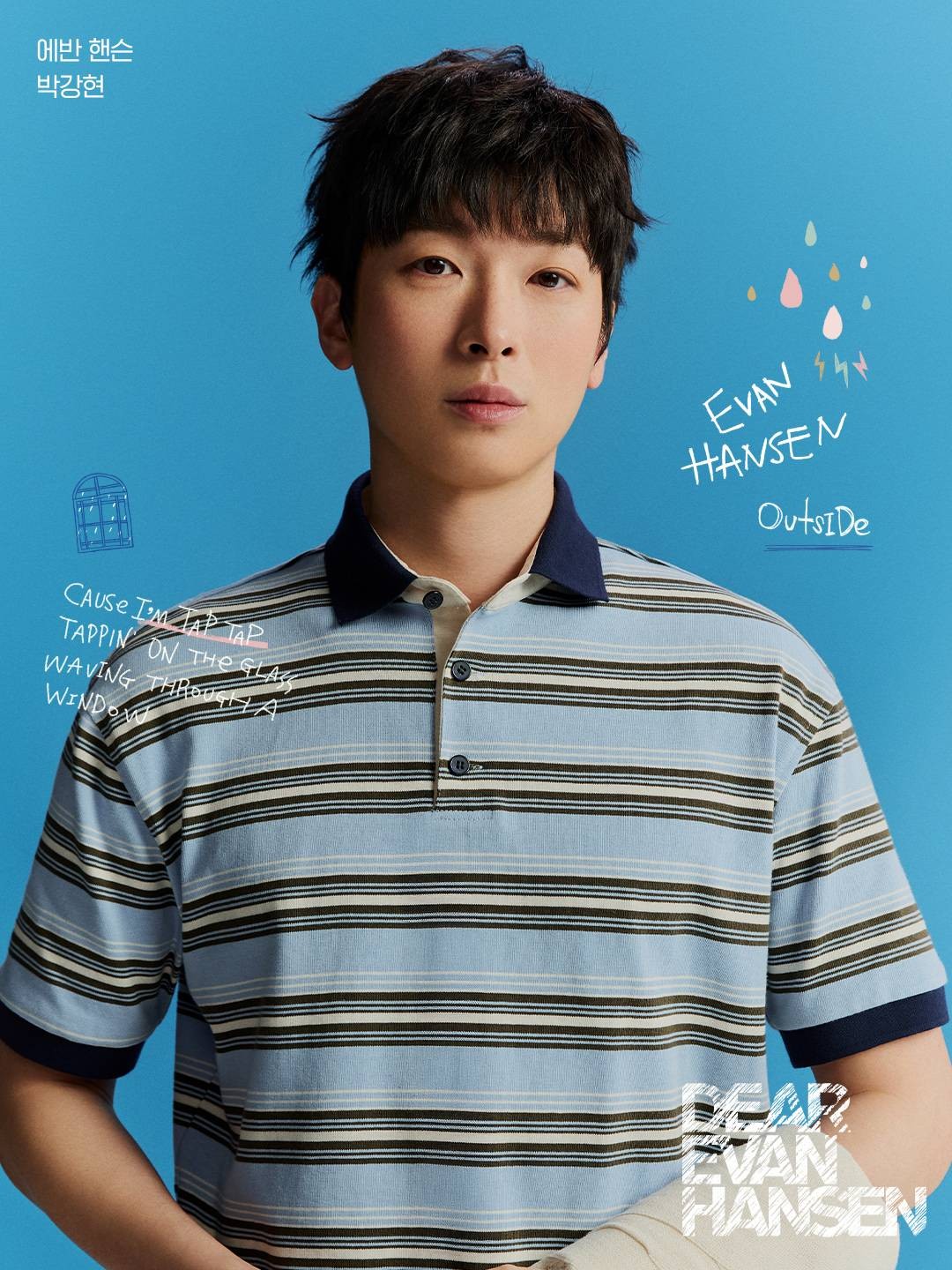
The unsteady, trembling eyes that can’t quite meet another’s gaze, the hunched shoulders, every awkward, sweat-damp gesture of his hands — above all, rather than trying to shine flashily on stage, his performance as a sincere messenger of the story, cradling the boy’s loneliness close to his heart, completes an “unblameable Evan” found nowhere else.
Hearing his voice break into sobs when the lie unravels makes you want, not to condemn him, but to wrap that lonely, transparent child in your arms. It makes you want to gently pat his shoulder and say, “I know you never meant to ruin anything.”
Meeting again, on stage, a story I had waited so long for, and getting to see it through the different interpretation of an actor I love — that is a rather special experience for an audience member.
In particular, the fact that the same actor plays the same character in both the premiere and the revival, yet shows something slightly different each time, gives me one more reason to return to this work again and again.
Every time I meet Evan on stage, I find a new face even in an actor I’ve watched for ten years.
And that change makes me realize that it isn’t only the actor who is growing — my own way of looking at this same work and this same character is shifting, little by little, too.
Until We Finally Find One Another
There's a famous line from the Japanese manga One Piece:
"Do you know when a person truly dies? … It's when they're forgotten by the world."
True death, it says, doesn't arrive when the heart stops beating — it arrives when you no longer remain in anyone's memory, when you are never found by anyone, and are simply forgotten.
While he was alive, Connor Murphy was a ghost-like boy no one ever turned to look at.
But through Evan's lie and the utopia of "The Connor Project,"
Connor was finally discovered — at last — as someone gentle and warm, living on in the memories of countless people.
And Evan, too, who had always lingered at the edges of the world, waving through a window,
only truly began to breathe and shine the moment others recognized him and found him — the moment "You Will Be Found."
Even if it was built on illusion, the warmth and comfort the characters shared within it was never, for a moment, false.
Because within that utopia of a lie meant to hide the truth, they ended up doing something wonderfully ironic — they found, at last, each other's deepest loneliness and each other's genuine love.
In the end, this is the final message Dear Evan Hansen offers to those of us living today: we are all lonely, each in our own way, and we all struggle, each in our own way, hoping to be found by someone.
Instead of harshly condemning that struggle, we need to quietly reach out our hands and truly look at one another. To meet the eyes of someone nearby who is curled up like an invisible ghost behind their own glass window.
To keep finding and remembering each other, saying, "I'm here," "I see you."
As long as we keep finding one another this way, no matter how dark the night gets, none of us will ever be erased or forgotten from the world.
Musical Dear Evan Hansen runs from August 1 to November 1, 2026, at the Chungmu Arts Center Grand Theater in Seoul.
