
Many theatregoers overlook the fact that two of the largest repertory companies in the Americas are located in Ontario, Canada. While the Stratford Festival is the largest, the Shaw Festival is a close second. Both present demanding schedules, highlighted by the Shaw's unparalleled nine-month operating season. But where Stratford offers grand scale, the Shaw commands widespread admiration for its consistently high artistic standards and unconventional programming.
Now in its 64th year, the festival immerses visitors within a 19th-century heritage village notably devoid of fast-food chains—save for a solitary Starbucks. Founded to celebrate the works of George Bernard Shaw, the festival has since evolved. Its playbills now include pieces by his contemporaries alongside modern, human-centric stories that mirror Shaw’s provocative spirit by challenging societal norms and addressing social consciousness. Pride of place goes to the festival's role as the country’s leading play development hub. This summer marked the unveiling of its $30 million Artists' Village, which houses the Burton Centre for Lifelong Creativity and offers dedicated performance labs, classrooms, and year-round educational programming for youth, seniors, and the local community. The complex is also home to Canada's largest unified theatre wardrobe facility. In addition, this winter, two Shaw productions will launch a new city season across the lake at the Harbourfront Centre in Toronto.
This season, the Festival features two award-winning masterpieces that successfully jumped from Broadway to the silver screen: Funny Girl and Amadeus. The latter primarily catalysed my return to Niagara-on-the-Lake, alongside a workshop of Branden Jacobs-Jenkins’s A New Work in Progress—a darkly satirical, self-directed adult reimagining of Cinderella. Much like Shaw's "theatre of ideas," Peter Shaffer’s work—itself just like the dense, intellectual style of Tom Stoppard—fell out of favour during the early 2000s. In the pre-pandemic era of heightened social movements, some even dismissed these text-driven, highbrow plays as a theatrical plague. Yet today, we are in a new golden age of boundary-pushing, essential theatre. This renaissance is apparent not just in groundbreaking new works, but in how we dynamically re-examine and revise classic texts across eras.
We all know the tales of the rivalry between Mozart and Salieri, but debating the historical accuracy of that friction feels tiresome when Shaffer’s play offers so much more. It is undeniable that unless you are well-versed in Mozart’s oeuvre, portions of this script risk sounding like musical jargon, rendering the story somewhat inaccessible to uninitiated theatregoers. Tim Carroll—the Artistic Director of the Shaw Festival—knows virtually every piece of music Mozart ever composed. He underwent a self-described crash course during one intense summer at the age of 28, when he was first entrusted to direct a staging of Amadeus. Now marking the Festival's very first production of a Shaffer play, this revival represents Carroll's third time directing the iconic piece.
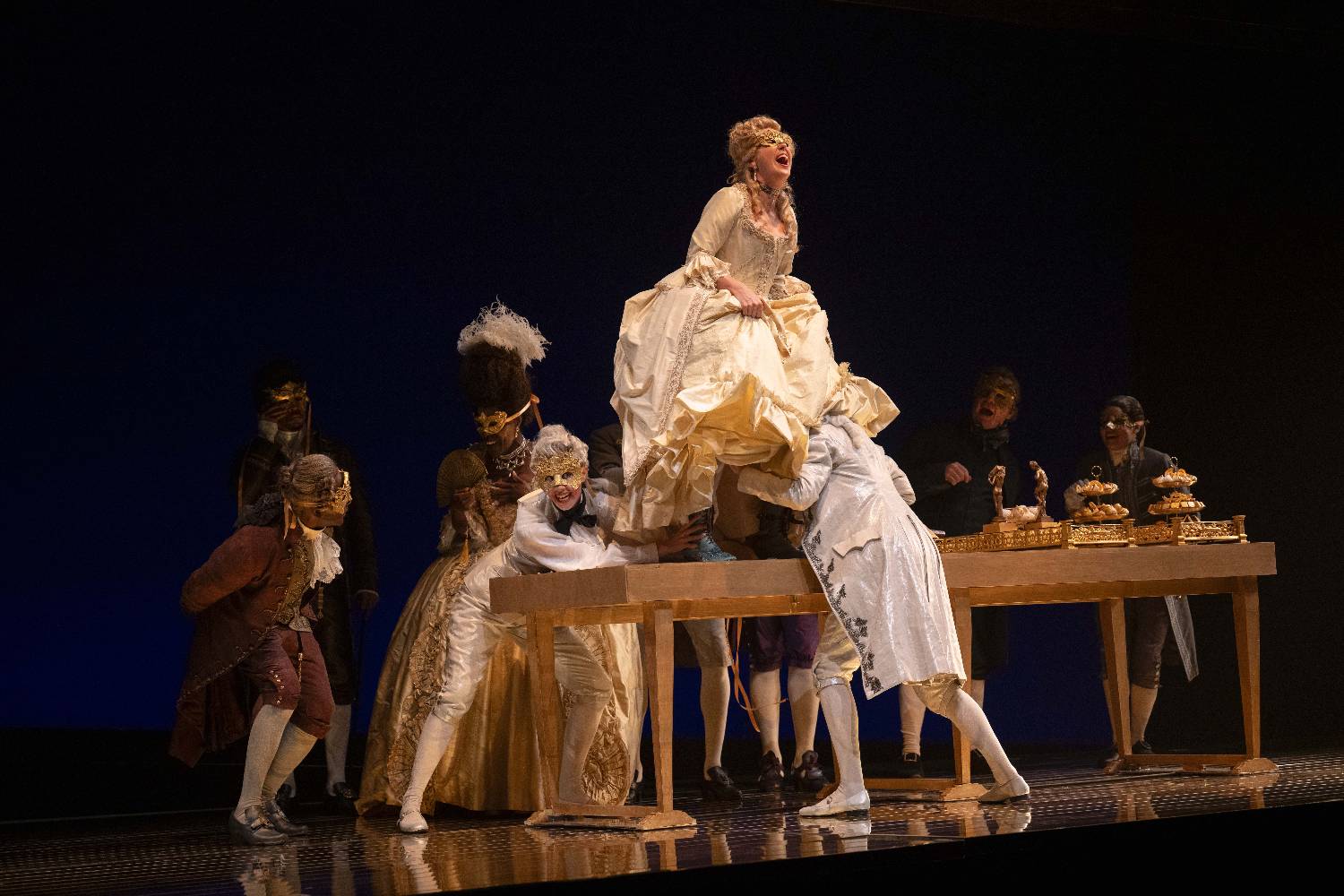
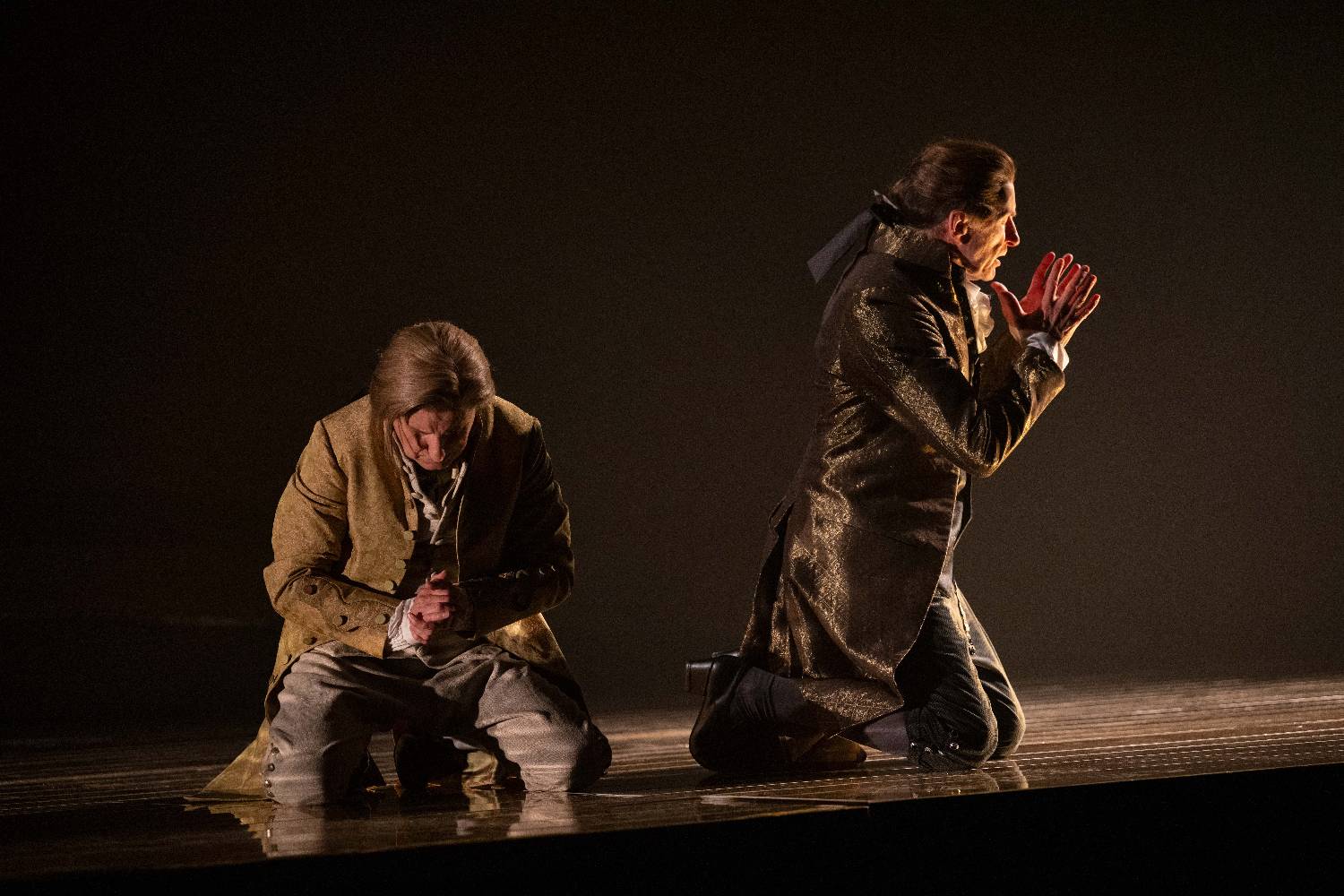
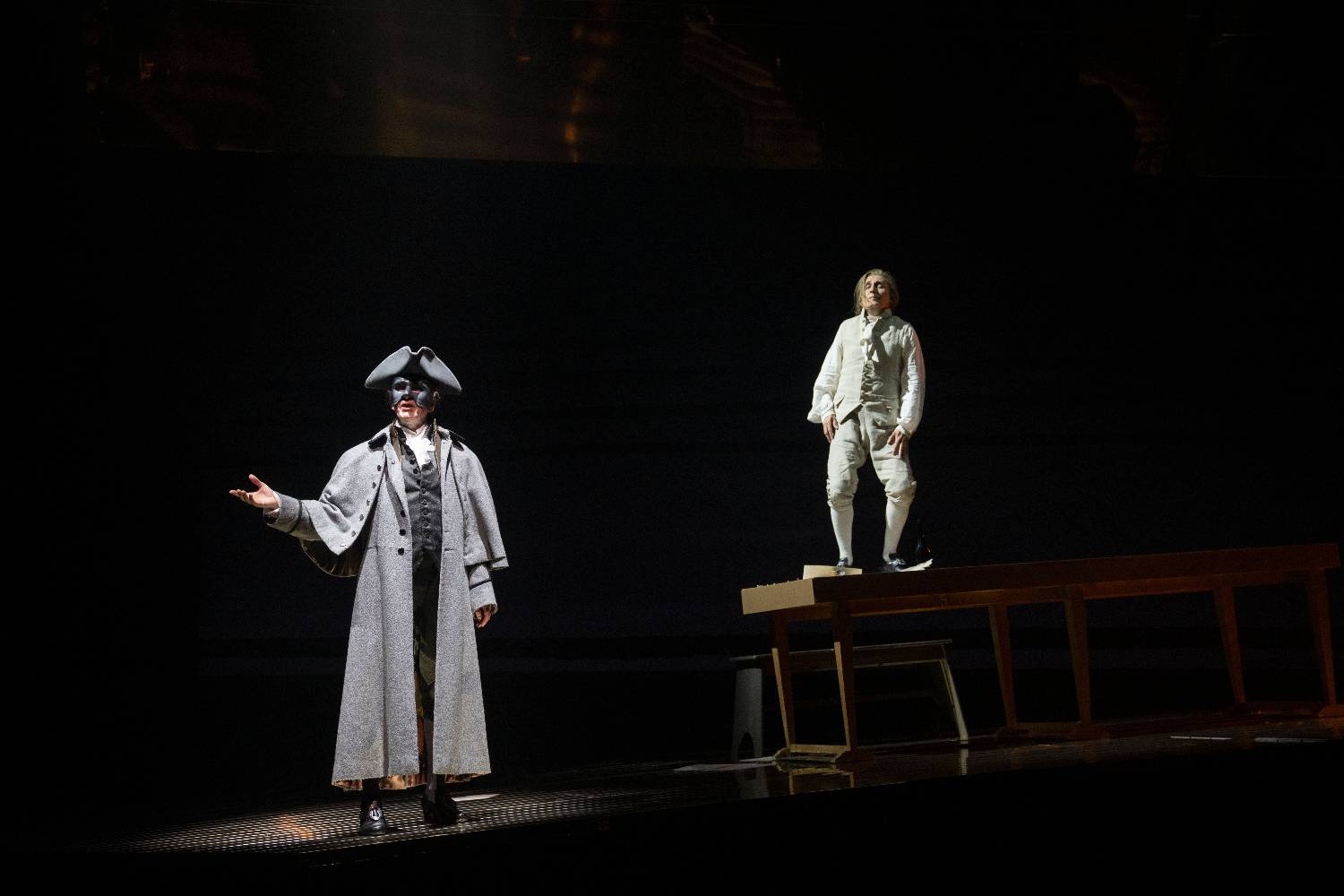
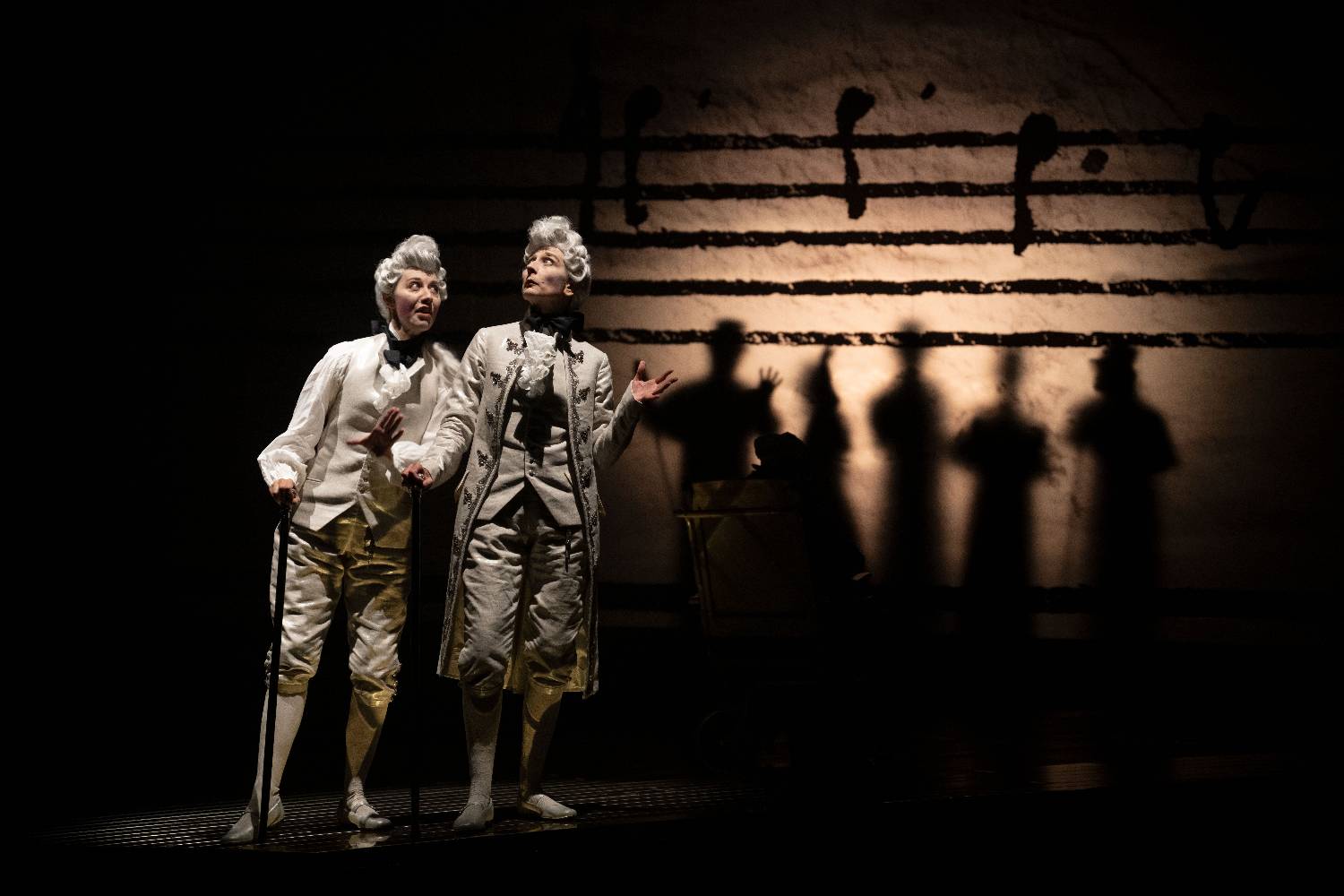
As if taking cues from Mozart's music, Carroll's production echoes two striking elements: a naturalistic parody of humour and pain held in pitch-perfect balance, plus a strong visual dominance achieved through the chiaroscuro effect. The monochromatic stage—featuring a backdrop of musical staff paper and a tilted, diagonal floor designed by Judith Bowden—is quietly broody. This setup trains a sharp spotlight on the action, heightened by Kevin Lamotte's simple yet effective shadowplay lighting design. In contrast, Bowden's exquisitely detailed costumes pop with rich colour saturations—even when working principally within a palette of white and brown—adding a visual evocation of the joie de vivre of court life to the production. Carroll's directorial lens leans into the multi-layering of emotions, emphasising the harmony between absurdity and dramatic gravity rather than relying on typical theatrical histrionics. This is most apparent in his stage direction of Salieri, who avoids a sweeping, Faustian transformation when transitioning between the final night of his life and the youthful version of himself during the play's extensive flashbacks.
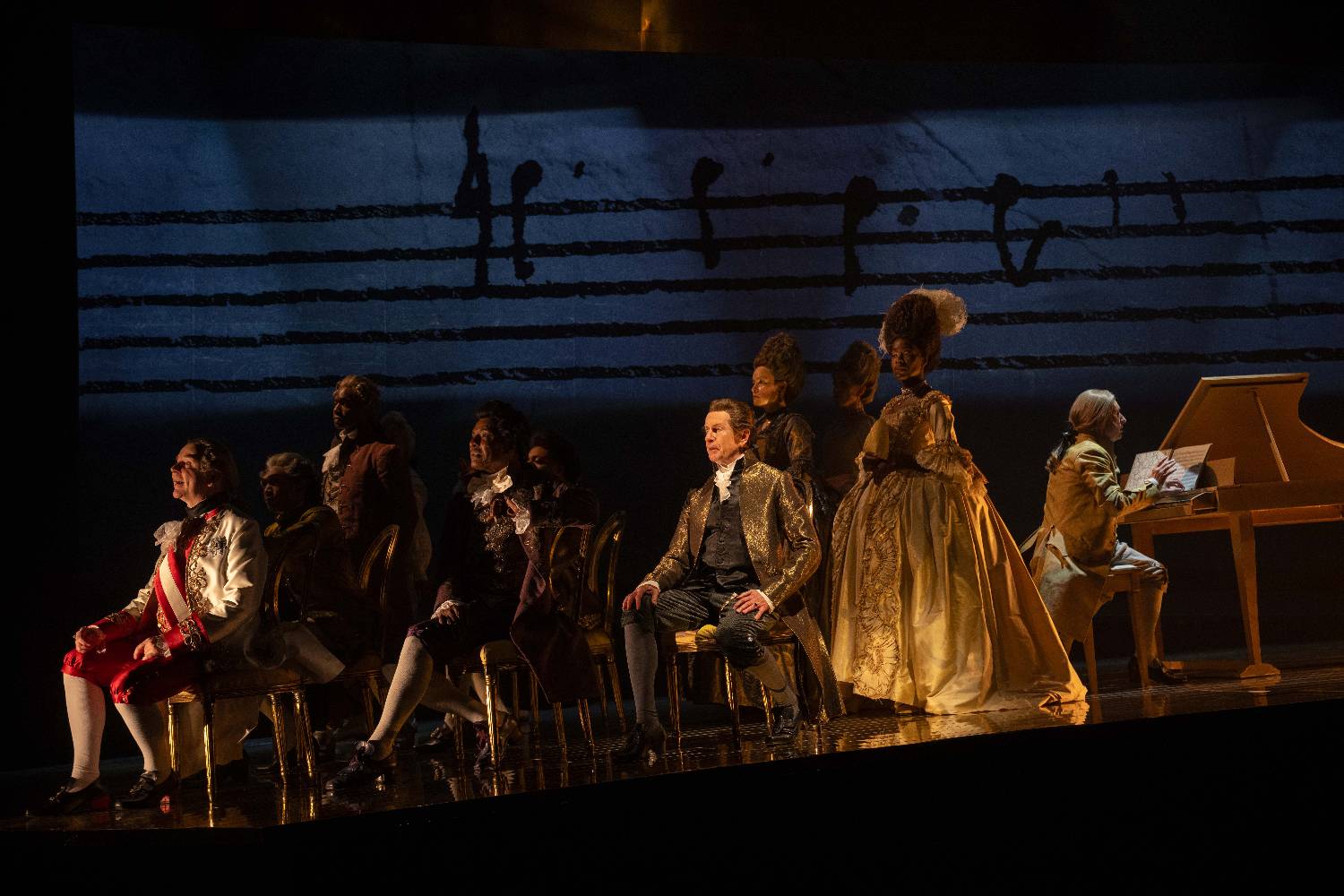
The brilliantly cast Venticelli, executed with wonderful poise and sharp dramatic timing by Julia Course and Sochi Fried, establishes the production's psychological insight from the very start. Appearing almost twin-like, their ability to amplify the power of rumour carries an underplayed sense of irony, while simultaneously projecting the structural weight of a two-person Greek chorus or a universal 'everyman.' Adding humorous royal grandeur to the mix is veteran ensemble member Graeme Somerville, who perfectly channels Emperor Joseph II, while Kristi Frank conveys a spirited, boldly modern Constanze.
As the young Mozart, seasoned actor Michael Therriault might not always look the part of a boy wonder, but his mastery of the craft is undeniable. He delivers a true 'jackass' Mozart—contradictory in his crude immaturity and fierce conviction in his own divine gift. While the portrayal occasionally borders on caricature, Therriault infuses it with a raw naivety that makes his scenes with Salieri both believable and deeply touching. Opposite him, Tom Rooney offers a profoundly complex Salieri. While his verbal delivery lacked a bit of crisp eloquence—at least on the night I attended—the sheer emotion and sincerity underlying his performance set him apart. Every creative soul and arts lover knows the precise feeling of coming face-to-face with undeniable genius—be it a sublime operatic voice, an actor who shakes you to the core, or a dancer who captures what words cannot. As you watch Rooney’s Salieri first encounter a Mozart composition or describe The Marriage of Figaro, you cannot help but feel transported to 18th-century Vienna, experiencing the music as if you were hearing Mozart for the very first time yourself.
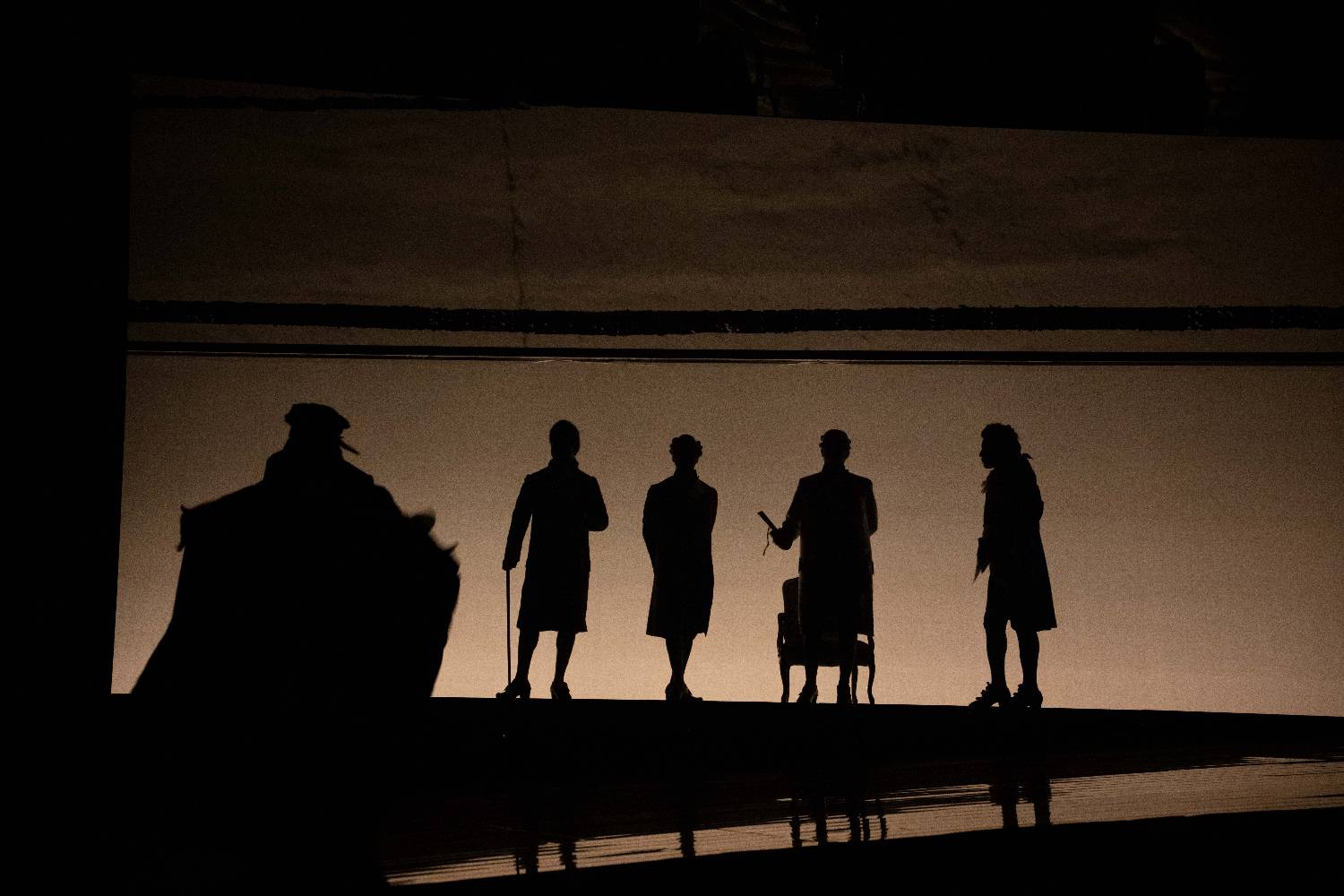
Anyone who witnessed Michael Longhurst's epic revival of Amadeus at London's National Theatre—complete with the Southbank Sinfonia live onstage—might believe they have seen the definitive production. To satisfy Peter Shaffer’s demand for "total theatre," Longhurst's version remains largely unrivalled. Yet, what Tim Carroll and his brilliant ensemble achieve at the Shaw Festival is no small feat. While structurally understated by comparison, this production powerfully amplifies the resonance of Salieri's closing monologue on the absolution of mediocrity. It could not be more timely. We are living through an era where embracing the mediocre is often treated as a social equaliser—a misguided remedy for life's inherent unfairness. As content creators and true artists are lumped into the same cultural brackets, and as we navigate the rise of fast-art driven by artificial intelligence, the hollowed-out language we increasingly absorb jeopardises our appreciation for complex masterpieces. Ultimately, Salieri surrenders to the tragic truth of his own mediocrity, realising his talent could never match the sublime heights of Mozart's genius. Yet Shaffer's tale serves as a powerful reminder of how glorious it is to bathe in the brilliance of others, urging us to aspire to something greater. Even if we cannot achieve that greatness ourselves, we can choose the art of everyday patronage—a concept well-known in the theatre, but one desperately needed in daily life.
production photos ©David Cooper
🔎Explore the production history of Amadeus by Peter Shaffer here.
