
Bonjoo, the leader of the theater company Survivor Project and one of the most fearless voices in contemporary Korean theater since winning the New Director Award at the 61st Dong-A Theater Awards in 2024, returns to the stage at Doosan Art Center's Space111 with a new play, again, again (갱更). In her previous work, Documentary of a Failed Collaboration: Can Survivor Project Survive?, she refused to conceal the brutal failures and conflicts of the creative process, instead confronting them head-on onstage, and this time, she draws on an intensely autobiographical experience of physical loss—being diagnosed with "early menopause" at the young age of 39—as the narrative starting point.
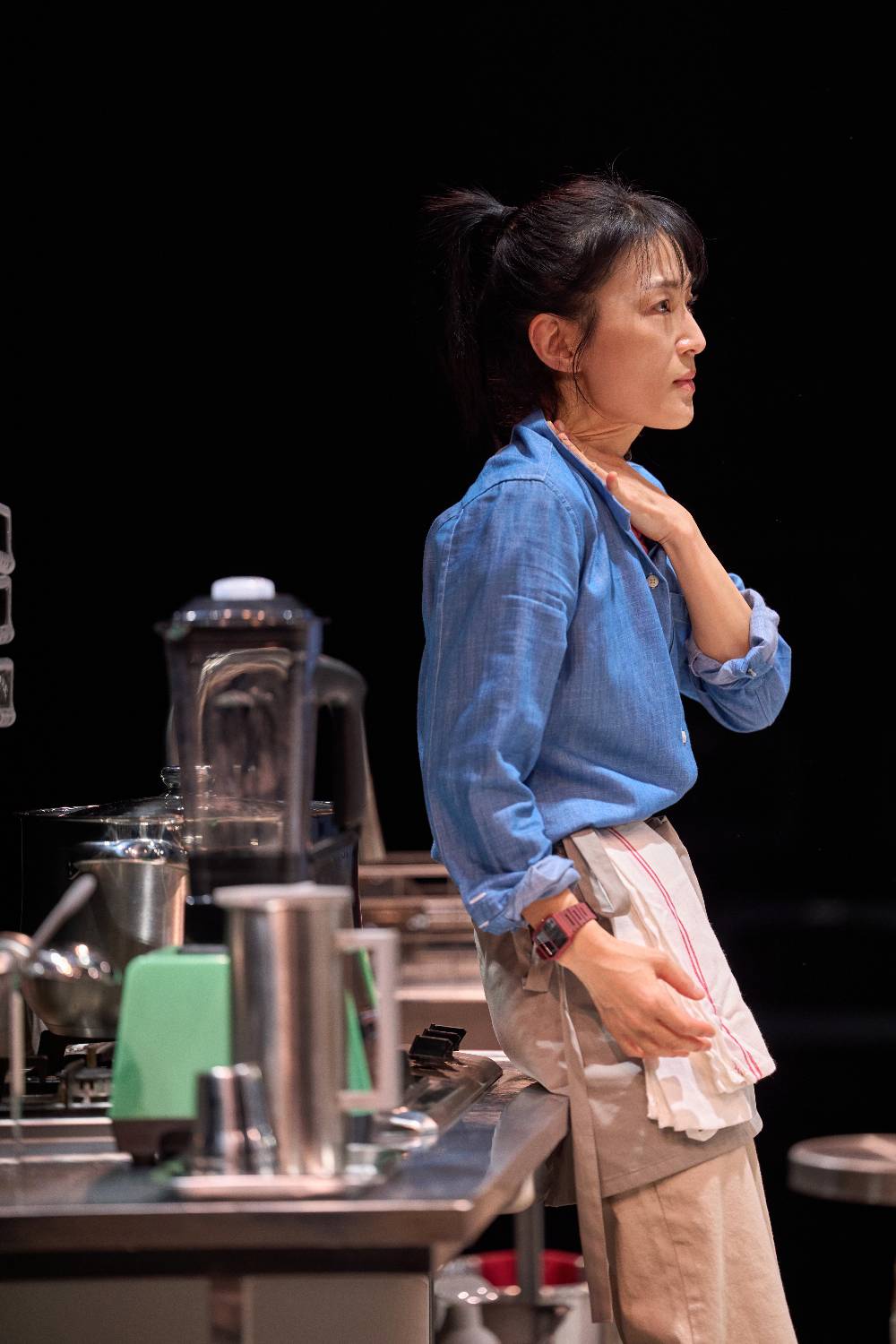
Titled with the Chinese character 更, which carries the dual meaning of "to mend" and "again," the play is set in a small, financially struggling youth-run lunchbox kitchen. What looks like an ordinary, everyday workplace is in fact, from the industrialization generation to baby boomers and millennials, and all the way to Gen Z, a fierce and solemn battleground where six characters spanning different eras of history converge in a cramped kitchen to fight for survival. The protagonist, a nutritionist named Pi-yeong, is diagnosed with early menopause and struggles with both physical change and emotional instability, while the kitchen she runs teeters on the edge of collapse under unpaid wages and financial strain. Amid the sound of knives, gas flames, and the smell of boiling oil, the deprivation and loss carried by each generation's characters collide head-on.
Playwright-director Bonjoo renders, through a sensory stage infused with occult elements, how capitalist society consumes and depletes individual bodies—and how we are meant to "digest" and carry on living with the scars of others and the weight of the times we've passed through.
How Moral Can We Afford to Be, in the Face of Capitalism?
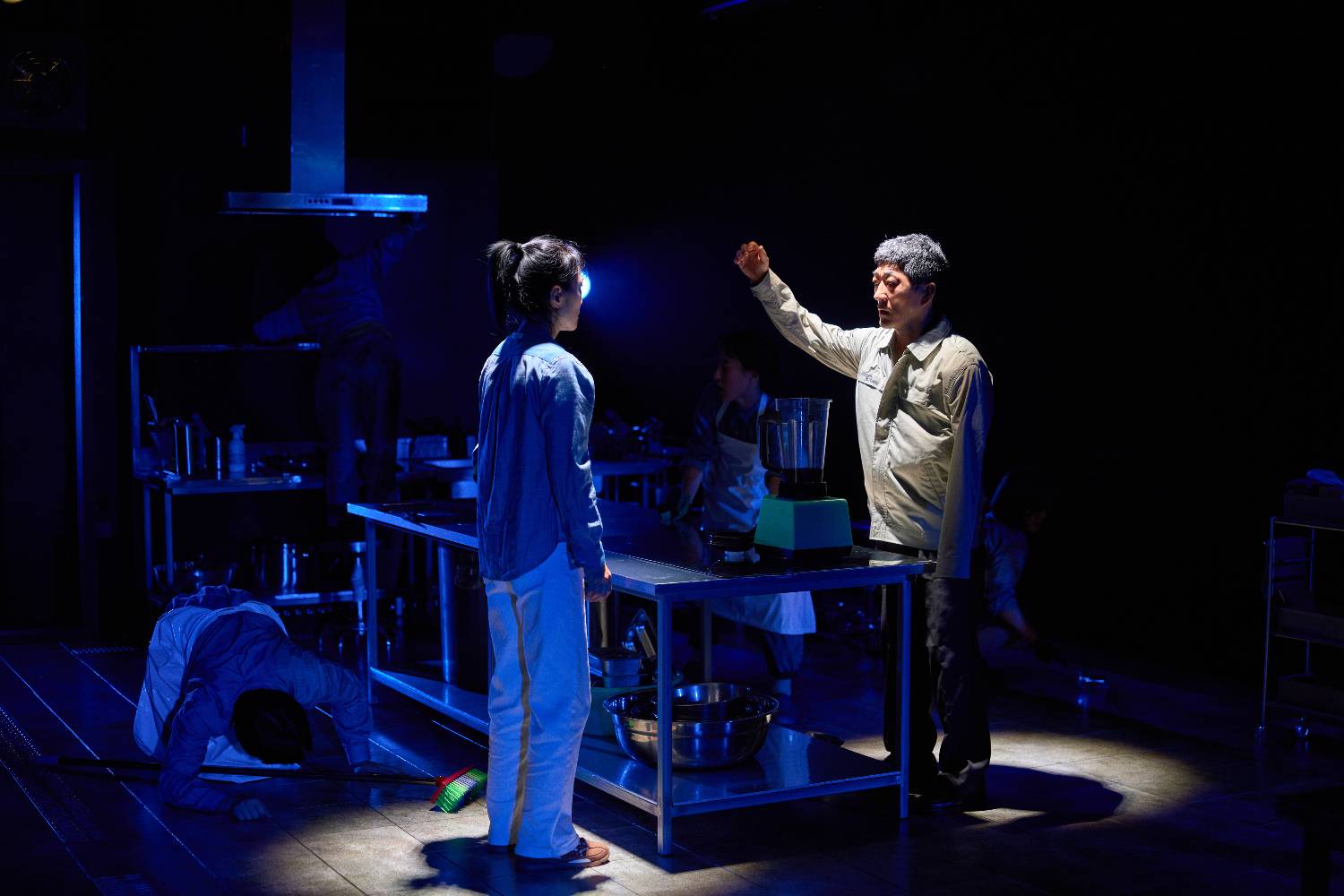
The dramatic rupture in again, again reaches its peak when Cheon-tae, an 80-year-old grandfather who abandoned his family decades ago, arrives at the kitchen carrying a bankbook holding 130 million won—workers' compensation he received after losing an arm while working at a slaughterhouse. This crimson bankbook, obtained at the cost of a lost limb, becomes the decisive symbol that puts the desires and morality of everyone in the kitchen to the test. For Cheon-tae, burdened by guilt over abandoning his family and left with nothing but an aged, ailing body, that 130 million won is his only remaining absolution and source of power to reclaim some standing before his child and grandchild.
"Clothing, feeding, and raising your children—it's all money. Without money, you can't even be a parent, you'll starve,"
Cheon-tae declares as he throws the bankbook down, embodying the brutal reality in which capital comes to stand in for humanity and the qualification to be a parent.
Faced with choices shaped by capital, how moral can a person truly remain?
In a world where money proves one's worth as a "good parent" or a "good person,"
where do we draw the line between being wealthy—"doing well"—and living rightly while preserving our humanity?
Is that line clear, or is it hopelessly blurred?
Today's society often quietly measures a person's worth and character by their wealth. A well-off parent is deemed a "good parent," and someone with financial comfort is framed as "generous and kind," while poverty is dismissed as personal incompetence or a moral failing. The 130 million won Cheon-tae brings is not a bridge toward reconciliation between generations, it is a mirror reflecting the bleak portrait of a capitalist society in which no human relationship or sense of responsibility can hold together without money.
"If You Mind Your Dignity, You'll Starve"
The characters' attitudes toward Cheon-tae's compensation money reveal the fractures between survival and human dignity. Pi-yeong's mother, Geum-ok, seizes the money her father brings after decades of absence, declaring flatly, "If you mind your dignity, you'll starve.” Pi-yeong, cornered by debt and on the verge of losing the kitchen, cannot bring herself to outright refuse the money either, even as old wounds and anger toward her parents churn beneath the surface, plunging her into raw anguish. In a world where one must set aside dignity simply to avoid starving, the humanity of preserving social decorum and self-respect grinds constantly against the instinct to survive by any means necessary.
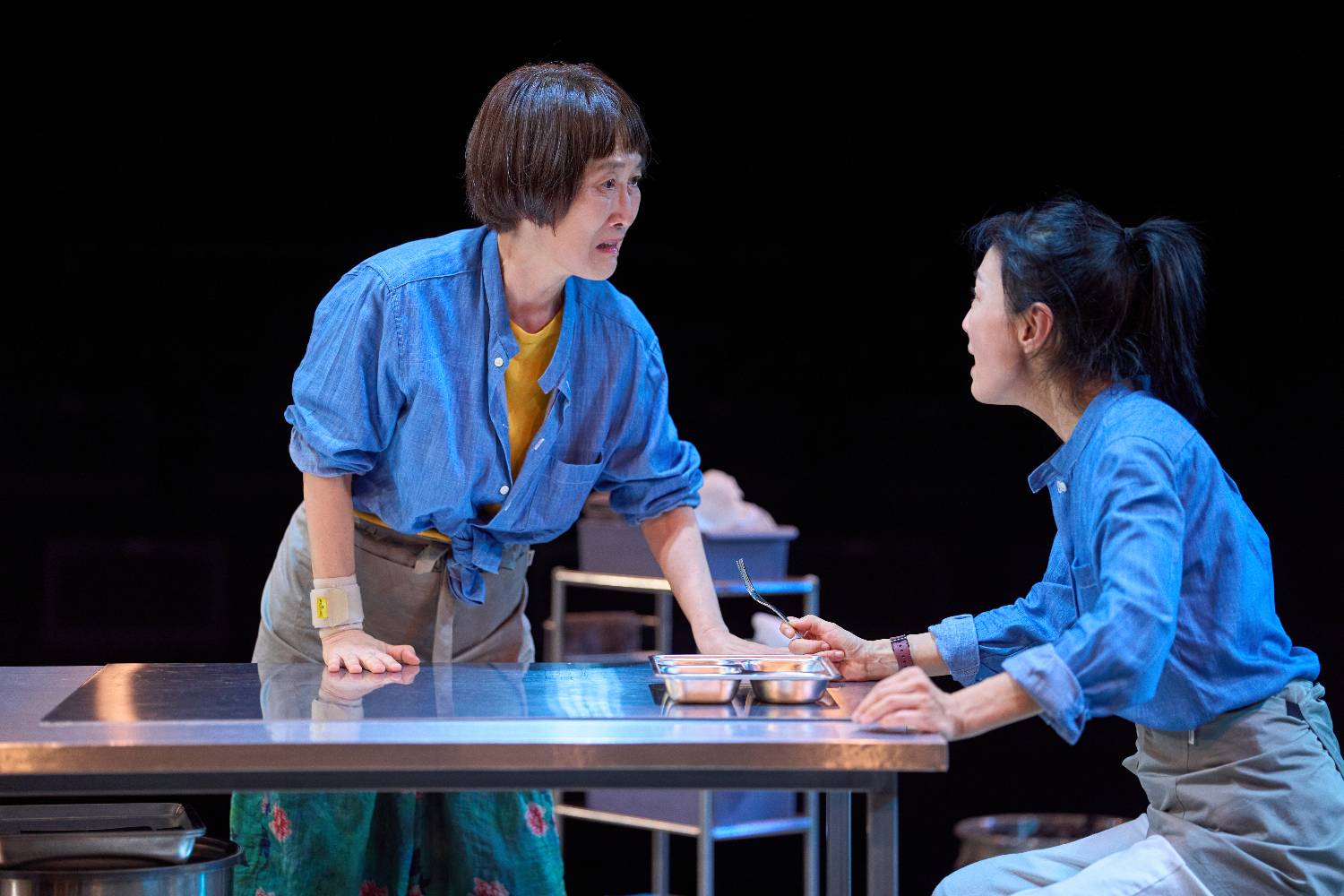
The younger workers—Bari and Doro-si, representing the MZ and Gen Z generations—move between temporary contracts, part-time work, and unemployment benefits, asking only for a minimum of dignity and fair compensation, but to the older generation's eyes, this reads as mere "entitled complaining" or "shameless whining." The industrialization and baby boomer generations, in turn, have long taken it for granted that survival requires discarding both pride and dignity. Bari's line—"Being helped can make me feel like shit"—carries real weight. The "help" or money that the older generation offers, often out of a sense of obligation, can become, for the younger generation, a form of violence that tramples their dignity. Between a life that demands discarding dignity to avoid starvation and a reality that pushes those who try to preserve their self-respect toward the cliff edge of survival, again, again refuses to take either side. Instead, it looks squarely at the cruel dilemma of a battlefield for survival where, within capitalism's vast machinery, trying to help one another only ends up causing wounds and driving people further apart.
Erased Scars, Consumed Bodies
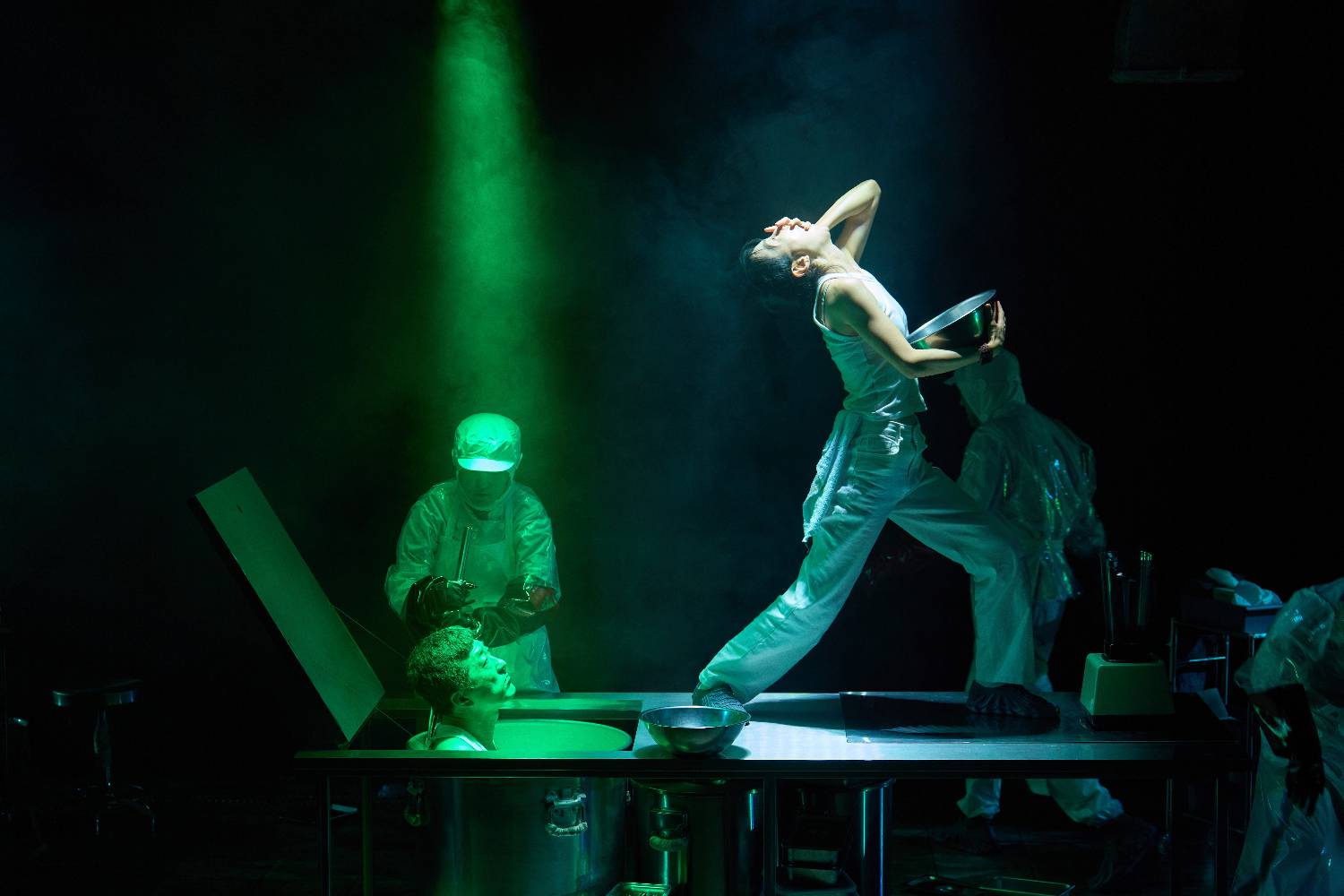
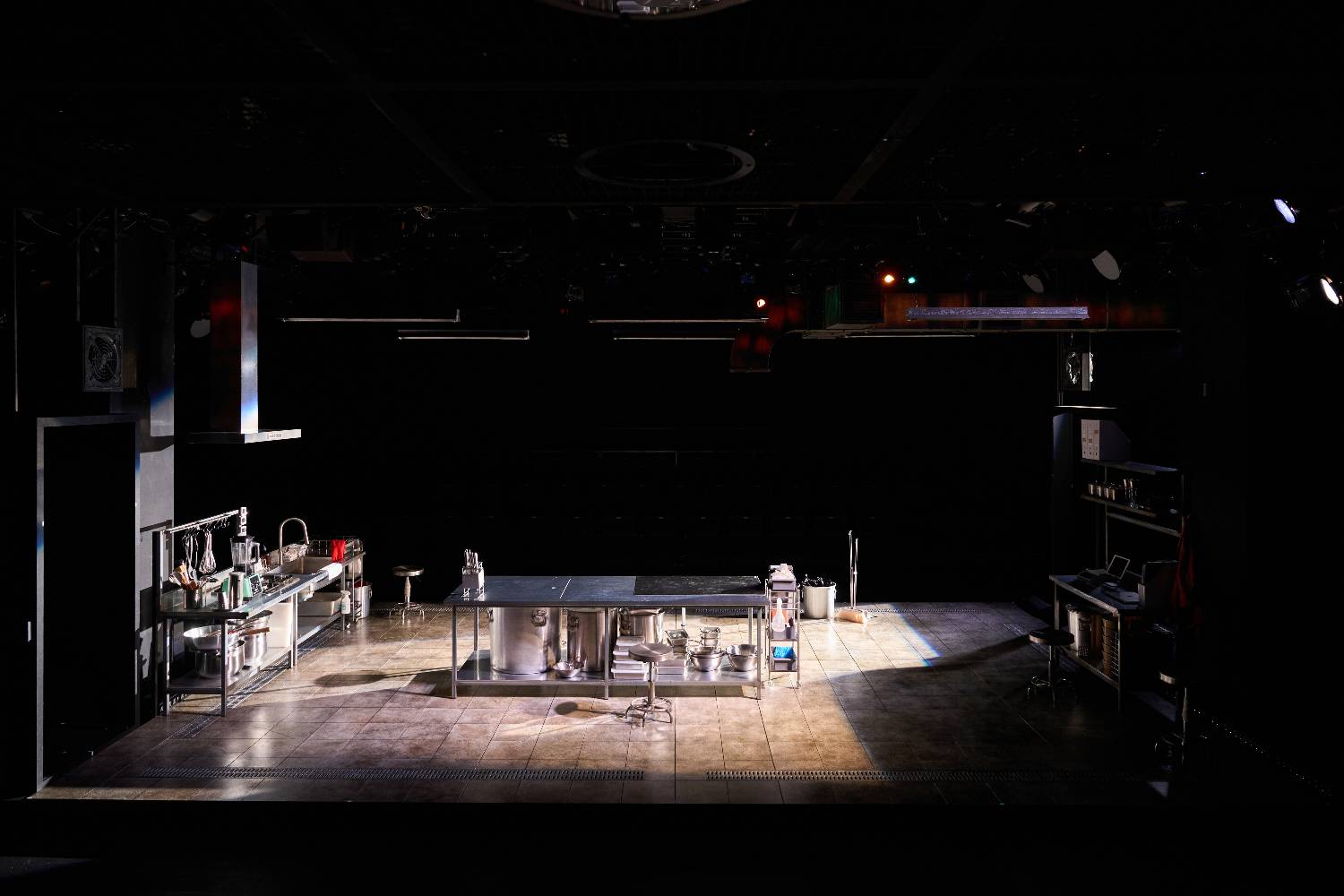
Again, again does not let this social message remain confined to abstract dialogue—it renders it visible through the play's visual, auditory, and costume design. The massive stainless steel kitchen counter dominating center stage is both a product of the steel industry that made Korea's compressed economic growth possible and a mundane, everyday fixture. And yet stainless steel has a property: no matter how much blood or grease stains it, a single wipe of a rag leaves it smooth and spotless again. This becomes a metaphor for how modern society erases the sweat, blood, and scars of industrial injury borne by laborers like 80-year-old Cheon-tae, who gave his body to an era—turning away from the bodies it has used up and consumed. Perhaps most distinctive is the choice to conceal the actual food ingredients—meat and vegetables—entirely through invisible mime. The stainless counter, which will never rot away, is rendered vividly visible, while the food and human flesh that will inevitably decay are left unseen. Layered onto this, the actors wear white kitchen uniforms overlaid with transparent plastic sheeting, evoking the unsettling image of "meat wrapped in plastic at a supermarket's fresh food counter"—a moment of visceral shock. It lays bare, with striking immediacy, how the laborers who once processed food are themselves commodified, processed, and consumed within the system of capital.
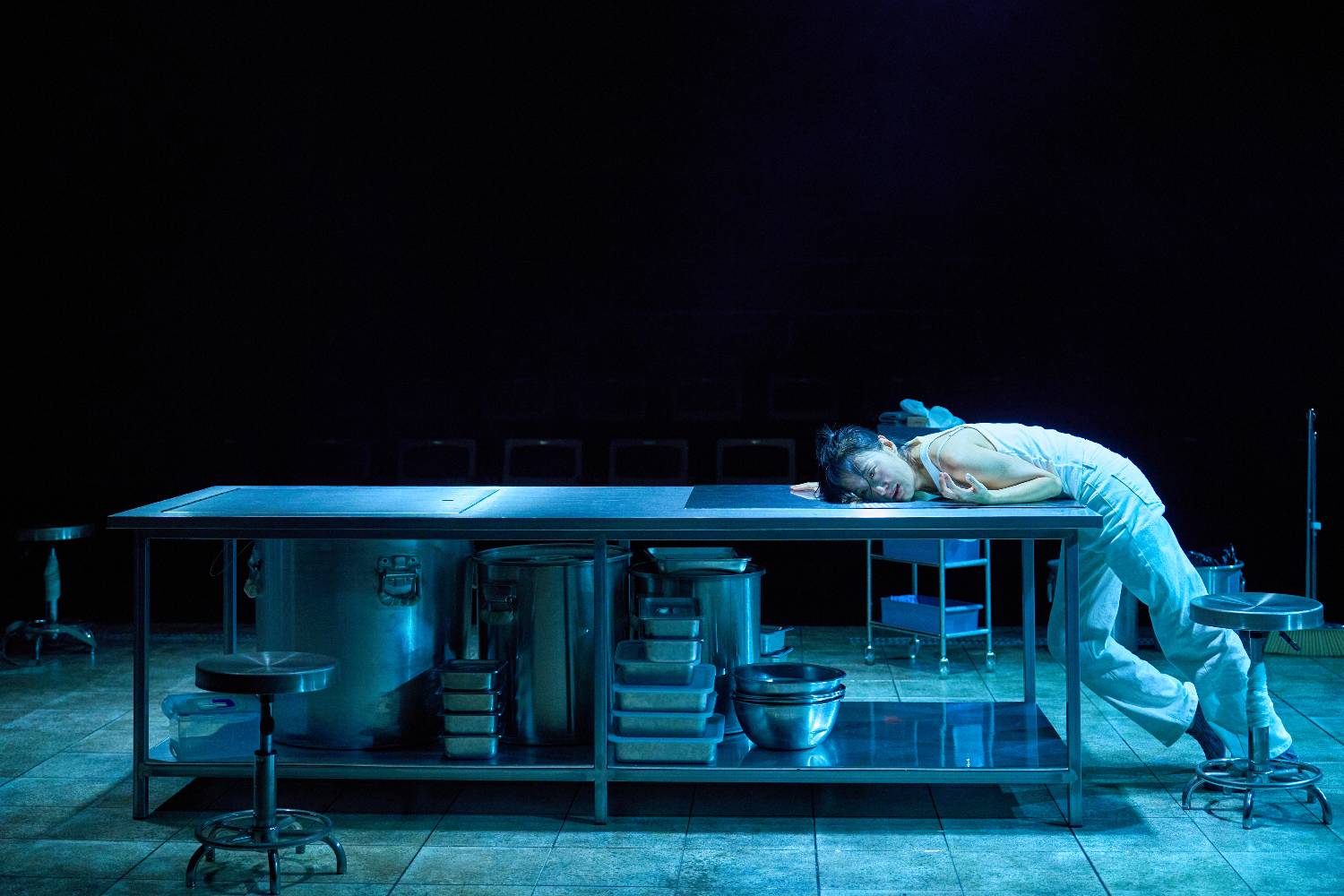
Further still, the kitchen's ordinary ambient sounds are transformed into occult-inflected soundscapes. The industrial ventilation fan in the background swells into the ragged breathing of Pi-yeong as she endures menopause, while the whirring of a blender morphs into the sound of a band saw from Cheon-tae's memories of the slaughterhouse, unsettling the audience at a visceral level. The "dual-facing" seating arrangement, with audiences seated on either side of the stage, also, as one section of the audience sees an actor's face, makes the other side see only their back, physically enacting the play's core idea that "we can only ever see one side of another person."
The Courage to "Accept" an Ugly Fragment
Amid the harsh conditions of labor and the painful inheritance left by her parents' generation, Pi-yeong repeatedly retches. This nausea is more than a simple physical symptom of menopause, as Cheon-tae puts it, "a pig will keep gnawing at its own sick firstborn, taking it in as nourishment,” it is the body's refusal to digest the wounds of preceding generations, the weight of money, and the brutal conditions of survival. But in the play's latter half comes a moment when Pi-yeong stops her obsessive wiping of the counter and resolves, at last, to swallow her nausea. Here, "swallowing" is not surrender or resignation to reality.
It is a decision to no longer turn away or flee from the shabbiness of the era she belongs to, the shameful stains left by the generation before her, and even her own decaying, ugly fragments—but instead to take them into her own body and take responsibility for them. In an interview, playwright-director Bonjoo said, "I used to think a righteous, virtuous person was what it meant to be an adult, but through this work, I came to realize that true adulthood means swallowing what is shameful and ugly, accepting it and taking responsibility even as it makes you ugly too.” The measure of adulthood she arrives at is not found in upholding "righteousness." It lies, instead, in swallowing and embracing what is shameful and ugly. We often wear a hypocritical mask of morality to conceal our own self-interest, but the courage to honestly acknowledge the irrationality and mistakes within ourselves is what truly qualifies as maturity. Only when we accept our own faults can we, in turn, embrace the wounds and corruption of others without hypocrisy.
When We Face the Uneven Track of Our Lives, Another "Again, Again" Begins
Again, again offers the audience no easy answers or moral certainties. Even in the dual-facing seating, audiences witness only an imperfect fragment of another person, coming to realize that they themselves are never truly free from the chains of capital and generation. And yet the point the play ultimately arrives at is, unexpectedly, one of tender acceptance and comfort. Bonjoo insists that we must embrace our imperfect, shameful lives exactly as they are, without hastily dressing them up or looking away. "Even if the trajectory of our lives doesn't unfold as expected, and even if the fragments we come to face aren't particularly beautiful, it's truly all right," she says. The reason we must confront the uneven trajectory of our lives head-on is clear. The more we deceive and hide ourselves to fit the illusion of perfection the world demands, the more we end up fleeing—unable to bear not only our own wounds, but the shabbiness and pain of others as well. When we find the courage to accept the rough, ugly fragments of our lives exactly as they are, we become able to reach out to the limits and sorrows of others without hypocrisy, and to gain the "responsibility of a true adult"—one who does not avoid a nauseating reality, but swallows it whole.
To all of us who live out each day grinding down our own bodies, the play seems to say the following. Even if our lives are shabby and ugly, even if they fall short of the smooth, perfect standards the world demands, facing that rough, wounded trajectory without flinching is itself proof that we are alive—the most sublime form of survival there is. And it is only when we embrace that shameful fragment and take full responsibility for it that our life's true “again, again" begins.
production photos ⓒDoosan Art Center
