

If there is even one person in this world who truly understands you, can that person really be a bad person?
Where does the human will toward goodness come from?
The play <The Lives of Others> begins with this question. Based on the German film of the same name, the work is set in East Germany — a place where surveillance and censorship were part of everyday life — and traces the journey of a secret police officer who comes to understand the lives of others. It was a production I had desperately wanted to see since its premiere in 2024, but one thing after another got in the way, and I finally got to see it in 2026.
Wiesler is one of East Germany's finest Stasi agents. Armed with exceptional interrogation skills and an unshakeable political conviction, he will use any means necessary to carry out the missions the state assigns him. Surveillance is his daily routine and his duty; the lives of others are simply information to be recorded.
Georg Dreyman, by contrast, is a playwright celebrated on both sides of the German border. He does not openly criticize the regime, but neither does he fully submit to it. After his closest friend and director, Albert Jerska, is banned from working, Dreyman finds himself at a crossroads, constantly wrestling with what he must do as an artist. His lover, Christa-Maria Sieland, is equally torn — caught between her life as an actress and the reality she inhabits. Knowing better than anyone that taking the stage means yielding to power, she is forced to choose between her life as a performer and her dignity as a human being.
On orders from the state, Wiesler begins wiretapping their home. But what he hears is not a conspiracy threatening the nation — it is the lives of people who love, who make art, and who worry about each other.Ironically, the wiretap installed to spy on others on behalf of the state ends up placing Wiesler in the closest possible proximity to art and to human life.

This review contains spoilers for the play <The Lives of Others>.
This review is based on a performance attended on July 30, 2026.
The first thing the watcher heard was a poem.
Throughout the work, traces ofBertolt Brechtare woven in. He appears not simply because he is a canonical East German playwright, but because Brecht was a writer who insisted that art must never turn away from reality — one who never stopped asking what people living through their era should see and how they should act. His poetry, therefore, functions in this work not as a decorative prop but as the first door through which Wiesler enters the lives of others.
At Dreyman's birthday party, while everyone laughs and talks and celebrates, Albert Jerska stands apart from the crowd and opens a yellow volume of poetry on his own. The book he is reading is a collection of Brecht's poems, and the piece he recites is"Es war einmal ein Adler" ("There Was Once an Eagle").
The work offers no tidy explanation of the poem — and that, if anything, made the moment more striking. It was enough simply to see that the one thing an artist stripped of his profession, no longer permitted to direct, refuses to let go of is a volume of Brecht. Rather than speaking his despair aloud, Jerska reads. In that image, we see what an artist fights to preserve until the very end. For Brecht, poetry was not mere literature but a way of inhabiting one's time; for Jerska, it was the art he refused to surrender even at the last.
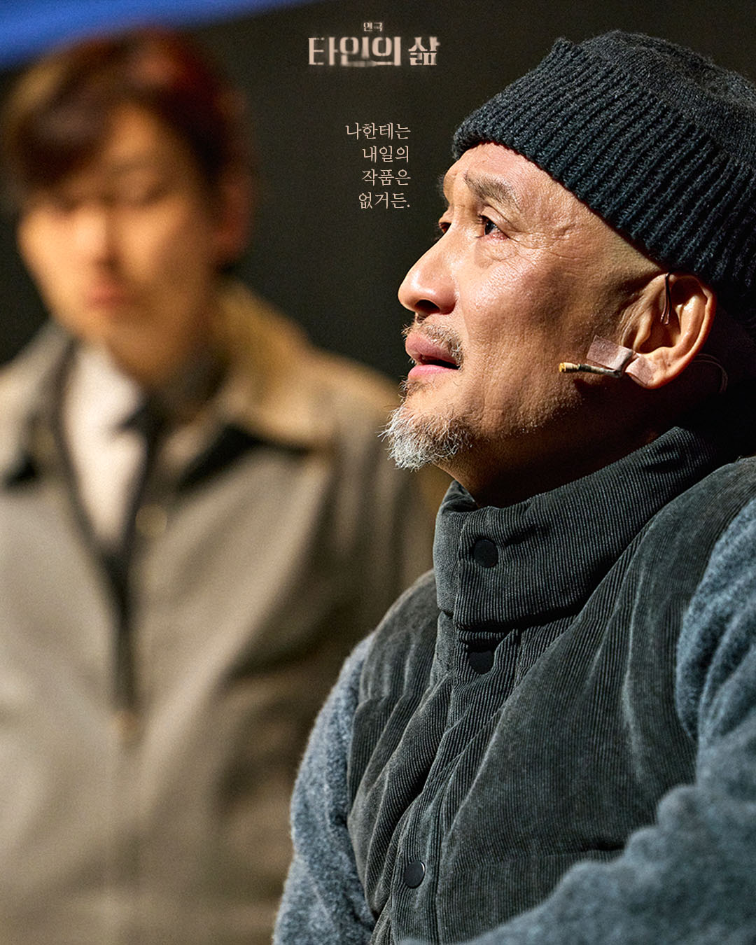
For me, this was the moment Wiesler's transformation began. He was listening through the wiretap to the conversation between Dreyman and Jerska, but the first thing he heard was not a plot against the state — it was one artist's despair and conviction. The watcher had leaned in to write a report, yet what he found himself understanding first, ironically, was the life of another person.
That is why Jerska's death cannot remain, for Wiesler, a tragedy that belongs to someone else. He cannot simply move past it; he holds on, reads Jerska's yellow volume of Brecht, and gradually absorbs the feelings of those he was assigned to surveil. And then he murmurs"Erinnerung an die Marie A." ("Remembering Marie A.")in his own voice. In the moment a poem about the memory of love becomes the language of mourning for an artist, Wiesler — who had written nothing but state language and reports — expresses his own emotion through the language of poetry for the very first time. Brecht in this work is not literary ornamentation; he functions as the most essential medium through which a man who had been furthest from art comes to understand the lives of others.
Music That Crossed the Wall

Wiesler's transformation does not begin with some grand event. It first shows itself in a very small moment. When he picks up a child's football in the street and hands it back, the child looks at him and says:
You're Stasi, aren't you. My dad says Stasi are bad people. But you don't seem like a bad person.
The old Wiesler would have asked without hesitation who the child's father was. That was the Stasi way — the work he had been ordered to do and had carried out more fluently than anyone. But after a long pause, he asks instead, out of nowhere: "What's your football's name?" It is the moment when the change quietly accumulating inside him — through Brecht's poetry, through listening to the lives of Dreyman and Christa — first surfaces as action. He no longer sees people purely as objects of surveillance. Wiesler begins to look at how a person lives before reaching for their name.
Another device that reveals this transformation is the"Sonata for a Good Man"that Dreyman plays.
"Can anyone who has truly listened to this music with their heart really be a bad person?"
This line rang out like a question that runs through the entire work. It was addressed to Dreyman, yet the person listening to that music most desperately was Wiesler, on the other side of the wall. Having lived a life more distant from literature and art than almost anyone, he hears poetry, music, and theatre through a wiretap. The headphones installed to surveil another person gradually become a channel through which he comes to understand a human life. The pure passion for art crosses the wall and reaches Wiesler, and he is no longer a watcher executing a mission — he becomes someone who hopes that these people's lives will not be destroyed.
Art does not overturn his ideology in a single blow. Instead, it reawakens his humanity. The reports being written to surveil Dreyman become, at some point, records written to protect him. That record is presented to the audience as a kind of play written by Wiesler in Dreyman's name. The line "Revolution is made through action" is no longer simply a line spoken on stage. It is completed by Wiesler's life — his willingness to accept a sacrifice no one will ever acknowledge, to bear every consequence, and still choose his own conscience.
There is no expectation that what he has done will ever reach Dreyman, no ambition to become a hero. If anything, he knows better than anyone that this choice will cost him most of what he had — his former rank, his power, his life as a Stasi officer. And yet he follows his own conviction over the loyalty the state demands. The work does not portray Wiesler as a grand revolutionary. It simply leaves him as a man who, having come to understand the lives of others, finally chooses his own.
The Moment the Records Fall onto the Stage
The power of theatre as a medium was also considerable. A grey stage and a bare minimum of chairs convey the bleakness of a surveillance society, while the humor scattered throughout the work continually reminds us that this story is about the people living inside that system, not the system itself. What struck me was that rather than focusing on recreating a surveillance state, the production keeps its gaze on the lives and emotions of the people enduring that era.
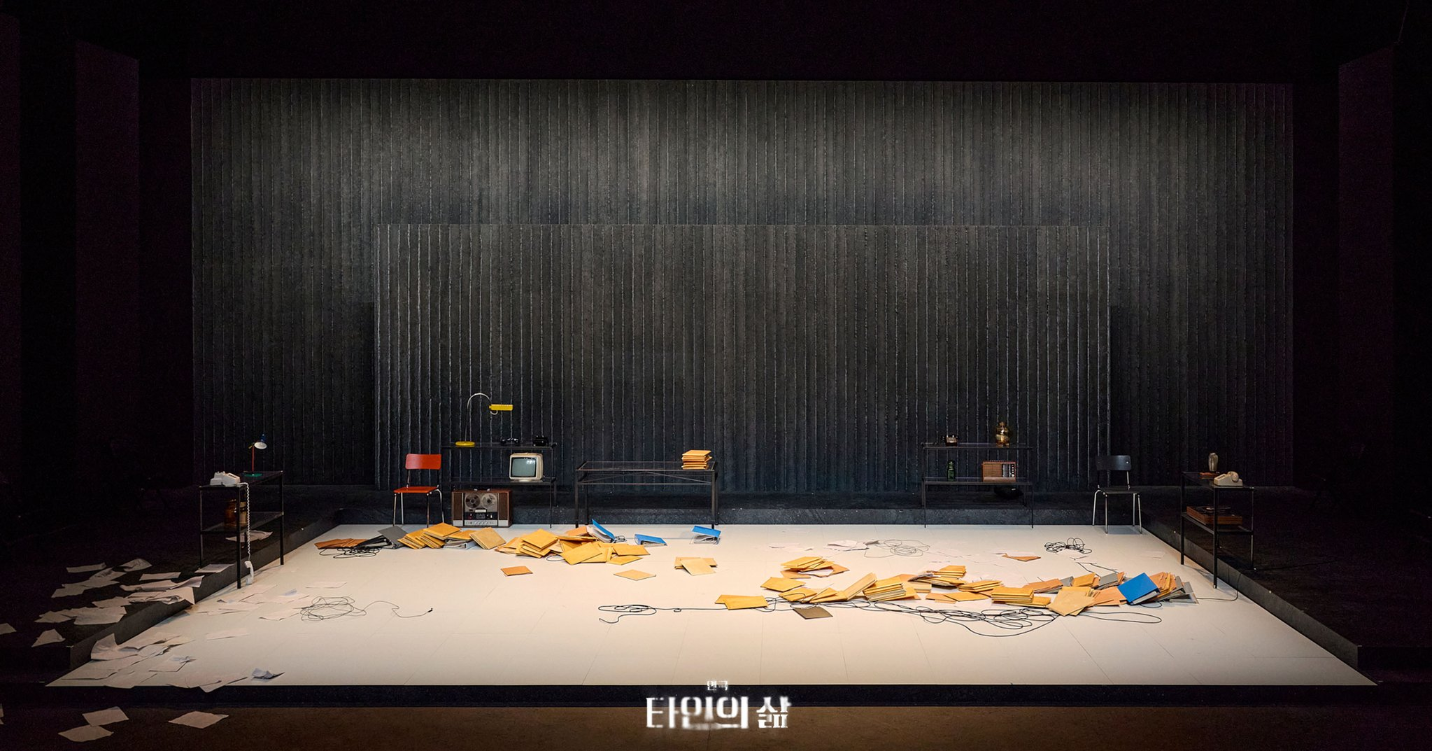
The ending, in particular, was the moment where the power of theatre as a medium came through most clearly. After German reunification, Dreyman discovers that he had long been protected, without his knowledge, by someone identified only by a code number. His life had been surveilled with meticulous, almost nauseating thoroughness. Yet as he reads through the surveillance reports page by page, he comes to realize something else: someone, within that very surveillance, had been quietly watching over him so that he would not have to abandon his art.
This scene is also where the play and the film diverge most sharply. The film follows a character's emotions through the camera; the theatre makes the "record" of surveillance physically present on stage. The moment the telephone line is cut, the countless surveillance reports hanging from the ceiling come pouring down toward Dreyman. The typed words inside the files become paper falling onto the actor's body, and the audience witnesses that weight directly before their eyes. The invisible surveillance finally takes on form, and the records become a landscape on stage.
What struck me most was the meaning carried by those sheets of paper. What began as the state's records — written to control and punish one person — ends as testimony that preserved one person's life and art. Sentences written for surveillance become sentences that allowed someone to survive; the language of power remains as a record proving one human being's conscience. This transformation lands with even greater force thanks to the materiality that theatre as a medium possesses. The countless pages blanketing the stage are not mere props — they lay before our eyes the weight of the conviction Wiesler refused to abandon, and the weight of the time he bore alone.
And then, the final moment.
This book is a gift for me.
A brief line — yet those few words complete the meaning of every record that has covered the stage until now. Dreyman never comes to know Wiesler, and Wiesler lives on with no expectation that his choice will ever be known. And yet each becomes the person who changed the other's life most profoundly. In the performance I attended, actor Yoon Na-mu played this moment with quiet restraint. It was precisely that restraint that made it linger. He accepted a sacrifice no one would ever acknowledge, and may have lost the life he once had in return — but a single book proves that his choice was not in vain.
The play <The Lives of Others> runs at LG Arts Center Seoul U+ Stage through September 13.
