


"That was genuinely fun." It was the first thought that came to mind as I walked out of the theater. What follows is a review of Solitary Gourmets of Gyeongseong, an immersive theater production in which audiences walk, drink, and eat their way into the story.
Run:Saturday, July 25, 2026 – Sunday, August 9, 2026
Venue:Doosan Art Center Space111
Running time:Approximately 180 minutes (including a 15-minute intermission; subject to change depending on on-site conditions)
Age rating:Suitable for ages 13 and above
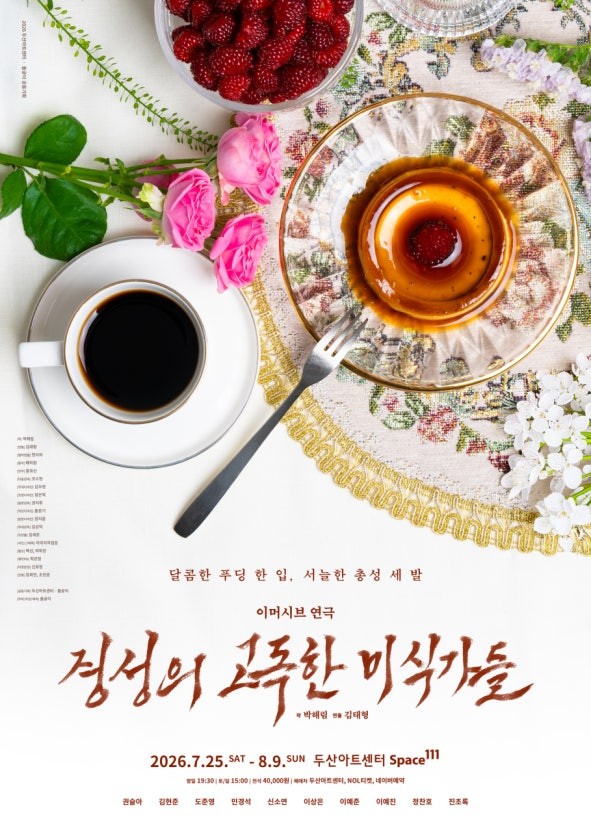
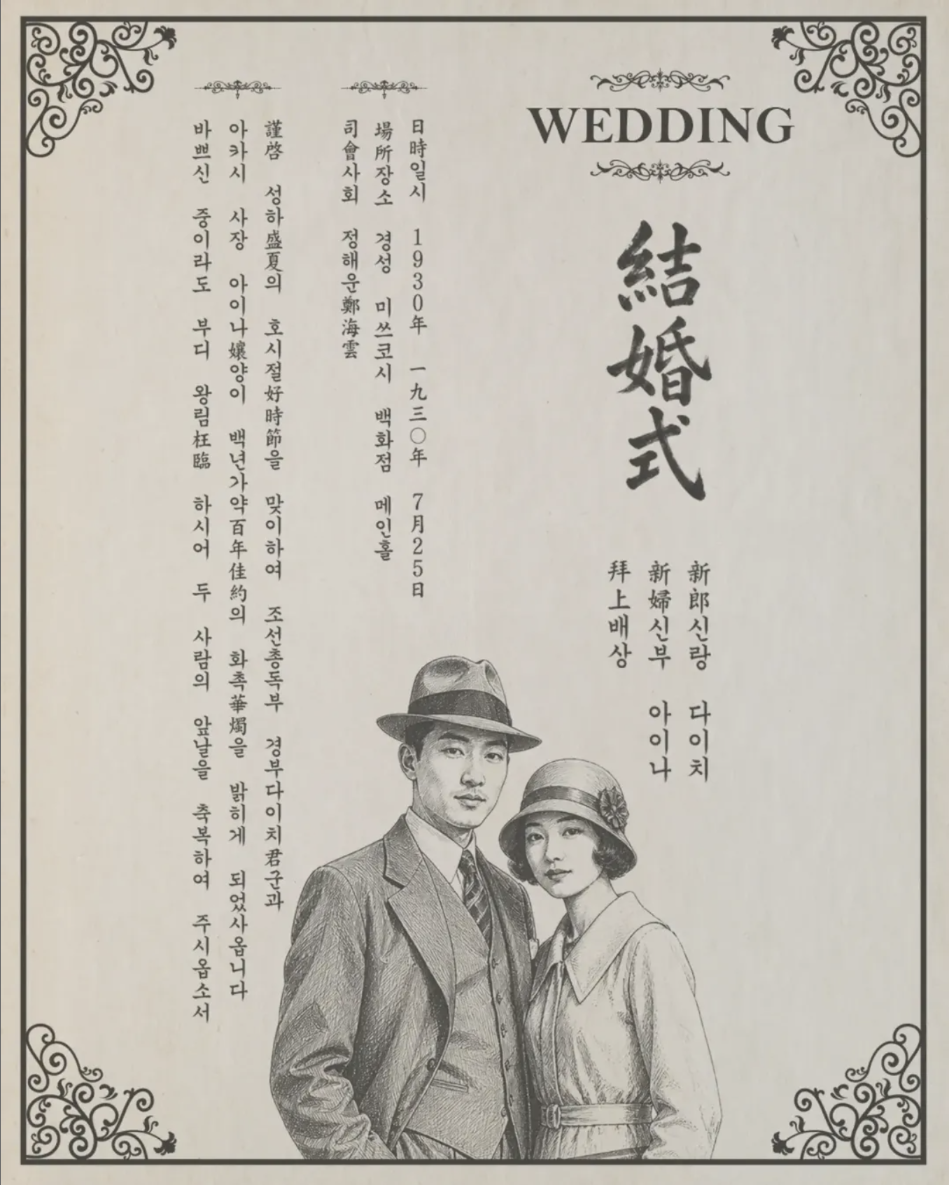
Solitary Gourmets of Gyeongseong is an immersive theater production that reunites director Kim Tae-hyung — who previously showcased experimental spatial staging with Geumranbang — and playwright Park Hae-rim. The show is co-produced by Doosan Art Center and Dolgoji. Set in 1930s Gyeongseong, the story begins with a gunshot that rings out in the middle of a lavish wedding ceremony, where the audience is seated as guests. Who pulled the trigger? Following the perspective of Jeong Hae-un, a modern boy who has just returned from studying in Tokyo, audiences move between various characters and spaces, gradually inching toward a truth hidden among sweet desserts, bitter coffee, makgeolli, and small bites.
Not a story you choose — a story that chooses you
This was my first time participating in an immersive production with so many branching storylines, and what struck me most in practice was that the choices were never entirely mine to make. At some forks in the path, an actor would seek out audience members to accompany them, which meant I could head in the direction I wanted. But at other moments, an actor would single out a specific audience member, or simply guide whoever happened to be nearby — making it, in effect, a structure where you are chosen rather than choosing. The next scene is determined half by the audience's will, half by the production's design.
This aspect struck me as both a strength and a weakness at once. The unpredictable flow keeps you wondering what comes next at every turn, and there is a genuine thrill in not knowing what a character you couldn't follow is doing somewhere else at that very moment. At the same time, it leaves a lingering frustration: even if you want to stay with a character whose story has captured your heart, you simply can't. I came away feeling that this production is designed so that audience intent alone cannot carry you through the whole thing — to the point where I wondered whether even multiple viewings would be enough to catch every thread. Since I only attended once, I couldn't tell whether the same audience members end up in the same positions each time, but I imagine that, given how the scenes are structured, repeat viewers can at least map out a preferred route to some degree.
A shared table — though not an equal one
Solitary Gourmets of Gyeongseong uses the act of eating as a central device in the storytelling. Some food is offered to all audience members — crème brûlée and coffee at the café "Acacia," for instance — but depending on which path you take, you might also receive dumplings, ice cream, or rice balls. The catch is that these extras are genuinely tied to which route you end up on, which means some audience members, myself included, may taste only the baseline offerings and nothing more. Everything was delicious, but the portions were small and the variety limited, and I found myself dwelling for quite a while on the dishes I'd missed. If the show wants to live up to the word "gourmet" in its title, it might be worth rethinking the structure so that more audience members get to experience a wider range of the menu.
Notes were taken — but there was no chance to piece the puzzle together
Early in the show, pencils were handed out; certain audience members who entered specific spaces were marked; a few received stickers or slips of paper. It felt like the setup for something — a proper mystery in which you'd gather clues and reason your way toward the truth. In practice, though, the experience leaned less toward audiences assembling fragmented evidence on their own and more toward characters eventually delivering the full story in one go. Given the immersive format, I think the show would have been far more satisfying if the pleasure of physically chasing down clues and fitting the puzzle together had been given a little more room to breathe.
Moments when the space became an end in itself
The most fascinating — and most frustrating — element was the use of space. The immersive theater's signature appeal of turning every corner of the venue into a stage was unmistakable, but because some scenes unfolded in areas like the box office or the exterior of the building — spaces where ordinary Doosan Art Center visitors continued to pass through freely — there were moments when my admiration for the actors' performances was punctured by a sudden break in immersion. Catching a glimpse of someone who clearly wasn't part of the play walking by, or watching two actors portray entirely different locations within the same physical space — these were the kinds of moments where everyone seemed to quietly step outside the fiction for a beat, unsure of where to look. On the flip side, scenes that took place in backstage areas normally off-limits to the public carried a sense of discovery all their own. That contrast only made me wish the spaces had been used more diversely, with less overlap.
Along similar lines, soundproofing was a noticeable issue. The partitions dividing the spaces weren't fully sealed, so dialogue and sound effects from adjacent areas frequently bled through. There were moments when I wanted to give myself over entirely to the scene in front of me, only to have the sounds of another scene seep in and pull me out.
These felt like limitations inherent to the venue rather than failures of the production itself, so I'm hopeful that if the show finds a more suitable space for a future run, these issues will be resolved.
A predictable arc — and yet a freshness that lingers
Taken as a whole, the story's trajectory was fairly predictable. Rather than landing a shocking twist, the production is structured around the weight of gradually uncovering each character's backstory, one piece at a time. What makes it compelling, though, is how neatly the title, the thematic concerns, and the mode of audience participation fit together. The acts of eating and drinking function as connective tissue between the characters' narratives and emotions, and the sensation of becoming part of the play through your choices — or through being chosen — is something difficult to find in any other theatrical form.
I've aired quite a few complaints, but if I'm being honest, I simply had a good time. It felt like an hour or two of setting down the self-consciousness of being an audience member and walking into another era, another place. If you're accustomed to watching theater from a fixed seat, this production may feel unfamiliar — even a little chaotic. But that unfamiliarity, that sense of not knowing what comes next, is precisely where its greatest pleasure lies. My advice: wear flat shoes, dress comfortably, and go ahead and open the door to that wedding hall in Gyeongseong yourself.
