

Just like Australia's own history with the play Doubt: A Parable, my relationship with the piece also spans exactly two decades. I first encountered Doubt in 2006 at the start of its US national tour in Los Angeles, fresh off its historic 14-month Broadway run where it collected both the Pulitzer Prize and the Tony Award for Best Play. I didn't know much about theatre back then; nonetheless, Cherry Jones’ ferocious performance as the iron-fisted headmistress, Sister Aloysius, and the intricacy of emotions riding on John Patrick Shanley's writing completely blew me away. That same milestone year marked the play's European premiere at the English Theatre in Vienna, as well as the Australian premiere right here at Sydney Theatre Company. Set during the Second Vatican Council, this transitionary 1964 landscape serves as the backdrop for Shanley’s masterpiece. Because Shanley crafts such extraordinarily meaty roles for actors, the intervening years have seen quite a number of global iterations. Yet, when I caught the most recent Broadway revival a couple of years back, the magic seemed to have dissipated. Showing its age, whatever moral certainty or philosophical ambiguity they were preaching on that New York stage, I simply wasn't buying it.
Then came quite a revelation. For its first major Australian production since the 2006 premiere, veteran director Marion Potts and her creative partners have completely restored my faith with what may very well be the best staging this play has ever seen. Potts somehow manages to return the play to its core while presenting fresh interpretations by excavating subtle details other productions may have overlooked or chosen to ignore. One of the major challenges with staging Doubt is that it is so deeply tied to its specific period and location; given the parameters of its setting, you can hardly blame the designers. After all, how much can you really do with nun habits and priest vestments? As a result, the visual landscape of the play has historically been predictable, to say the least.
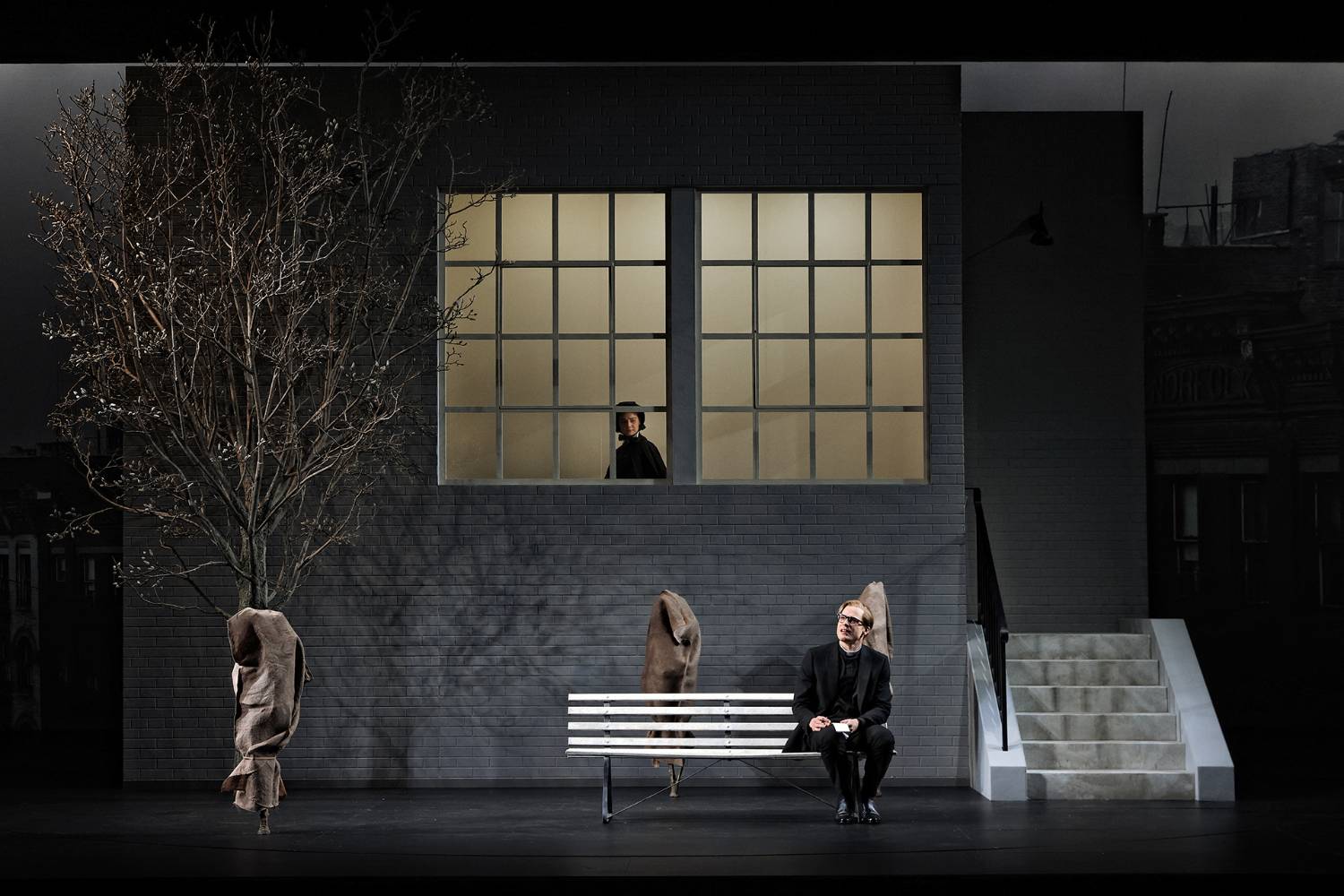
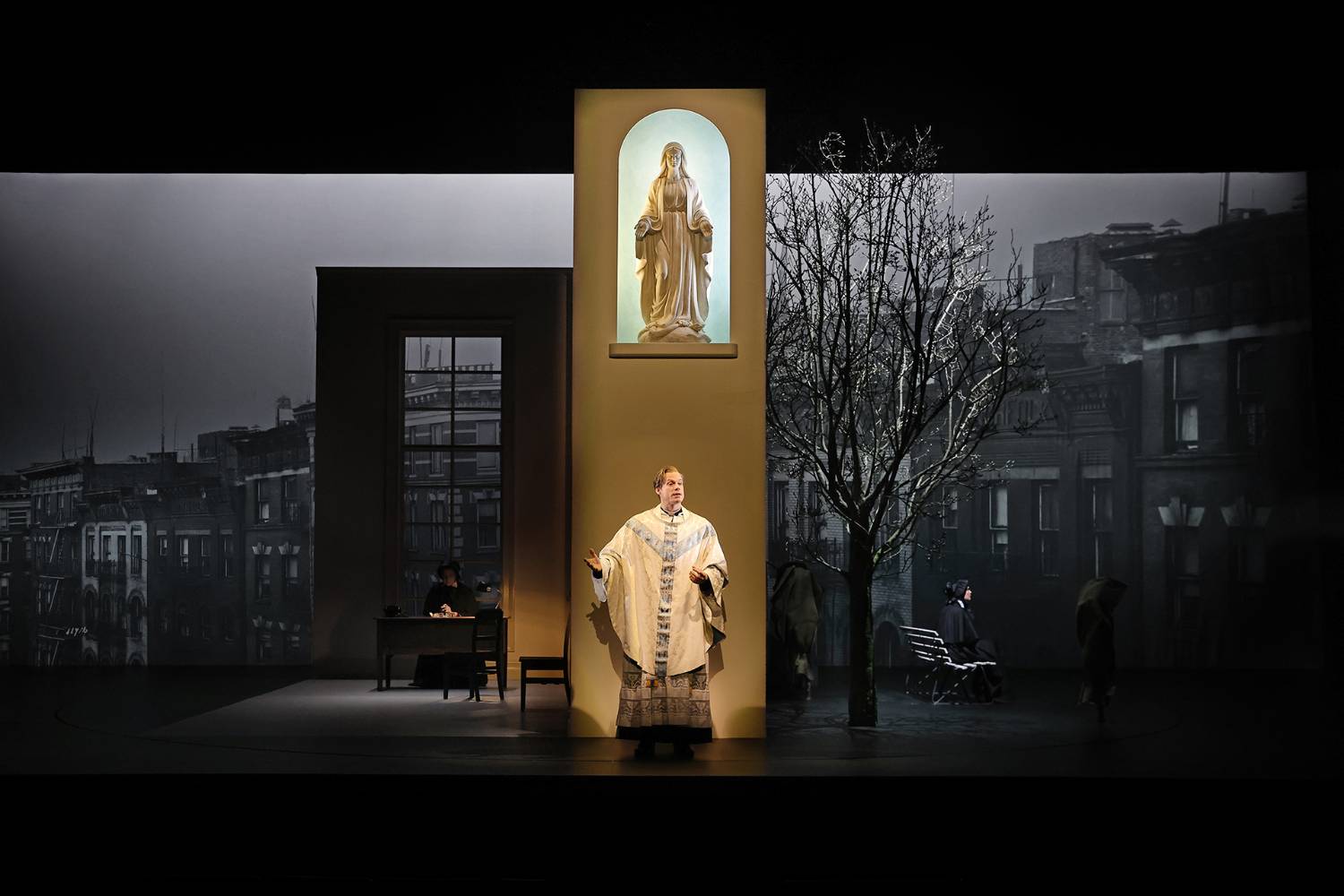
Potts entrusted her vision to internationally renowned designer Bob Cousins. The first image of Father Flynn giving his sermon about doubt underneath a giant replica of Francisco de Zurbarán's Agnus Dei painting simply takes your breath away. As the curtain rises, we see a white, cube-like building block with just a touch of pastel blue encircling the statue of Our Lady of Grace at the top of the structure. This architectural frame is accented by a handful of dark brown, leafless trees in the foreground of the St. Nicholas Church school—beautifully juxtaposed against the black-and-white backdrop of the 1960s Bronx skyline. Despite the abundance of space and brightness, an austere coldness and lingering sense of claustrophobia remain. The set sits on a large revolve that generates smooth yet dramatic transitions between the interior and exterior scenes; there is nowhere to hide, yet it feels entirely isolated at the same time. This stunning visual aesthetic is hauntingly soothed through Jessica Dunn's heavenly sound design, which uses the murmuring of hymns, distant sounds of children playing, church bells, and a cappella singing from the cast. This intricate music is deployed minimally, yet mesmerisingly.
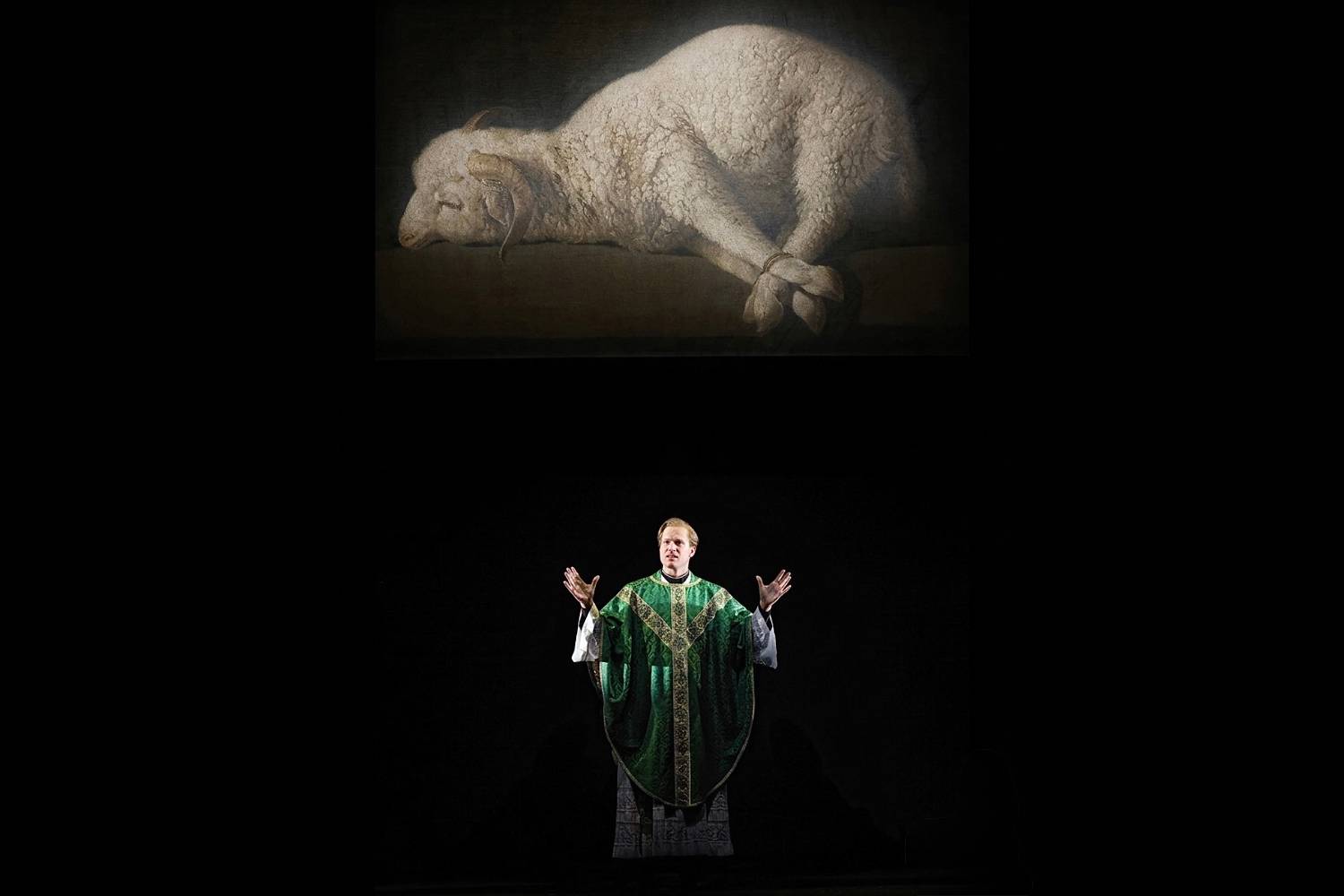
It is an unexpected aesthetic, stripped of traditional heaviness and, as the drama unfolds, any chaotic sentiments. Potts lets the opacities of human complexity shine through her quartet of formidable messengers with some unorthodox interpretations. One has never witnessed a Father Flynn so visibly vulnerable from his very first appearance. The role was originally cast with Sam Worthington, in what would have been his follow-up to a 2021 appearance in the Australian premiere of Branden Jacobs-Jenkins' Appropriate—a production that had marked his return to the stage after over 20 years. Worthington's withdrawal may have been a blessing in disguise. Instead, we have Sam Reid, who oozes magnetism and a personable quality, as if channelling a young Joel Osteen. The rawness of his affect makes him even more likeable from the get-go, and yet it scratches deeper at that wound of doubt. We soften as we get used to Reid's sensitive portrayal, but there is a hint of deviousness the moment he wins over Sister James and jots things down in his notepad—a habit that repeats throughout the play. Yet again, maybe it is simply his natural disposition. Is he a visionary—a God's gift to the Catholic Church at a time of change? What if his sensitive nature is as performative as it is the essence of who he is? Reid's complex portrayal is simply faultless.
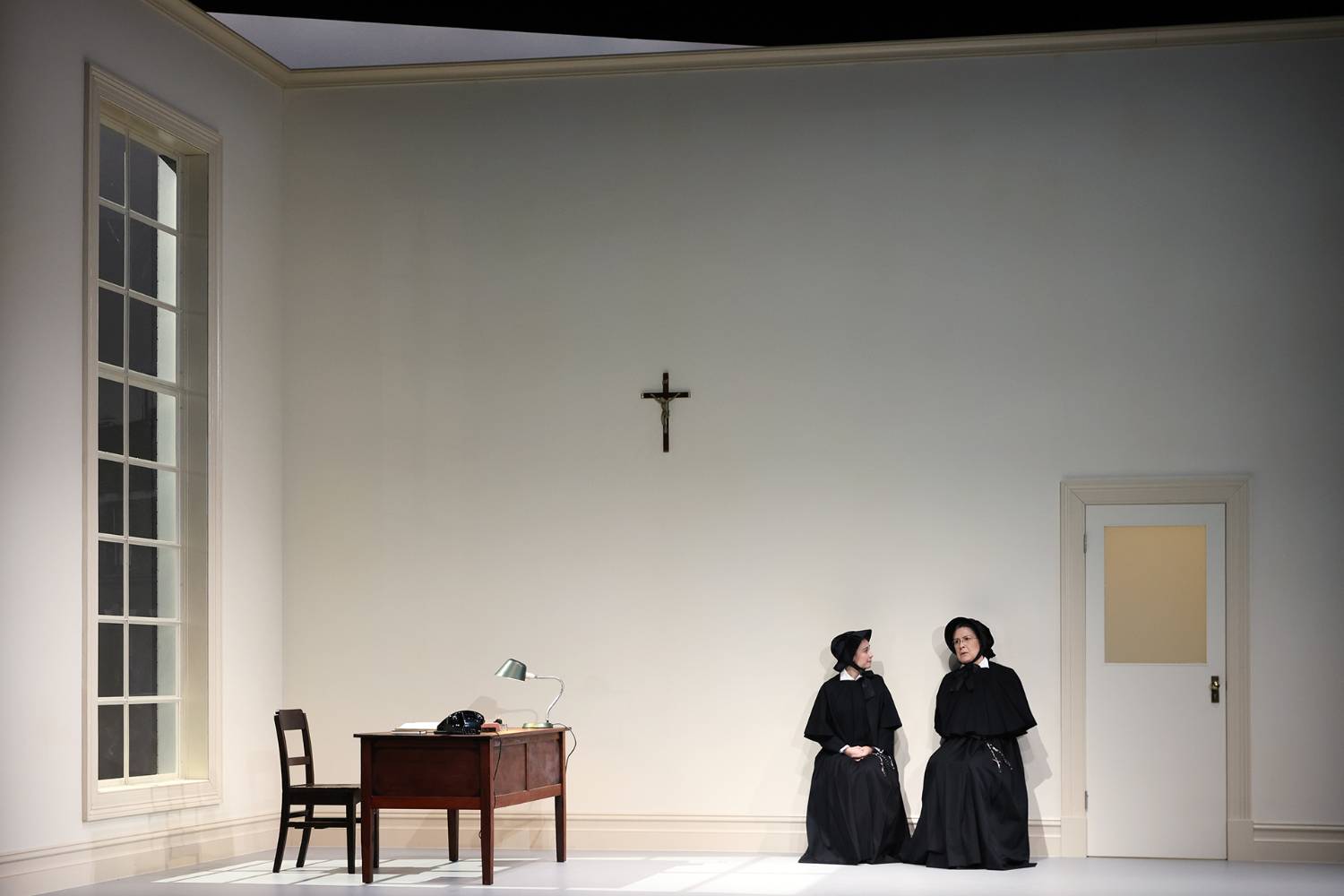
Sister Aloysius, or "an ice block" as Father Flynn refers to her, has been given an intricate, authentic vitality through what is clearly Pamela Rabe's immaculate preparation for the role. Giving the Sister the soft undertone of a European accent beautifully shatters the unlikable hardness so frequently associated with the character. This is a real woman with a history and stories to tell. The lines where she speaks of losing her husband during "the war against Hitler"—recounting how she used to listen religiously to radio news while he was on the frontline—now resonate with added dimensions, rendering the character all the more fascinating. Rabe's Aloysius is never a stone-cold dominatrix in a habit, but a woman who has lived through tumultuous cultural shifts and an unspeakable past, and survived them both. Order is her survival key, and compassion comes only from God. We catch a glimpse of her looking at her own reflection through the window more than once (another superb aesthetic highlight from Damien Cooper's lighting). We hear often that certainty is something she seeks, but has it ever truly been there, even temporarily? Instead of relying on constant intimidation, Rabe sprinkles just the right amount of humour into the role through her highly relatable intergenerational dialogues with Sister James. If there is one minor caveat to pick, softening Sister Aloysius into someone less than impenetrable may have dampened the supposedly chilling final moment of the evening.
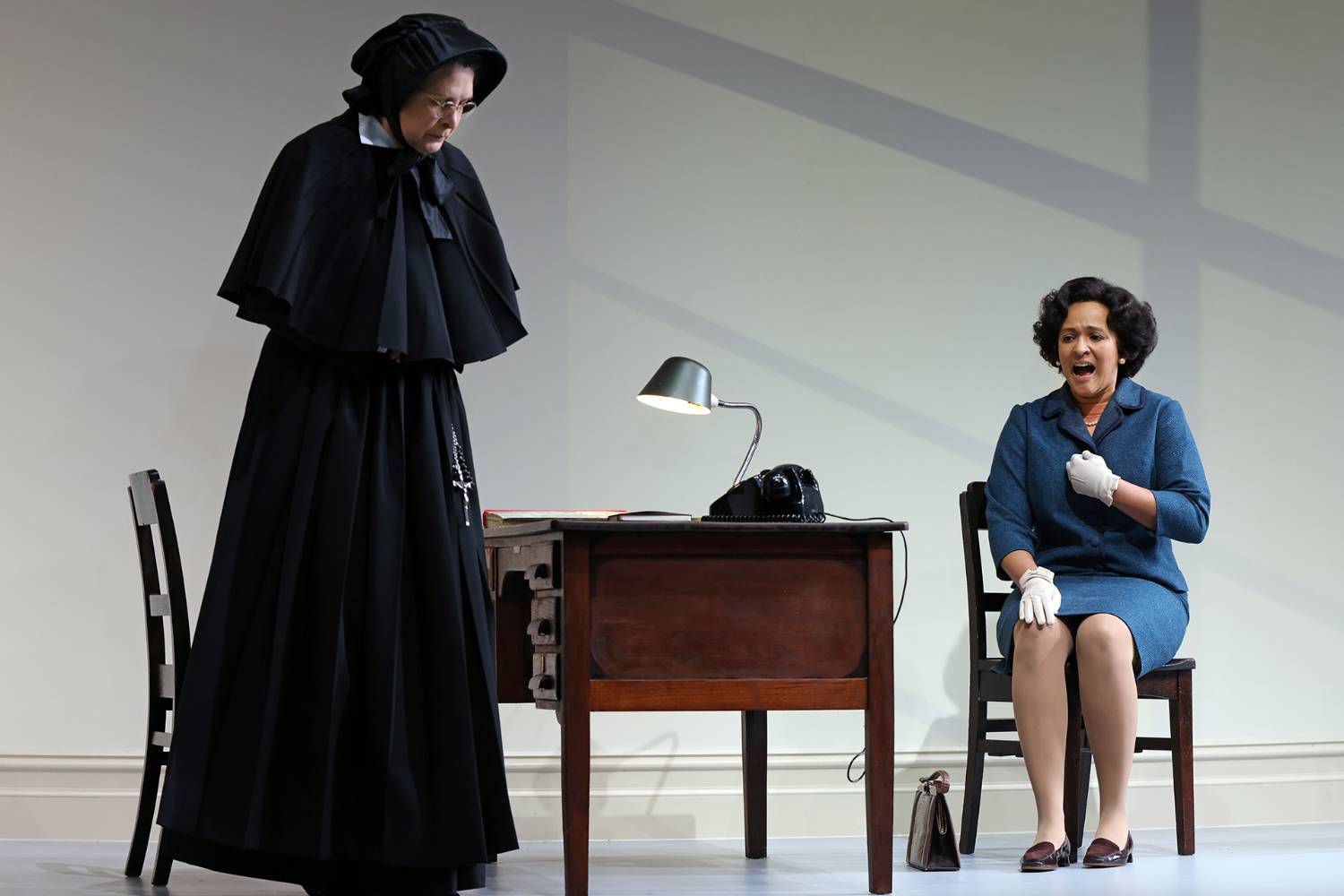
A delightful surprise performance comes from Shannen Alyce Quan, a young Chinese Australian actor with a musical theatre background. Without losing the wide-eyed innocence the role requires, Quan gives Sister James a true backbone, standing up to challenges as if she is the audience's proxy between the old world of Sister Aloysius and the evolving moral movement presented by Father Flynn. Completing this well-rounded quartet is Zindzi Okenyo as Mrs Muller. Cigarette in hand, she approaches the school as if the weight of the world is resting on her shoulders. Not unlike Rabe, Okenyo grants her character a multi-layered depth; within the confinement of her Sunday best, her demeanour shows she is never truly comfortable in that tweed skirt suit. Okenyo's maternal approach is driven not by angst, desperation, or ignorance, but by a clear-eyed acceptance of the unfairness of the world. When Sister Aloysius exclaims, "What kind of mother are you?"—the one moment in the play where an audience might usually sway to the headmistress's side—this time we are pushed to ponder much deeper questions about the true definition of a mother's love.
The lack of an impenetrable fortress in Rabe’s final confession shifts the play away from a clinical, shocking climax. Theatre is, by its very nature, a place designed to ignite questions, but this time the debate is less about which side you are on or who you choose to believe. Instead, we see ourselves mirrored in all four of these flawed characters—a profound baseline of shared human frailty. Potts delivers an enduring, deeply moving exploration of how certainty is constructed and the unsettling gray areas we must all inhabit when absolute proof remains entirely out of reach.
production photos ©Prudence Upton
🔎Explore the production history of Doubt by John Patrick Shanley here.
