
Revisiting the Second Run
In 2024, I saw the second production of the musical 〈The Last Man〉. I watched Kim Ji-on's Survivor and Hong Na-hyeon's Survivor, and the show brought me great comfort at the time. It was also my first encounter with the solo-performance format, and what struck me most was how each actor gave the Survivor a different backstory and emotional arc. In 2026, the third production ran at Link the Space Hall 1 across two seasons. The two Survivors who had left such a strong impression in the second run returned to the stage — one in the first-season cast, the other in the second. It became a natural opportunity to compare the second and third productions side by side.
(Season 1) 26 March 2026 – 7 June 2026
(Season 2) 9 June 2026 – 9 August 2026
Venue: Link the Space Hall 1
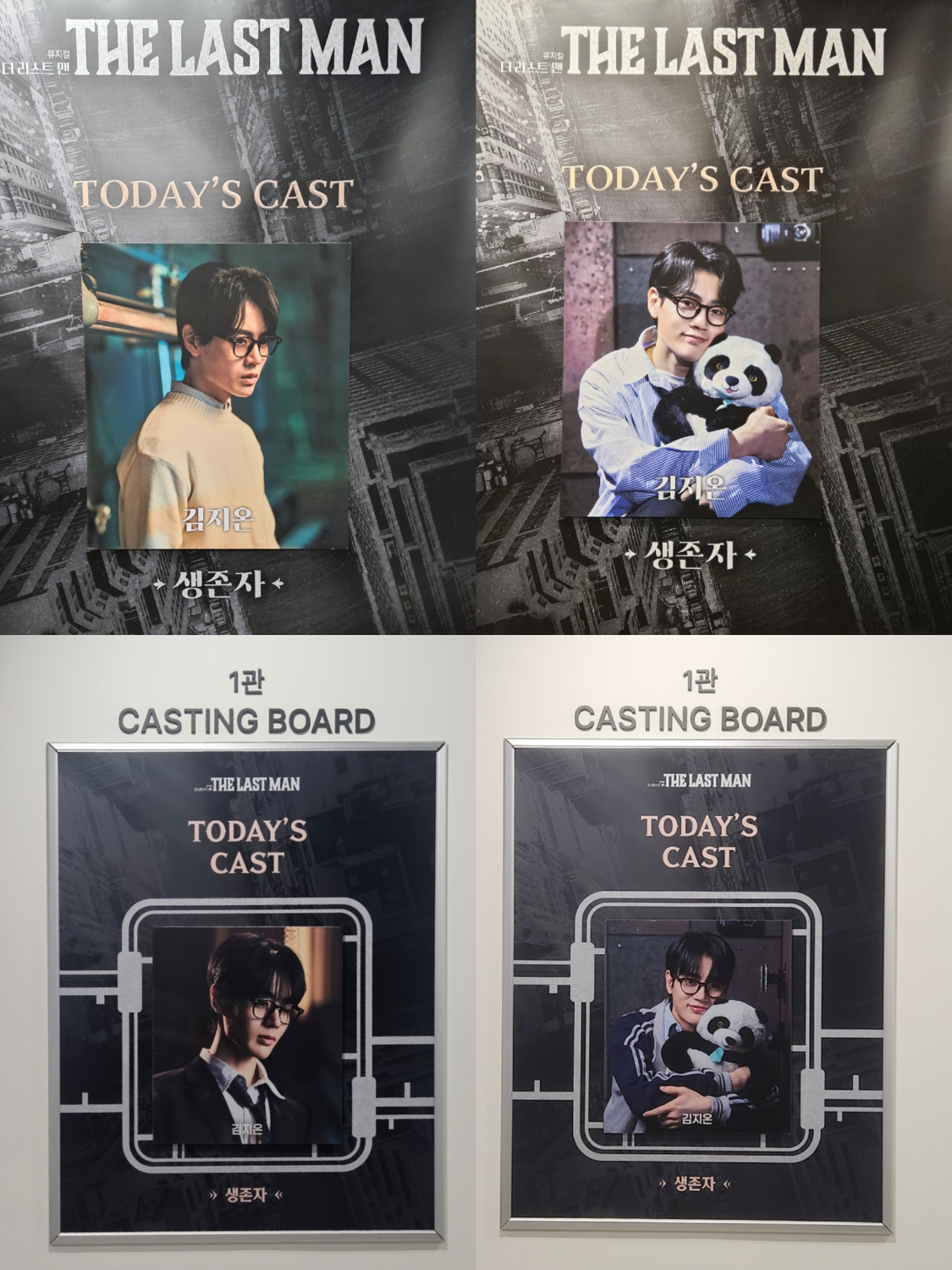

This piece contains personal interpretations and spoilers for the show in its entirety.
What kind of show is musical <The Last Man>?
You are not alone.
On the surface, 〈The Last Man〉 is the story of a single survivor living in a bunker during a zombie apocalypse. The Survivor seals the bunker door, hoping to be able to step outside in a year's time. Before long, they detect signs of another survivor and desperately want to rescue that person. They broadcast continuously through a mobile phone, sending the message "You are not alone" to someone who may or may not exist — and those broadcasts are actually uploaded to the real B-103 YouTube channel. In the latter half of the show, however, the arrival of a census worker and a landlord reveals the truth to the audience: there is no zombie apocalypse. The 365 days that have passed exist only within the world of the play, and the day's real news headlines, woven into each performance, blur the boundary between fiction and reality even further.
What was it that severed the Survivor from society and drove them to step inside a bunker with such a heavy door?
Each actor answers that question differently. In Kim Ji-on's interpretation, the Survivor is a contract teacher who has endured years of verbal abuse and harassment; in Hong Na-hyeon's, the Survivor is a high-school senior who has aged out of the foster-care system. The backstories and circumstances differ, but the emotions the show conveys are anything but extraordinary. Anyone who has ever felt, in the course of living in this world, that they simply cannot go on will find themselves in the Survivor's feelings. That is precisely why the message this musical ultimately offers is one of solidarity and encouragement — a reminder to those who are holding on that they are not alone.
The biggest difference between the second and third productions: the "error scene"
The most striking change between the second and third productions is what has come to be called the "error scene." In the third production, just before the final number 〈You Are Not Alone〉, a broadcast video from another Survivor appears on screen. In most performances, the footage featured the Survivor from the previous show; at the final performance of Season 1, it is said that videos of every cast member were used.
The addition of this staging choice felt like it shifted the musical's central keyword as well. Where the second production left the Survivor's choice and fate entirely open to the audience's interpretation until the very end, the third production makes the theme of "solidarity" among Survivors far more explicit.
The device that best embodies this is the door. At the top of the show, the Survivor enters the bunker and seals the door shut during the number "Go into the Bunker." In the early number "The Door 1," the door's thickness is described in millimetres; in the reprise "The Door 2" later in the show, the unit shifts to metres. This door is not simply the entrance to a bunker — it is the door of the mind that separates the Survivor from the world.
In the second production, whether the door could be opened and whether the other Survivor truly existed were both left to the audience to decide. In the third production, the other Survivor's existence is made tangible through the "error scene," and the Survivor's desire to connect with them becomes far more unambiguous. As a result, the third production felt like it delivered the show's core message — you are not alone — more directly than the second.
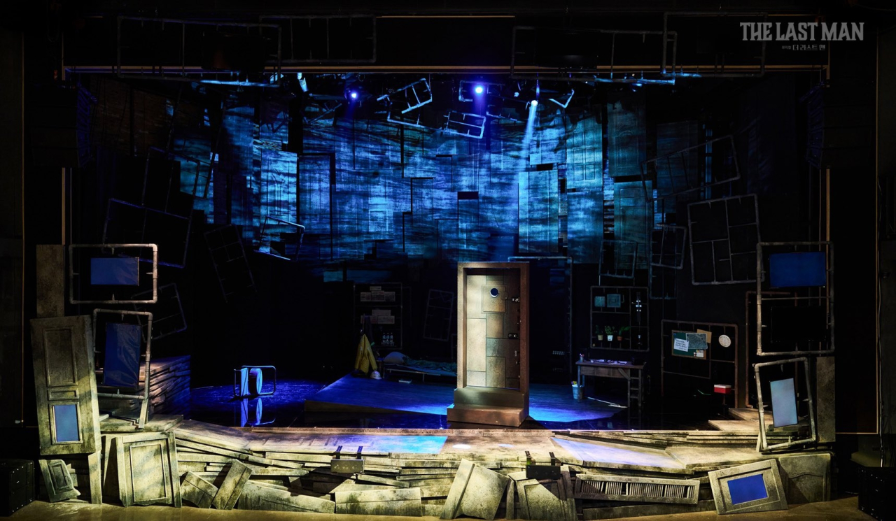
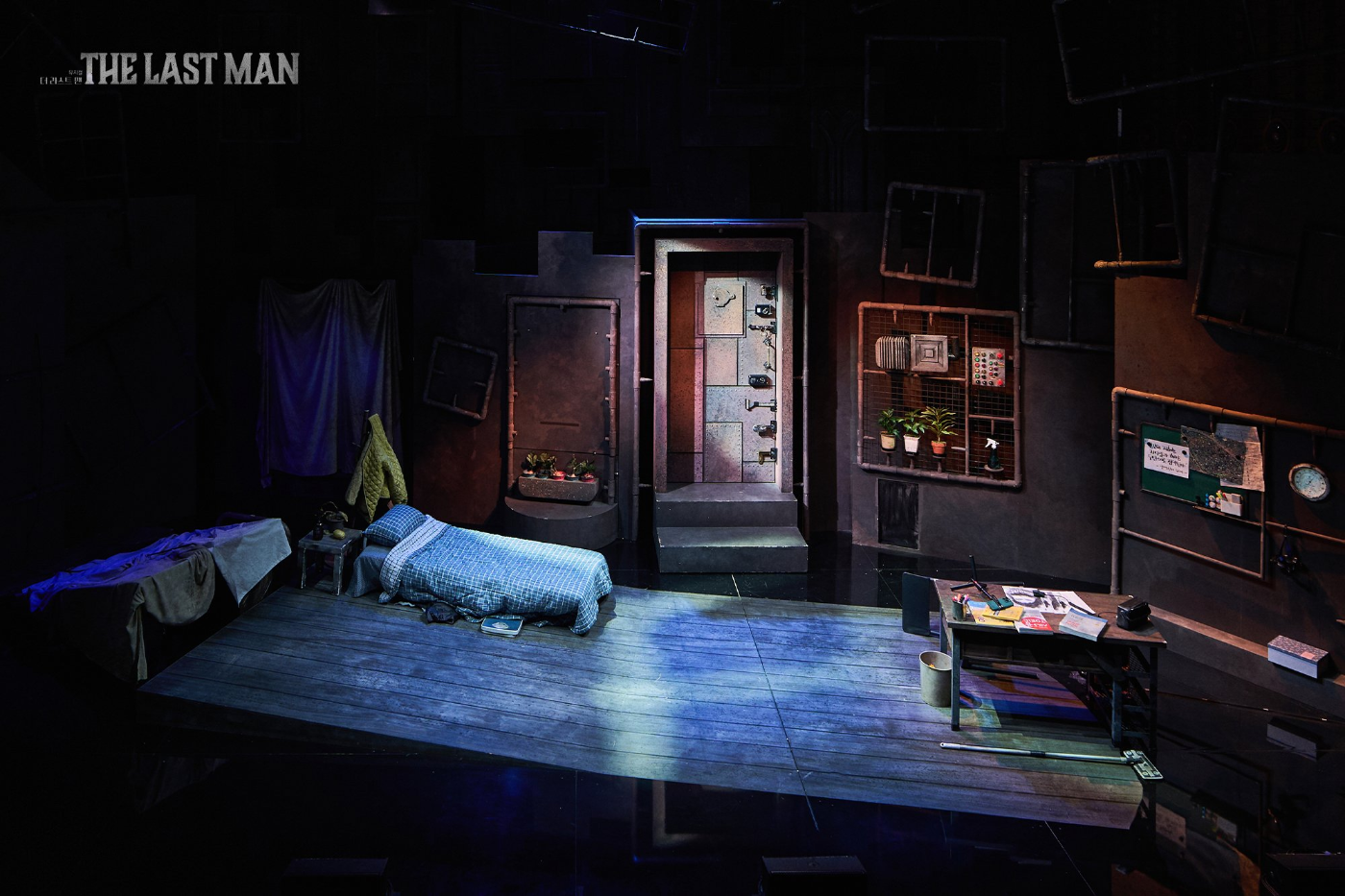
Bunker B-103 and Room 103
The change in the stage space was equally striking. The second production's set carried a strong image of a literal bunker, true to the title. In the third production, however, the space reads far more clearly as what it actually is: a semi-basement studio flat.
Coming in familiar with the second production's set, I initially wondered whether this might blunt the show's twist. On reflection, though, I think it was a choice that conveyed the show's intentions more intuitively — because it presented the figure onstage as someone who could exist anywhere around us.
The flood scene and the space
The change I found most fascinating personally was the flood scene. This is the moment when the show begins to make the protagonist's psychological shift viscerally legible — as the water rises, the bunker becomes a place the Survivor can barely endure.
In the second production, a chair that had been suspended from the ceiling descends, and the space gradually closes in. There is a sense of the bunker itself bearing down on the Survivor. In the third production, the staging instead uses lighting that evokes lightning and reveals the pipes running across the ceiling, causing the physical outer walls of the bunker to recede from view. This shift also influenced my personal reading of the show. Where the second production emphasised the sensation of being physically trapped, the third production underscores the idea that what matters was never whether the door can be opened, but the Survivor's own perception. What confines the Survivor is not the thick bunker door but the belief that they are cut off from the world. The door is no longer an obstacle to be overcome; it becomes a symbol that exists more powerfully in the mind than in reality.
How the actors who appeared in both productions evolved their interpretations
The broad framework of the staging remained intact. The tilted floor, symbolising psychological instability, was still there, as was the space beneath the raised platform, representing the unconscious. The detail of Hong Na-hyeon's Survivor referencing the "platform" throughout the performance felt like the most effective use of this staging — it pinpointed the directorial concept precisely while naturally weaving in her character's backstory of preparing for independent life.
The actors' interpretations, too, had been refined across the second and third productions. The emotional throughlines felt more natural, and the backstories were far easier to follow. The change that stayed with me most was Kim Ji-on's Survivor tidying the room just before the final number — it read like someone putting their space in order before stepping back into the world, lending the final choice considerably more conviction. Hong Na-hyeon's Survivor had changed even more noticeably. A gesture of self-embrace was added to the scene where the Survivor introduces the bunker and explains the air purifier; that single small movement made it all the more vivid just how hard the Survivor was fighting to hold themselves together.
Personal interpretation and hopes
On a personal note, I want to highlight that this show can also be read as a story of one's present self offering comfort to one's past self.
In 2024, Hong Na-hyeon's Survivor was someone preparing to live independently, feeling so out of place in the world that she seemed like a stranger in it. Her bucket list included travelling the world. In the third production, a new prop appeared: a university department jacket. The character who had entered the bunker shielding herself with textbooks, pencils, and a school uniform reached for that jacket in the moment she tried to step outside the door — as if using it as armour. This change felt like more than a simple addition of a prop; it evoked a Survivor who had lived through the time since the second production. There is a meta dimension to it as well: the Survivor who spent the run of the show inside the bunker opens the door and walks out into the world at the final performance.
Just as Hong Na-hyeon's Survivor gently stroked her own head at the final performance of the second run on 24 May 2024 — as though remembering her younger self — the audience too is moved to think of the time their own past selves endured, and to draw strength from it. That is why I personally hold out the hope of one day seeing a version of the "error scene" where, instead of the current Survivor, it is the past Survivor's broadcast that appears on screen.
In closing
〈The Last Man〉 was all the more compelling for being a musical that resists a single interpretation, and I found myself returning to see it multiple times across both seasons. From one angle, it speaks to a society in which I am a survivor while simultaneously being someone else's zombie; from another, it speaks to the solidarity of survivors each holding on through their own lives. I can only imagine that the show's foray into international markets —its London premiere, which ran from 8 May to 6 June 2026, among other ventures —was received positively for precisely this reason.
The change I felt most keenly in comparing the second and third productions was that the show's centre of gravity had gradually shifted — from physical isolation toward emotional isolation, and from individual survival toward solidarity among survivors. This piece, of course, is a personal response based on only a handful of performances. Another audience member who saw the same musical might arrive at an entirely different reading. I think that is exactly why I have come to love this show as much as I do.
