

Big Mother is a play that confronts its audience with urgent questions about fake news, information manipulation, and the surveillance of power in contemporary society. Where George Orwell's Big Brother in Nineteen Eighty-Four controlled people through fear and coercion, the "Big Mother" of this play arrives wearing the warm face of an algorithm. She appears to understand people's preferences and give them exactly what they want — yet beneath that surface lies a new form of control built on data.
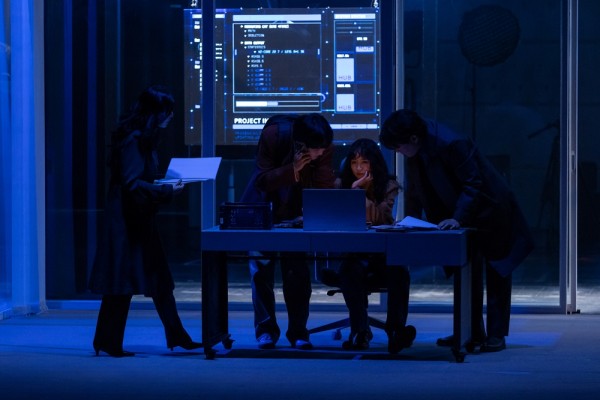
What gives this production its powerful sense of immersion is not only the story itself but also the space and atmosphere the director has created on stage. A director is the artist who weaves together an actor's movement, stage design, lighting, video, and sound into a single unified performance. In Big Mother, these varied elements combine to make the audience feel as though they have stepped inside a vast information network.
The production's most distinctive feature is its roughly sixty short, intense scenes that unfold in rapid succession. Director Lee Jun-woo has said that he "focused on pace in order to bring out the appeal of a script dealing with the media landscape and the algorithms of the data age." That directorial intention is evident throughout the performance. The stage evokes a vast broadcast studio; inside transparent glass walls and before enormous screens, the actors move without pause, creating images that feel cinematic. Screen footage evoking American crime procedurals of the 1990s adds yet another layer of visual pleasure.
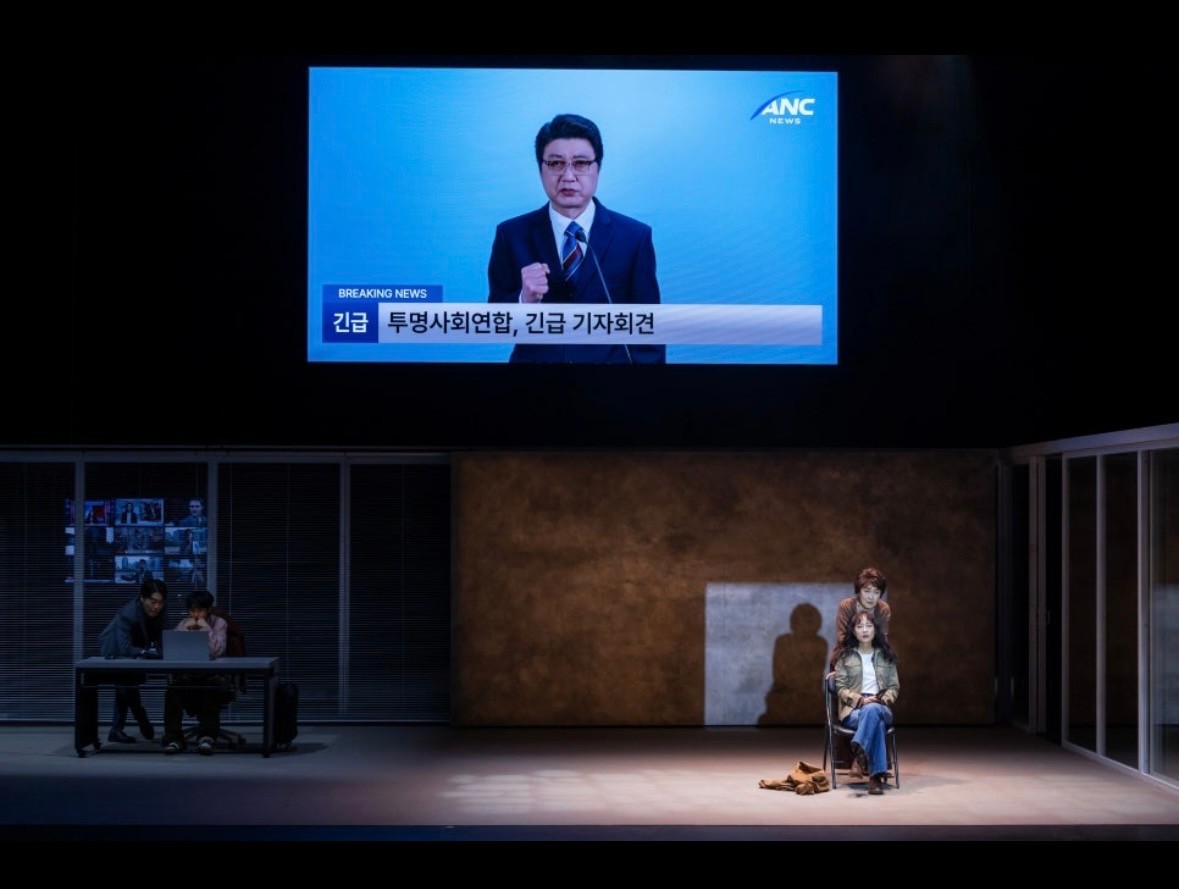
The most striking elements of the set are the glass walls and the screens. A space enclosed on all sides by glass makes clear that the actors have nowhere to hide and nowhere to lean — and at the same time offers a visual embodiment of a surveillance society in which every action is exposed. The actors move constantly in and out of the glass enclosure, and through that movement the audience comes to feel, almost instinctively, how an invisible power controls people's lives.
The screens installed throughout the stage and the use of live cameras are equally important directorial devices. The subjects being reported on by the journalists in the play, and the figures who appear in the media, are filmed in real time by live cameras and broadcast onto the screens above the stage. The audience watches the actors' live performance and the edited footage on screen simultaneously — a directorial approach that lays bare the intentions and processes behind the video content we consume in our everyday lives.
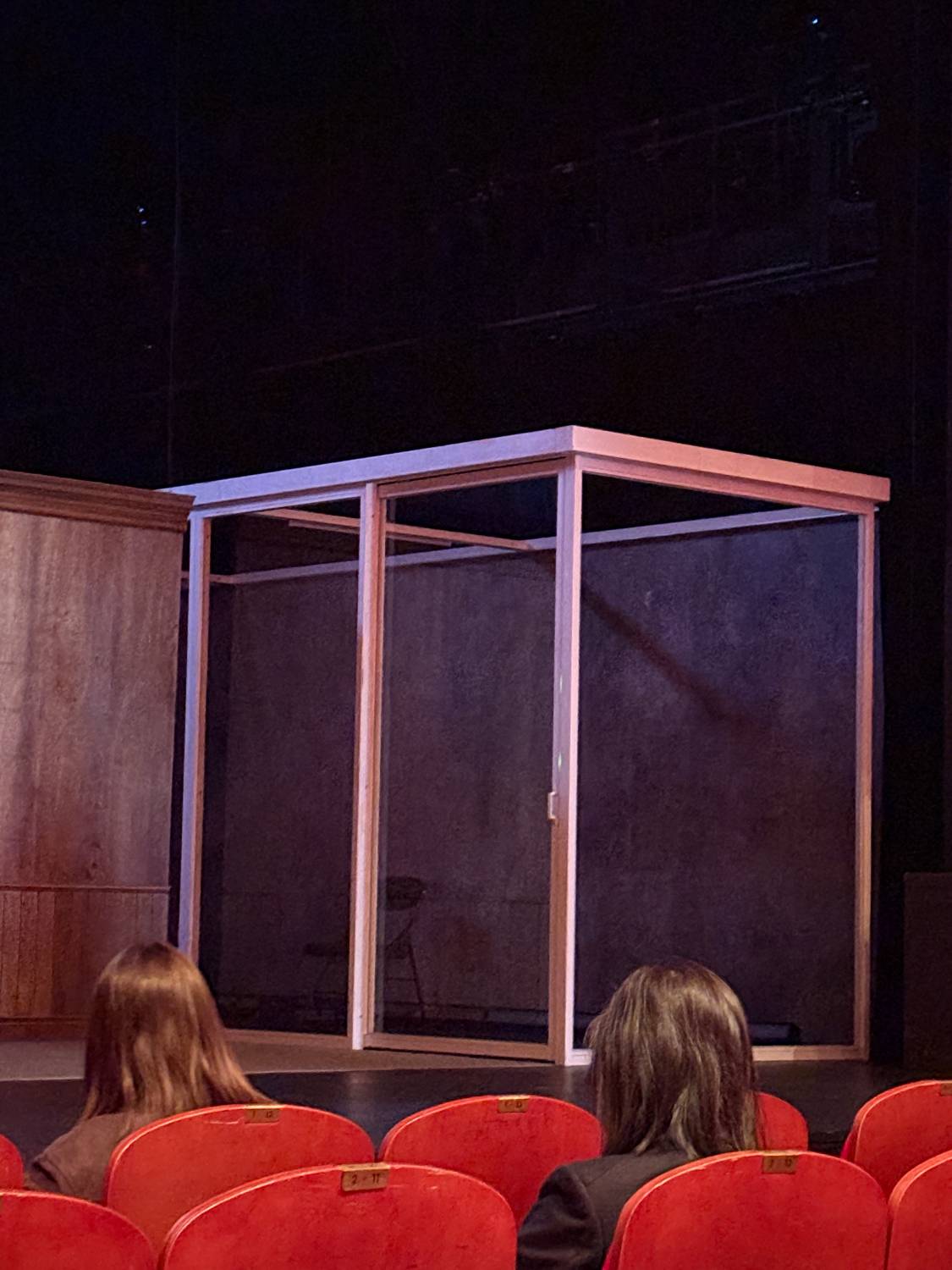
The rapid scene changes and the actors' movement across the stage also heighten the tension. The performers traverse the wide stage without rest — pursuing, confronting, and opposing one another — while the lighting transforms the space in quick succession, generating an atmosphere of urgency. Thanks to this direction, the audience does not simply observe the performance from a distance; they experience the sensation of being at the very center of events.
Lee Seung-won, artistic director of the Seoul Metropolitan Theatre, explained: "Scripts that are both accessible to a wide audience and genuinely of their moment are rare, and Big Mother is exactly that kind of work — a story that shows how information is manipulated in the age of big data and how it operates as power."
Marc Dugain and Christophe Labbé, authors of The Surveillance Society, describe "Big Mother" as a "soft dictatorship" — one that controls people not by suppressing their will, as a mother might, but by granting their every wish. They argue that what defines Big Mother is a mode of domination that offers comfort and ease while leading people to surrender their freedom of their own accord.
Sharp political satire and direction that cuts to the heart of how media operates push the production's intensity to its peak. Director Lee Jun-woo has said that he "worked with a deep sense of conviction that even if a journalist dies, their voice does not disappear — and with a sustained reflection on what it means to write a story grounded in truth." Four journalists who set aside personal feeling in pursuit of justice ultimately close in on the true identity of Big Mother — but at the very moment the truth is about to surface, all of them vanish without a trace. This ending makes all the more bitter the play's central argument: that the greatest threat of our time is not the lies of any individual, but lies engineered on the basis of data.
In this way, the direction of Big Mother uses glass walls, video, lighting, and the actors' movement as a single unified language to deliver the work's message. Each element of the stage design is not merely a prop but a symbol that gives visual form to the themes of surveillance and information manipulation — expressing, far more vividly than dialogue alone could, the tension and dread at the heart of the play.
An information environment in which it is nearly impossible to judge what is true; the high view counts generated by sensational footage; the rapid spread of misinformation; personal data and search histories left behind online; brainwashing and manipulation through algorithms; the anger and division manufactured by media — all of these exert a persuasive hold over people, steering them in particular directions without their awareness. These phenomena are intimately connected to the mode of dictatorship that Big Mother depicts.
The power that controls big data paralyzes people's capacity for judgment and leads them to surrender their freedom and rights while believing they are making the right choice. The collusion between government and big data corporations; the technological power that exploits a younger generation hungry for a just world; a critique of the media's absence of purpose and its failures; questions about the continuing validity of democratic systems — Big Mother encompasses all of these social concerns and brings its audience face to face with a near-future dystopia.
At the play's end, the New York investigative journalism team sacrifices everything to expose the full truth — yet Howard Mercer is elected president with a record-breaking share of the vote. In the end, Big Mother's surveillance transforms people from beings who question and critique into beings who simply accept and consume. A thread of hope remains — the material uploaded to "Forbidden Stories" carries the message that "even if you kill all the journalists, our voices will not disappear" — but that alone is not enough to change a bleak future. The play leaves its audience with the message that what is needed is action from everyone: the willingness to face the situation clearly and seek new alternatives.
Big Mother stages this entire structure in a way that allows audiences to understand and become absorbed in it naturally. It poses the question: will we accept the dystopia that may be coming, or will we refuse it? George Orwell's warning — "Until they become conscious they will never rebel, and until after they have rebelled they cannot become conscious" — remains as urgent today as ever.
Ultimately, Big Mother is a work that demonstrates just how profoundly direction can shape the atmosphere and message of a performance. It makes unmistakably clear that a director is not simply someone who transfers a script onto a stage, but a creative artist who connects every element of the production and designs the very way an audience sees and feels a work.
production photos ©Sejong Center