

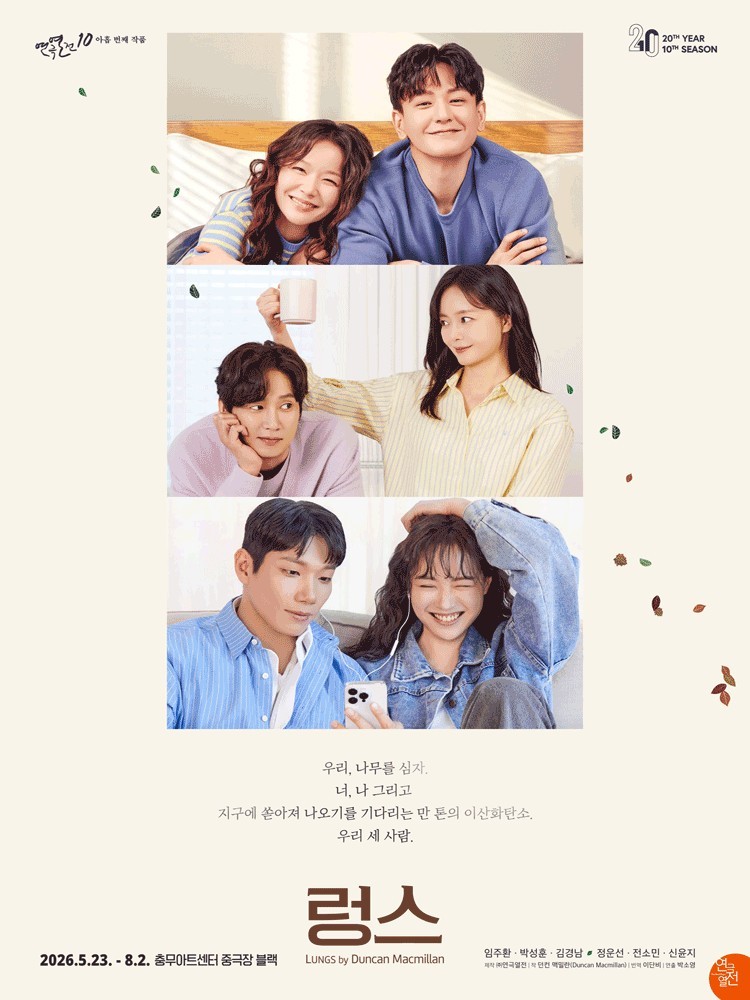
Running time: 95 minutes
Dates: 2026.05.23 – 2026.08.02
Venue: Chungmu Art Center Black Box Theater
Cast: Lim Ju-hwan, Park Sung-hoon, Kim Kyung-nam / Jung Woon-sun, Jeon So-min, Shin Yoon-ji
On July 8th, I saw the play <Lungs>. A sprawling script, just two actors — a man and a woman — and a bare-bones stage. The production is deceptively simple, yet within it lives an enormous story about life, love, and human connection. As the performance unfolds, audiences find themselves swept up in the emotions of characters living through seasons of life that may be utterly unlike their own — or uncomfortably familiar.
If you read this after seeing the show, I hope it gives you space to revisit the feelings and questions the performance left behind. If you read it before, I hope it serves as a guide that helps you meet the questions <Lungs> asks with a little more depth.
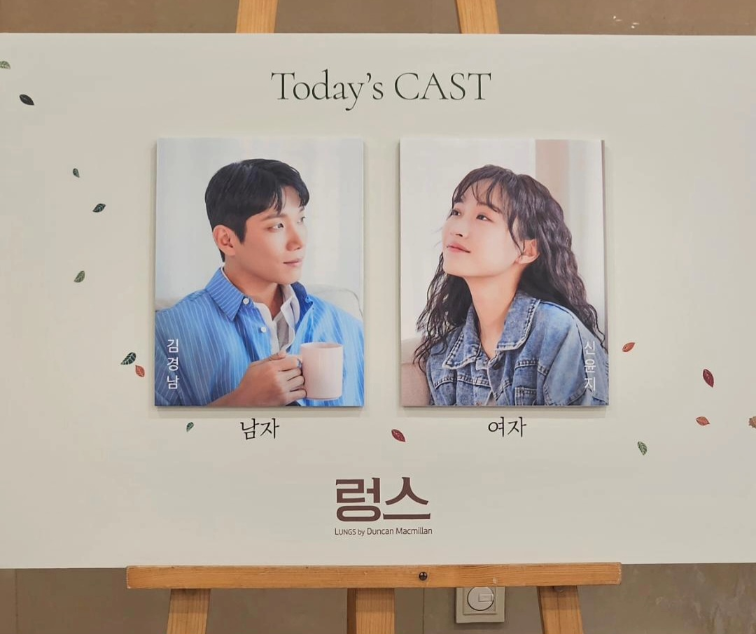
The Play <Lungs>
1. Lungs: What It Means to Breathe and Live
Breathe.
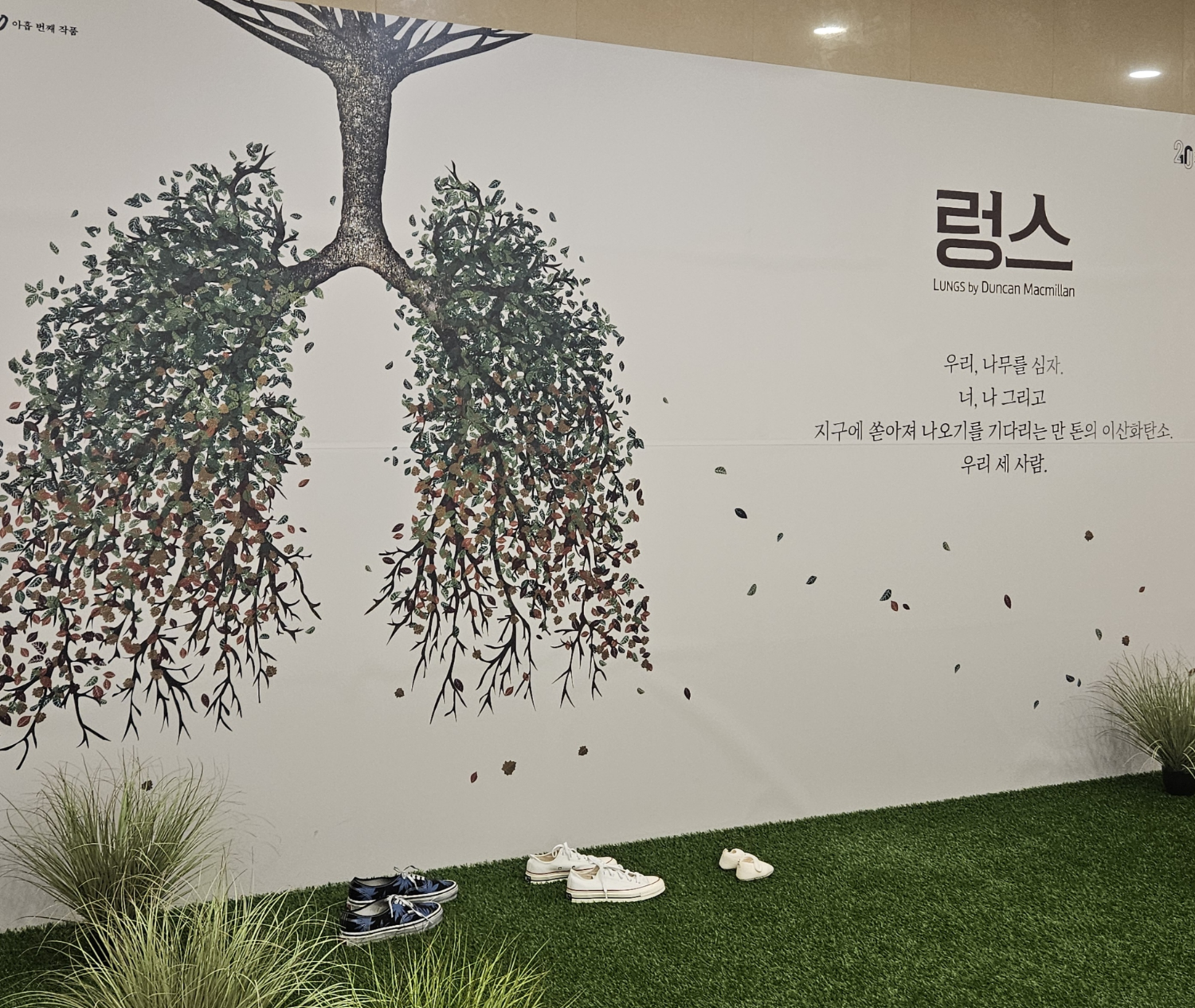
A play titled Lungs. The act of breathing. This most elemental of acts is what allows a human being to exist. We take in oxygen and release staggering amounts of carbon. Sometimes even breathing isn't easy. It is simultaneously an act of exhaling and an act of drawing in all the carbon dioxide that saturates the air around us — and in doing so, dirtying the lungs of the earth. In this play, the act of breathing stands for something larger: the effort each person makes to sustain their own world, their own life.
From early in the play to its final moments, the Woman delivers an unrelenting stream of monologues — sharp, unfiltered, and direct enough that the Man describes her as being like thunder and lightning. As an audience member, I found her bluntness so raw and real that certain moments made me uncomfortable. And yet, the more I listened, the more I found myself nodding along.
My own sense is that the Woman is a character who speaks every thought that crosses her mind without filtering a single one. This is precisely what distinguishes her from any one real person and allows her to encompass a broad range of human experience. Her anxieties about having a child spill out as calculations of how much carbon dioxide a new life would produce, or as musings about whose features she'd want the baby to inherit. The weight of those concerns ultimately belongs to the two of them to carry. But as the Man receives her words, certain ideas begin to curdle — sliding toward eugenics, or igniting arguments about their respective parents. Amid the rapid-fire dialogue, it becomes genuinely difficult to pinpoint the moment a value gets distorted, or when conversation stops doing what conversation is supposed to do.
Woven through those monologues and exchanges, the Woman and the Man keep returning to the question of whether they are "good people." But as the phrase itself suggests, this is a deeply uncertain concept. The one thing an audience can know for certain is that they are, at least, people who wrestle with wanting to be good.
2. Shoes: Questions Asked at the Edge of Change
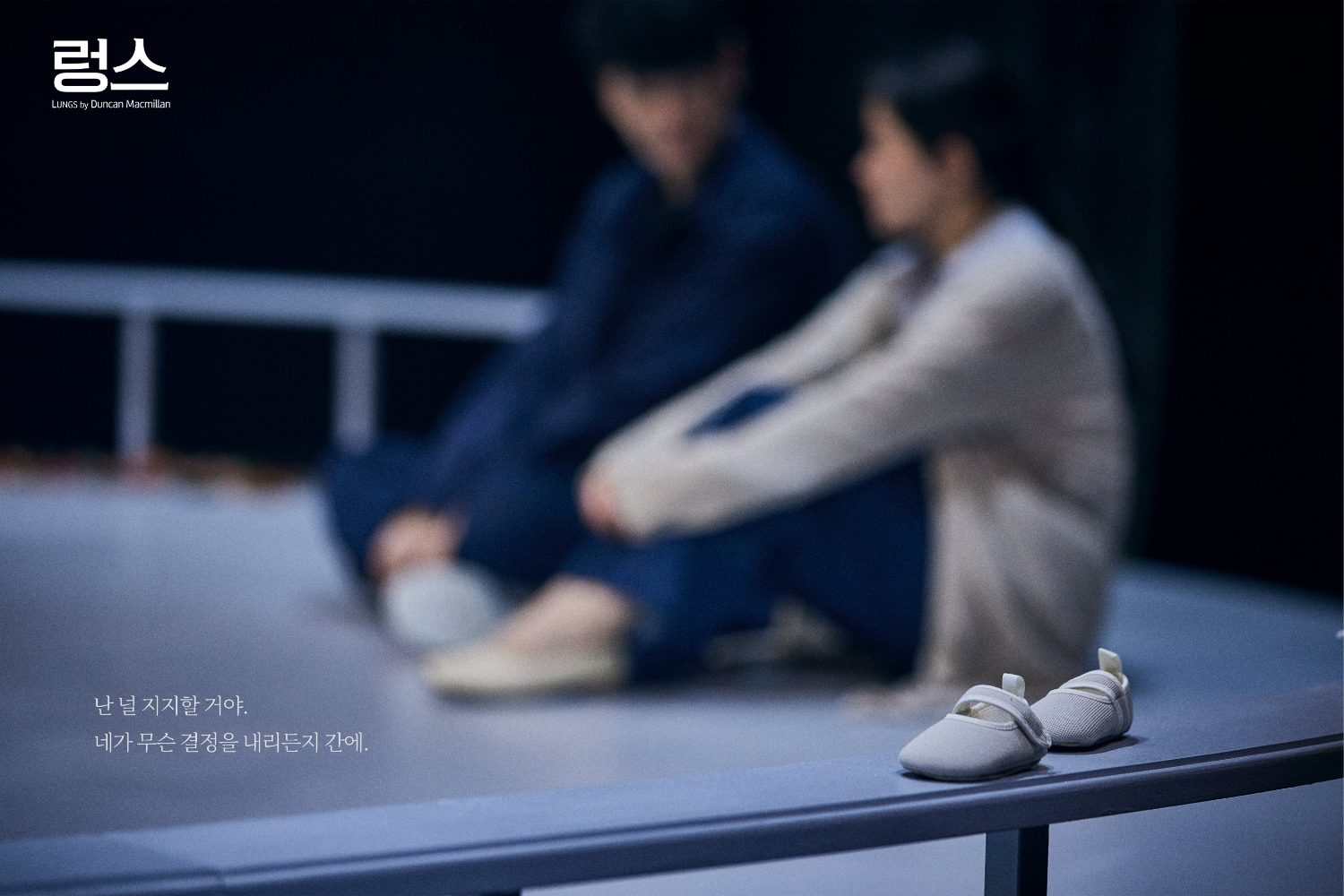
Did you know? Faux leather doesn't break down in the ground. It's basically plastic. We use it to avoid killing animals, but I don't know what's actually right anymore. At least real leather can go back to the earth eventually, right? But you have to wear them for a long time. Are they comfortable?
The staging of this play is remarkably spare. Almost no props appear on stage; scenes shift through dialogue and light alone. The one object that recurs throughout is the shoes the characters change into at each turning point in their lives. The lines above come from the moment the Woman gives the Man a pair of shoes to mark his getting a job — the first time shoes register as something meaningful for the audience. From that point on, each discarded pair is left on the circular stage like footprints along a path. This opening "turning point" and the question it carries felt deeply significant, making clear that the issues these two people face and think through are anything but simple.
I found myself thinking further about shoes as the play's central piece of direction and its central metaphor. In English, there is the expression "put yourself in someone's shoes" — to try to see things from another person's perspective. The characters before and after each change of shoes are unmistakably different people: the Man who has become capable of providing for someone, the Woman who is preparing to become a mother. The conflict that begins with that first question, then, is a conflict that runs the full length of their lives. Because values, and right and wrong, are never absolute.
3. Conversation: How a Relationship Grows Up
You probably think sometimes that we're having a conversation — that I'm listening and responding to what you say. But the truth is, I stay quiet because I don't know what to say.
Throughout the play, the Man and the Woman talk about marriage and children, yet they are fundamentally different people who have come from entirely different worlds. Because pregnancy means a direct, physical transformation of her own body, the Woman pours out an endless stream of questions and doubts before she can bring herself to decide — so many that she seems to run out of breath. The Man listens to all of it, quietly. For him, having a child carries no bodily change. And so there is a limit to how far he can enter her experience; all he can do is watch. In that space, he fears he is not as solid or as mature as she believes him to be. The monologue above — spoken while the Woman sleeps — is the first moment in the play where the Man draws out his own feelings and thoughts.
Through this rare confession, the audience understands how deeply the Man loves the Woman. And yet, just as he stays silent because he cannot fully understand her, the relationship remains unstable — not out of a lack of love, but out of an immaturity neither has yet outgrown. At the turning point of that relationship, the two are looking in different directions. He wanted her to fight through whatever she was facing and come back to see him again; she wanted him to understand her and hold on. And so these two people who so badly wanted to be good end up facing each other again — perhaps as versions of themselves they never wanted to be, perhaps at their very worst.
4. A Tree: Love Anyway
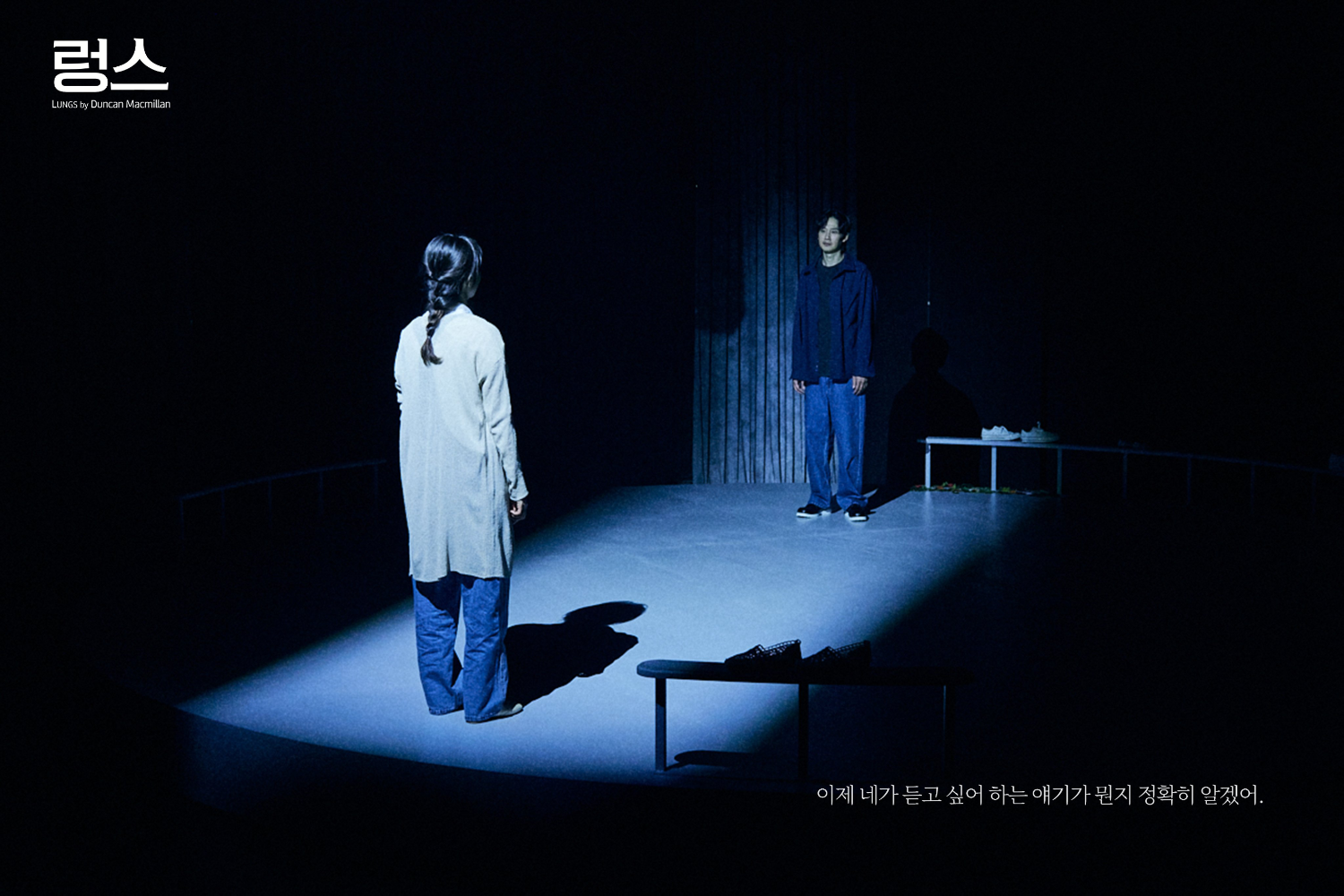
I know now, exactly, what it is you want to hear.
Let's plant a tree. You said that.
The Woman and the Man have grown through the passage of time. The Man has finally matured enough to understand the Woman's thoughts and receive them in his own words. The Woman, too, has passed through so much fear and so many questions that she has become someone different from who she was. What <Lungs> ultimately shows us is not a story of love changing, but a story of two people who love each other slowly, imperfectly growing up as they move through life together.
And so the play tells us: we do not love after we have become complete people — we grow, continuously, while we are loving. Even if we can never fully understand each other in the end, the refusal to stop trying is what carries a relationship forward. And so the footsteps of the Man and the Woman trace the shape of a life along the circular stage. That is why — despite everything — we love anyway.
Personally, I found myself thinking I'd like to see this play again sometime in my late twenties or beyond. At my current age — early twenties — I can recognize that the conversations between the Woman and the Man are realistic and uncomfortable, but my understanding of them is still largely anticipatory, a kind of imagined empathy. As I get older, my perspective on life will broaden, and so will my feelings about other people, about romantic partners, about love itself. I suspect that if I see this work again then, far more of it will land.
<Lungs> is currently running at Chungmu Art Center's Black Box Theater through August 2nd. I hope you'll step into the rhythm of the play as it comes alive through the actors' performances, and let yourself sit with its questions about life, love, and what it means to be in a relationship with another person.
