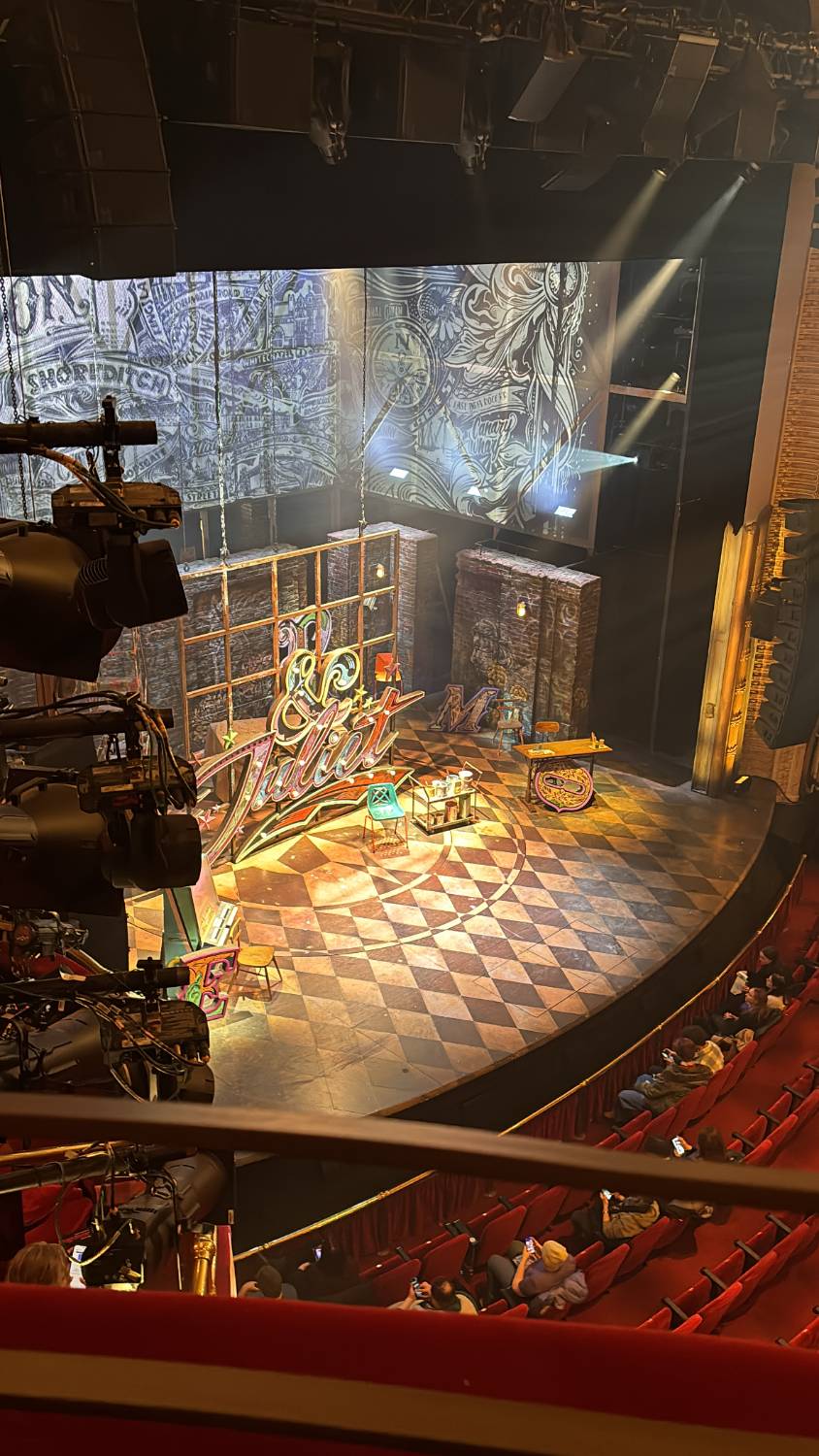


I watched it at the "Royal Alexandra Theatre" on Feb. 5, 2026. It begins with the moment playwright William Shakespeare tries to reveal the ending of his new work, Romeo and Juliet, to the public. As soon as he tries to reveal it, his wife, Anne Hathaway, will tackle him, stealing a flag pen. "Why does Juliet have to die for a man she met when she was just a teenager? Change the ending!" As the couple's fight begins, <&Juliet> unfolds on stage in Act 2 of Juliet's New Life, written by Anne Hathaway.

I think the highlight of <& Juliet> is the outstanding singing ability of the actors. In fact, most of the acquaintances who watched <&Juliet> said, "I watched the performance once more thanks to the actor's singing ability," and "I learned why musicals are a comprehensive art."
As such, the audience's interest and reviews of the musical number in the work are different, and there is another reason. <&Juliet> is a jukebox musical. The jukebox musical is a musical genre that reconstructs basic pop songs or popular songs that are already well known to the public and uses them as stage music instead of writing and composing new numbers for musicals.
Among them, it is the most famous and responsive Number

On the contrary, there are also criticisms from audiences and artists..
<&Juliet> is a play with a framed composition. I think it is a performance with too much turning-over content and directing. There are opinions among experts that the scene where Shakespeare and Anne Hathaway exchange flagpens in the first scene of the play and modify the play in real time seems to have been too easy to solve in directing. Also, the probability of the play itself is insufficient. When the character's psychology changes or the sub story ends and moves on to the main story, I see it's too urgent and trying to move on at once.
Accordingly, there is a part where the plot is slightly collapsed. There must be a "reason" for everything a character moves, acts, and says. Even if you recognize that it is a genre called a play within a play, you can feel that the original author intervenes too much and the play itself has lost "must play". This is compared to "Scarpene" by Moliere, a playwright with a similar composition.
Nevertheless, <&Juliet>, which has the skills of actors beyond story composition and direction, has led to a huge box office hit in Toronto. This may be a huge "planned product" that can catch the eye of the audience, but we need to wait and see if it is a jukebox musical that we should continue.