

A man walks into a room. He looks at the window. He thinks about leaving. But before any of this happens, an actor says: “He walks to the window.”
In most plays, such a sentence would remain hidden in the stage directions. In Roland Schimmelpfennig’s theatre, however, it becomes part of the performance itself. The action is spoken, the spoken word becomes movement, and the boundary between telling a story and performing one begins to disappear.
This is the first surprise many readers encounter when they discover Schimmelpfennig, one of the most distinctive voices in contemporary German-language theatre. His plays do not simply ask what happens on stage; they ask how a story is created in front of an audience. A character can become a narrator, a narrator can suddenly become a character, and a simple sentence can carry the power of an entire scene.
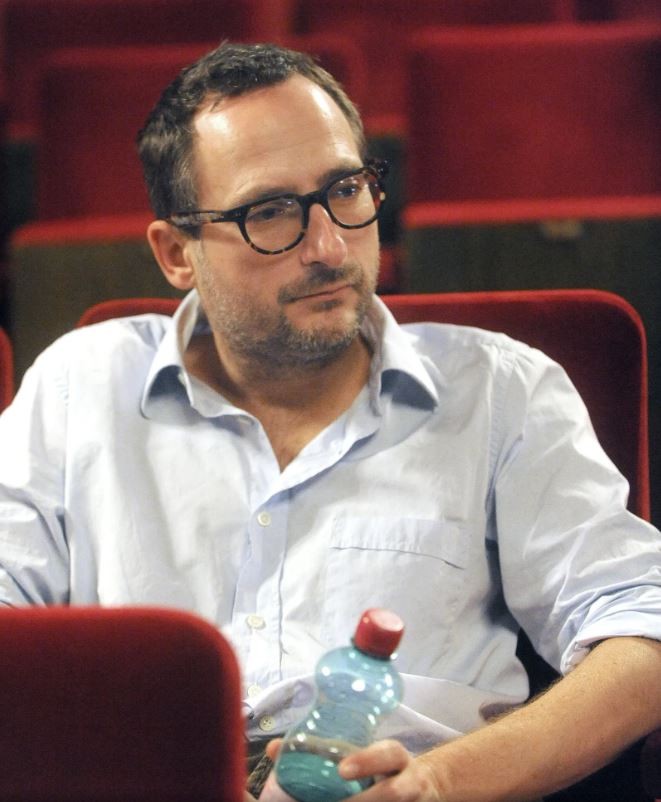
Born in Göttingen in 1967, Schimmelpfennig is today one of the most internationally performed German playwrights. Before dedicating himself to theatre, he worked as a journalist, and his writing still reflects the curiosity of an observer. He looks closely at ordinary lives and familiar spaces—a small restaurant, an apartment, a family gathering—and reveals the hidden conflicts beneath them. His worlds often begin with everyday reality, only to slowly open into something stranger: a place where memory, myth and imagination coexist.
One of the best ways to enter Schimmelpfennig’s theatrical universe is Der goldene Drache (The Golden Dragon, 2009). Set in the kitchen of a small Asian restaurant, the play brings together seemingly unrelated stories: undocumented migrant workers, a flight attendant, elderly neighbours, and even characters from a modern version of Aesop’s fable about an ant and a cricket. Yet the structure of the play is as important as its themes.
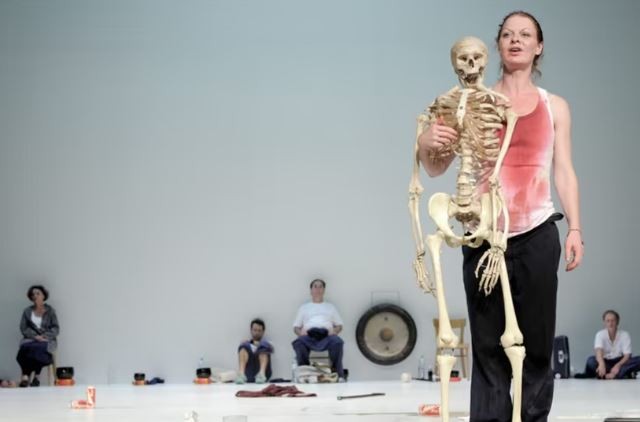
Five actors perform more than fifteen characters, moving freely between different ages, genders and identities. A young actor may portray an elderly man; a performer may suddenly become a completely different character without leaving the stage. The production does not attempt to hide the theatrical illusion. Instead, it places the process of storytelling directly in front of the audience.
The play premiered on 5 September 2009 at the Akademietheater in Vienna, the second stage of the prestigious Burgtheater, with Schimmelpfennig himself directing the production. Although Schimmelpfennig is a German playwright, this important work first appeared in Austria rather than Germany. The production quickly attracted attention, was invited to the Berliner Theatertreffen in 2010, and established The Golden Dragon as one of the defining works of contemporary German-language theatre.
Through this play, audiences can experience a technique often discussed by theatre scholars as Narration des Dramas—the narration of drama. Unlike traditional drama, where characters mainly reveal themselves through dialogue and action, Schimmelpfennig allows narration itself to become dramatic action. His characters describe movements, emotions and events while they are happening. Rather than creating distance, this unusual method encourages audiences to look more carefully at what is being shown and what might remain unseen.
This relationship between storytelling and theatre also explains why Schimmelpfennig’s works are often connected with the idea of the Dramatisierung des Romans. His plays frequently borrow qualities associated with novels: shifting perspectives, fragmented timelines, multiple layers of narration and a strong sense of literary rhythm. Reading his texts can feel like following a novel, while watching them creates the experience of seeing that novel being constructed live on stage.
Schimmelpfennig’s interest in storytelling has continued to expand. His recent large-scale project ANTHROPOLIS revisits the ancient myths of Thebes through a series of interconnected plays. Instead of treating Greek mythology as a distant historical world, he uses these stories to examine questions that remain urgent today: political power, violence, social responsibility and the fragile relationship between individuals and communities.
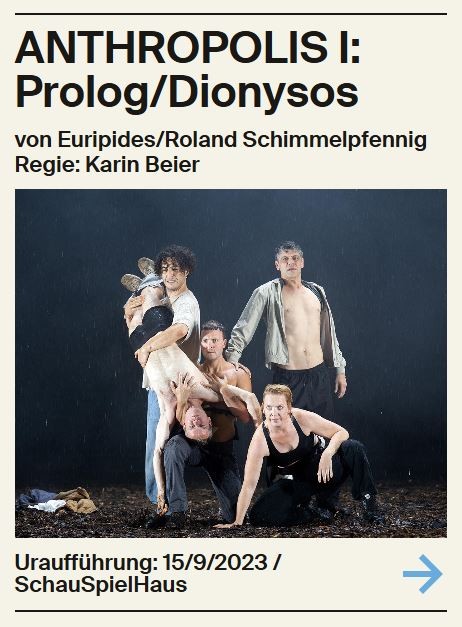
ANTHROPOLIS premiered at the Deutsches Schauspielhaus Hamburg in 2023 and became one of the most ambitious projects of his recent career. The cycle also introduced Korean audiences to Schimmelpfennig’s evolving theatrical language when the National Theater Company of Korea presented the work in 2025. The Korean production drew attention for bringing a major contemporary German theatre project to local audiences and demonstrating how ancient myths can become a mirror for present-day society.
From The Golden Dragon to ANTHROPOLIS, Schimmelpfennig’s career shows a continuous exploration of one central question: how can theatre tell stories in a way that feels new? His answer is not to abandon narrative, but to reinvent it. He combines the immediacy of performance with the freedom of storytelling, allowing audiences to experience both the event itself and the process of creating meaning.
His plays have now been translated into more than forty languages and performed across Europe, North America and Asia. Yet their international appeal does not come only from universal themes. It comes from his unique theatrical language—a language where words become actions, silence becomes part of the story, and the act of narration becomes the very heart of performance.
A Guide for First-Time Readers of Roland Schimmelpfennig
Start with: Der goldene Drache (2009) A perfect introduction to his distinctive style, combining social reality, poetic language and narrative experimentation.
Explore next: Die Frau von früher (The Woman Before, 2004) A tense exploration of memory, relationships and time, showing his ability to transform everyday situations into psychological drama.
For his latest theatrical direction: ANTHROPOLIS (2023–) A monumental reimagining of Greek mythology that reveals how Schimmelpfennig continues to expand the possibilities of contemporary drama.
Schimmelpfennig’s theatre begins with a simple but powerful idea: a story does not only exist in what happens. It also exists in the way it is told. And once his characters begin to tell their own stories, the stage becomes a place where reality itself can be rewritten.
