

This review is based on the 7:30 p.m. performance on Monday, 1 June 2026, of Theatre Company Green Pig's <The Great Battle of the Sheep Ranch> (written and directed by Ju Eun-gil), staged at the National Jeongdong Theater Cecil.

Inspired by the 2023 escape of "Sero," a zebra from Seoul Children's Grand Park, <The Great Battle of the Sheep Ranch> begins when a sheep that has broken out of a sheep ranch crosses paths with Sero. The two make a pact to reclaim the freedom that humans have taken from them. But Sero is tranquilized and captured just three and a half hours after the escape, and is returned to the zoo — while the sheep, vowing to find freedom on its own, sets off running once more.
It is telling that the place the animals encounter after rejecting human hands and breaking free of their enclosures is the asphalt of the city — a landscape made by humans. Equally bitter is the realization that for a zebra born and raised in a zoo and a sheep bred on a farm, "the wild homeland of freedom to return to" is in fact a nonexistent ideal. The play poses a searching question: if both the place one escapes from and the place one escapes to have been reshaped by human hands — if even the home one imagines returning to is not truly home — is this "escape" really possible at all?
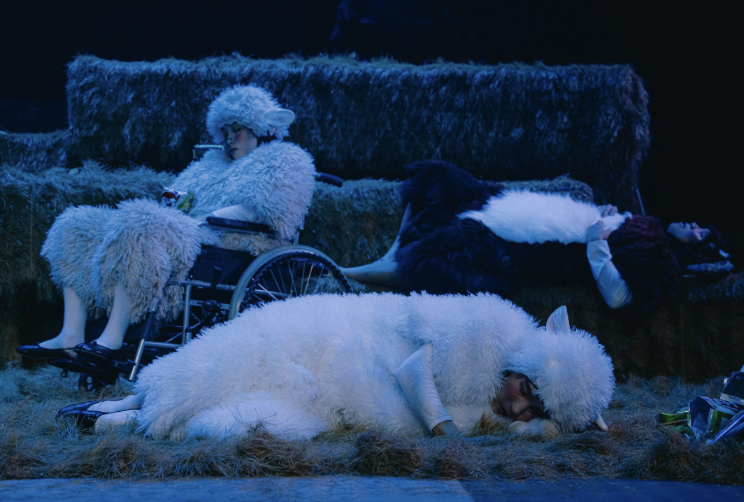
Also worth noting is the choice of the sheep as subject — an animal so thoroughly domesticated that, without humans periodically shearing its wool, it will suffocate and die. This "curse of fate" makes the choice all the more agonizing: is it right to accept human intervention and conform, or must one set out in search of freedom even at the cost of endless wandering and suffering? <The Great Battle of the Sheep Ranch> dwells on this dilemma, ceaselessly questioning the meaning of true freedom and whether it is even attainable.
The setup takes on its full allegorical weight with the appearance of a young man called "the Black Sheep," who has been hiding among the flock and settling for life inside the ranch. Through a dream within a dream, the Black Sheep witnesses the lives and deaths of sheep yearning for freedom, and resolves to break out and live on his own terms. But reality is unforgiving. Having stumbled through life as a bored office worker, a failed small-business owner, and a bankrupt investor — racking up failure after failure — the Black Sheep comes to resent the very freedom he sought, and loops a noose around his own neck to walk back inside the ranch. His surrender to the world — his declaration that he wants to return to being a lamb — is not simply one individual's regression; it is the cry of a generation of young people bruised by the contradictions and absurdities of a harsh modern society. Ultimately, the sheep dreaming of escape from within the ranch stand for the millennial and Gen Z generation caught in the middle of contemporary life: a generation that loses its autonomy when it conforms to the system, yet finds every path blocked no matter how persistently it tries to break free.
Yet the play does not end in defeatism or resignation. The audience has witnessed and viscerally experienced an unrelenting hunger for freedom. Despite every inevitable reason why free living seems impossible, watching these figures hurl themselves toward freedom again and again, we find ourselves affirming and cheering on the very act of that struggle. At this point, rather than closing on emotional despair in the face of the existential limits humans confront, the play seizes on a paradoxical will to live.
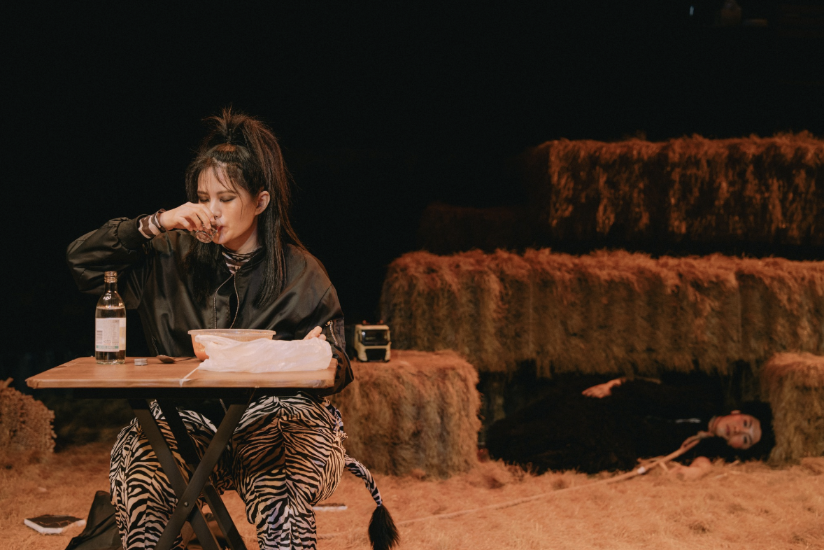
The ending — in which Sero the zebra repeats "again, again, again" endlessly on stage, with no separate curtain call — carries precisely this message. Even after the house lights come up, that repeated vow continues to ring out: not as a confirmation of despair, but as a declaration of human dignity — a promise to begin again, from whatever rubble one finds oneself in. The play asks sharp questions that cut to the heart of an absurd system, while at the same time offering comfort to every act of resistance that refused to be tamed by it.
On the whole, <The Great Battle of the Sheep Ranch> brings the story of Sero and the sheep to vivid life through Theatre Company Green Pig's characteristically experimental theatrical language. Without ever losing sight of its central argument, the production stimulates the senses through direction that is kitsch and delightfully irreverent. The music, lighting, and props are flamboyant yet lean, capturing the production's bouncy, black-comedy sensibility with precision. The play deserves high praise for the intensity with which it unpacks the dilemmas of the millennial and Gen Z generation through a tightly constructed fable. It is a production that sends audiences out of the theater still searching for their own questions — and their own answers.
