


Musical <Mongyudowon> is full of memorable moments, but if I had to name the one that lingers most powerfully, it would be the baduk duel between Yeogyeong and Domi. This is not simply a scene of two characters competing for victory. It is a scene that compresses the collision of love, desire, fate, and obsession into the language of the stage — and, I would argue, the scene in which the work's aesthetic speaks most effectively.
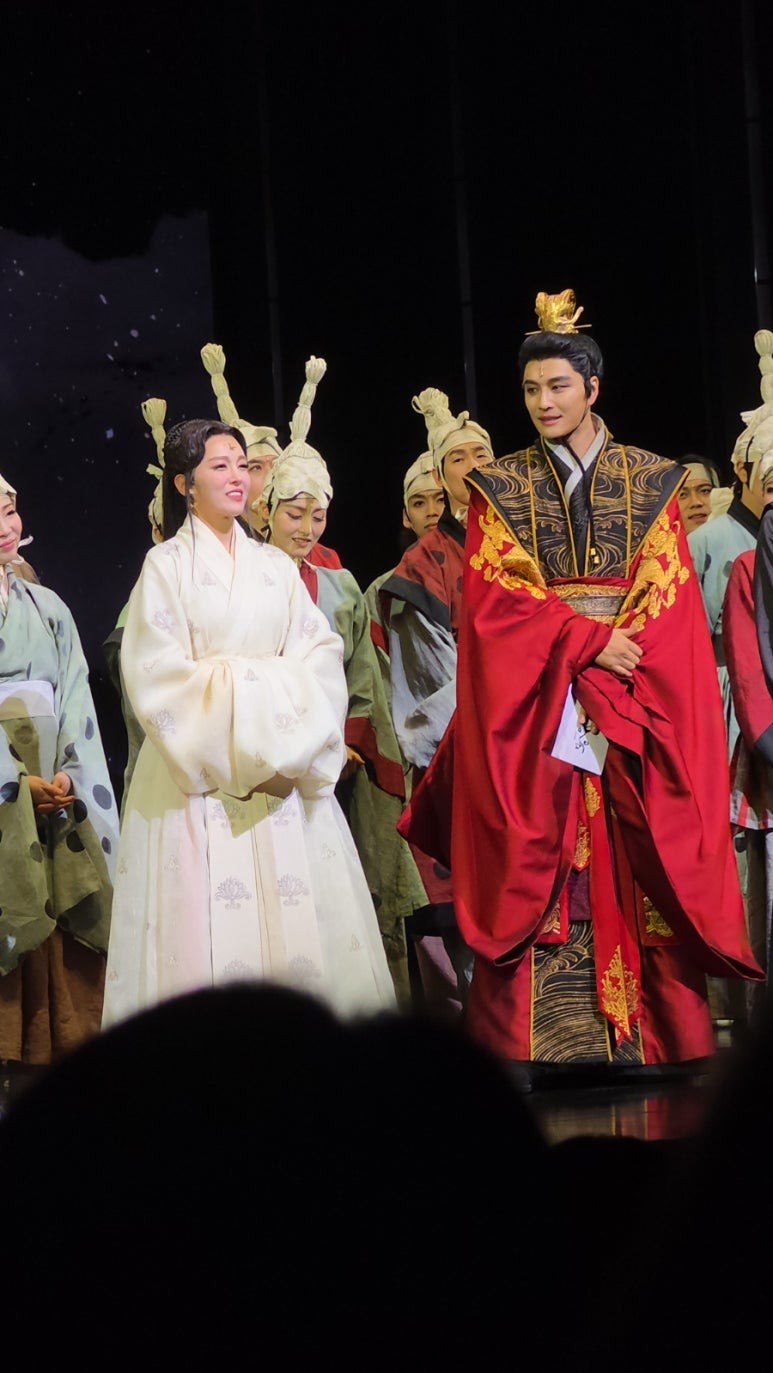
In the story, Yeogyeong, king of Baekje, cannot forget Arang, a woman who has appeared in his dreams since long ago. But Arang is already married to Domi. Even so, Yeogyeong refuses to let her go, and together with his retainer Hyangsil he devises a scheme. Hyangsil first plays baduk against Domi, studying his moves, and on that basis Yeogyeong challenges Domi to a match. After suffering several defeats, Yeogyeong finally breaks free of Domi's patterns in the decisive game and claims victory — and with it, he demands Arang as his prize.
What makes this scene so fascinating is not the contest itself but the way that contest is expressed. At the back of the stage, Yeogyeong and Domi are actually playing baduk, but what captures the audience's eye is the ensemble of performers filling the entire front of the stage with their movement. The very first thought that came to me when I saw this scene was: "The direction is extraordinary."
The ensemble members, dressed in costumes symbolizing black and white, move ceaselessly across the stage — pushing and pulling, intertwining, at times encircling one another and at times probing for openings. The effect is like watching black and white stones moving across an actual baduk board. The audience cannot see the board itself, yet through the performers' bodies they intuitively grasp the flow of the match at every moment.
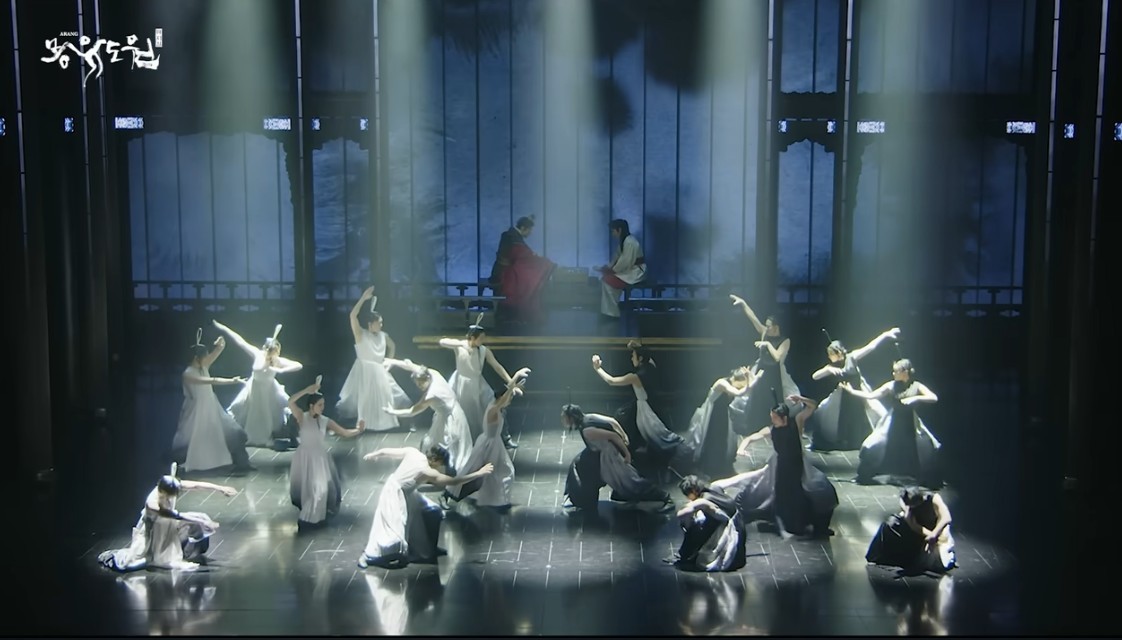
What struck me most was the dynamism of the choreography. Watching from the second-floor seats, I could take in the full composition and pathways of the ensemble at a glance and found myself marveling at the design; when I returned to watch again from the first floor, I was even more astonished by the sheer energy of the performers. They moved without a moment's rest, executing demanding choreography and acrobatic sequences. Seeing them up close — completing every moment of the scene without faltering, even as the sweat showed — made the achievement all the more striking.
What makes this scene so special is that it translates baduk — an inherently still subject — into an intensely kinetic theatrical language. Baduk is, by nature, a game of minimal physical movement. Yet <Mongyudowon> visualizes its invisible psychological warfare and strategy through the ensemble's bodies, transforming the entire stage into one vast baduk board. As a result, the audience is not merely watching two characters compete; they are drawn naturally and completely into the fierce battle of wills unfolding between them.
The costumes, too, were worth close attention. Black and white — the contrasting colors of baduk stones — were used, but rather than keeping the two colors strictly separate, the design applied a gradient that allowed them to blend naturally toward the hem. This felt like more than a symbol of the game's black and white stones; it read as a device for conveying the layered, complicated emotions of the characters within the work.
The lighting, too, works to heighten the tension of the scene to its fullest. Light and shadow shift constantly in response to the performers' movements, evoking the sense of watching territory expand and contract across a baduk board. The music, building steadily toward a peak, amplifies the suspense of the match and deepens the audience's immersion. What was most impressive was that the stage, music, lighting, and choreography did not exist as separate elements but meshed together organically in service of a single scene.
The reason this scene stays with me long after the curtain falls is not simply that it looks spectacular. It is that the direction is organically connected to the work's larger message. The more I think back on it, the more it feels like a scene that opens itself to new interpretations each time. The level of craft is such that a close analysis of the direction alone could fill an entire essay.
Another reason <Mongyudowon> felt so special was that it is an original Korean musical set during the Three Kingdoms period — a historical backdrop rarely encountered in today's theatre scene. A distinctly Korean sensibility was woven throughout the work, and the music, too, demonstrated a high level of accomplishment. Domi's solo number in particular stayed with me long after the performance ended.
If <Mongyudowon> ever returns to the stage, I know I would go back without a moment's hesitation. A great work always gives you a reason to return, no matter how much time has passed. And the baduk duel between Yeogyeong and Domi was one of the scenes that showed me exactly why. The image of an invisible baduk board laid out across the stage is one I expect to carry with me for a long time.
YouTube — sharing a link to the "Black and White" number from musical <Mongyudowon>.
