
Among the most widely discussed productions in contemporary German-speaking theatre, Leonie Böhm’s Fräulein Else has established itself as a major success.
Premiered at Vienna’s Volkstheater in February 2025 and later invited to Berlin’s prestigious Theatertreffen in 2026, the production has been praised both for Julia Riedler’s striking solo performance and for its ability to turn a century-old literary text into something that feels immediate and unsettlingly present.
Schnitzler’s Else: a voice trapped inside thought
Austrian author Arthur Schnitzler’s 1924 novella Fräulein Else is built entirely as an interior monologue.
Else, a young woman on holiday, receives a letter from her indebted father asking her to obtain a large sum of money from an art dealer, Dorsday.
The condition he imposes is simple and devastating: he will only provide the loan if Else allows him to see her naked for fifteen minutes.
What makes Schnitzler’s text so powerful is not only its moral situation, but its form. Everything unfolds inside Else’s mind.
The reader is inside her consciousness, moving through fear, shame, anger, and confusion in real time.
This creates a paradoxical position: we are intimate with her thoughts, yet physically removed from the situation.
We observe, but we are not seen. This distance allows the reader to judge the situation safely—Dorsday appears clearly predatory, the father morally compromised, and Else trapped by forces beyond her control.
Böhm’s adaptation radically changes this structure by moving the monologue outward—turning inner speech into direct encounter.
Between Fleabag and theatre: intimacy as entry point
For audiences familiar with Phoebe Waller-Bridge’s Fleabag, premiered at Edinburgh Festival Fringe in August 2013, the opening of Fräulein Else may feel immediately familiar.
Both works revolve around a single performer who carries the entire performance alone, speaking directly to the audience with sharp humor, emotional volatility, and a tone that resembles stand-up comedy as much as theatre.
Both foreground female desire, shame, and the body as central themes. And in both cases, the actor’s charisma is not just part of the performance—it is its driving force.
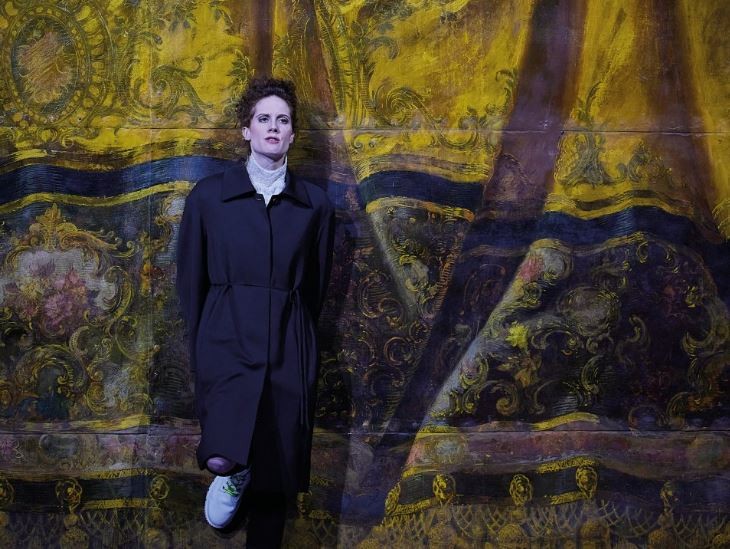
Julia Riedler does not appear as a distant literary figure but as an immediate presence who moves through the auditorium, addresses spectators directly, gives nicknames to individuals in the audience,
and adjusts her delivery in response to their reactions.
What was originally Schnitzler’s internal monologue becomes a live, shifting conversation with the audience.
Like Fleabag, the production creates an atmosphere of confession, as if the audience has been invited into a private space of thought.
For this reason, many German-language critics have described the production as a reinterpretation of Schnitzler through a Fleabag-like theatrical language:
a highly audience-friendly solo performance that uses contemporary humor and direct address to revisit questions of power, gender, and, inevitably, the legacy of #MeToo.
Yet this resemblance only goes so far.
While Fleabag uses direct address primarily to build intimacy and complicity between performer and audience,
Fräulein Else gradually destabilizes that intimacy.
The audience is no longer simply a confidant. It becomes part of the situation itself.
From spectators to participants
As the performance unfolds, Else repeatedly asks what she should do.
Should she accept Dorsday’s offer? Should she sacrifice herself for her father?
What begins as storytelling slowly turns into consultation.
The audience is no longer just listening—it is being asked to respond.
At one point, Else even attempts to solve her financial crisis by collecting money from the audience.
The gesture is half playful, half desperate, but it shifts the dynamic in a subtle way:
spectators are no longer outside observers but potential participants in the resolution of the conflict.
The amount collected is insignificant, yet the ethical pressure is real.
What would it mean to help? What does it mean not to?
This shift is central to the production’s impact.
In Schnitzler’s novella, readers remain inside Else’s mind and therefore maintain a stable moral distance.
On stage, that distance collapses. The audience becomes implicated—not because it is accused, but because it is involved.
The gaze and the body
The most striking example of this occurs during the famous undressing scene.
In the original story, Dorsday is the one who looks at Else.
In the theatre, however, hundreds of audience members are looking at her as well.
The production subtly shifts the question away from Dorsday alone and toward the broader structure of spectatorship itself.
Who is looking? Why are we looking? Can we completely separate ourselves from the power dynamics unfolding before us?

The production never accuses the audience directly. Instead, it creates a space where spectators become aware of their own gaze.
This is where the performance moves beyond a simple feminist retelling.
It is not only about a woman's exploitation but also about the social conditions that allow exploitation to persist, even among people who consider themselves progressive.
For this reason, the comparison with Fleabag is ultimately limited.
Both works use direct address and depend heavily on the charisma of a single performer.
Yet Fleabag is primarily concerned with personal grief, desire, and self-deception.
Fräulein Else begins with a similar intimacy but gradually expands into a collective question. The audience is not simply a confidant; it becomes part of the situation itself.
From tragedy to refusal
Where Schnitzler’s novella ends in despair, with Else taking Veronal after public humiliation, Böhm’s adaptation refuses closure.
Instead of collapse, the production moves toward a strange form of liberation.
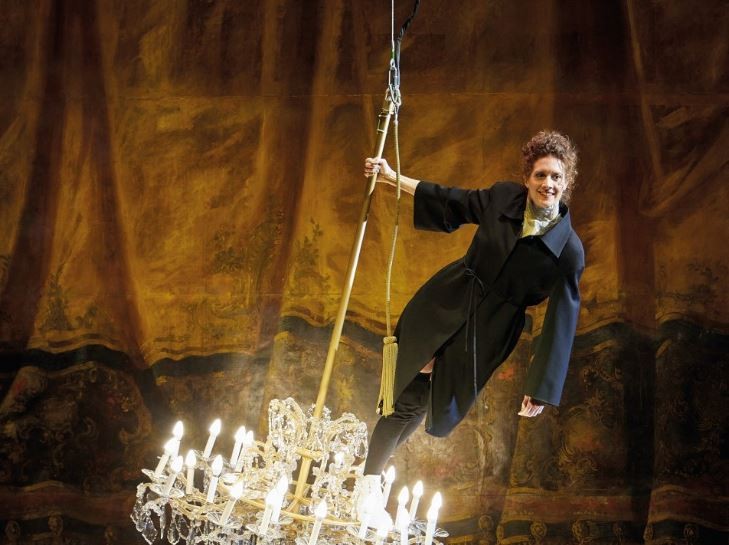
Else appears not as a victim consumed by shame but as a figure who refuses to be fully defined by the gaze that surrounds her.
The final image is not realist but almost utopian: a body that no longer exists solely as an object of interpretation.
Whether this ending feels convincing or not is less important than the gesture itself.
The production imagines an alternative conclusion to a story historically shaped by constraint and inevitability.
Why it resonates
The success of Fräulein Else in the German-speaking theatre landscape suggests that its impact lies not only in its thematic relevance but in its formal clarity.
It is accessible without being simplistic. It allows audiences unfamiliar with Schnitzler to follow the narrative easily, while offering theatre critics a layered reflection on spectatorship itself.
The combination of immediacy and conceptual precision may explain why the production has received major recognition,
including invitations to prominent festivals and strong critical attention across Austria and Germany.
It manages to operate on two levels at once: as an engaging solo performance and as a meditation on what it means to watch, to respond, and to remain passive.
Fräulein Else does not simply modernize Schnitzler.
It shifts the conditions under which his story is experienced.
By transforming interior monologue into direct address, it dissolves the safe distance between character and audience.
What remains is not just Else’s dilemma, but a shared space of observation in which spectators are quietly asked to consider their own position.
In doing so, the production turns a historical text into something unexpectedly present: not a story about looking, but a situation in which looking itself becomes impossible to ignore.
