
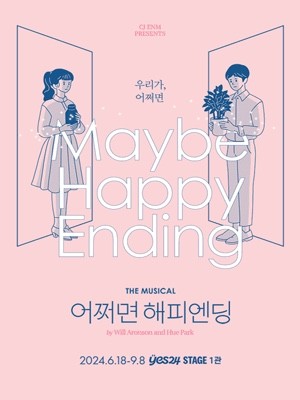
A small story about two obsolete robots became the most celebrated new musical of the Broadway season — and a landmark moment for Korean theater on the world stage.
Broadway does not often reward modesty. The Great White Way tends to prize scale: the turning set pieces, the belted finale, the cast of dozens moving in synchronized spectacle. Maybe Happy Ending, which opened at the Belasco Theatre on November 12, 2024, is, by almost every conventional measure, the opposite of that. It runs without intermission. Its cast numbers four. Its story — two discarded robots, alone in adjacent apartments, tentatively reaching toward each other — could be summarized in a sentence. And yet it walked away from the 78th Tony Awards with six prizes, including Best Musical, and spent its run being called, by critics at publications ranging from The New York Times to Deadline, one of the finest new musicals in years.
The story of how it got there is, in its own way, as unlikely as the show itself.
Where It Began
Korean playwright and lyricist Hue Park and American composer and playwright Will Aronson met as students at NYU through a mutual friend, and have been collaborating for over a decade. Their partnership is built on an unusual creative method. Aronson is the first lyricist with whom Park writes music first — a norm in K-pop — which gives the lyricist the role of interpreting the music and translating it into words, rather than the other way around. Many of their songs share the same opening line in both Korean and English, before diverging due to the structural demands of rhyme in English versus the precision required in Korean.
The idea for Maybe Happy Ending came from Park. Aronson had previously been writing shows with a layer of irony, and Park's invitation to write about robots discovering the world appealed to him precisely because of what it demanded: an approach to life that was open, direct, and heartfelt, rather than cynical or distanced.
The show's origins trace back to 2014, when it was first developed with support from Korea's Wooran Foundation. After being pitched to the foundation's Seeya Stage program, the musical was developed through 2014, and had a three-night tryout engagement in September 2015, with tickets selling out within three minutes of going on sale. The Korean-language version opened on December 20, 2016 at DaeMyung Culture Factory in Seoul, directed by Kim Dong-yeon, and won Best Book, Lyrics, and Music at the Korean Musical Awards.
Over the following years, the show built a devoted following across Asia, running for five seasons in Seoul's intimate Daehangno theater district, and touring to Japan and China. The English-language version, then titled What I Learned from People, was awarded the 2017 Richard Rodgers Award by the American Academy of Arts and Letters. Its English-language stage debut came in early 2020 at the Alliance Theatre in Atlanta, directed by Michael Arden — the same director who would eventually bring it to Broadway.
The Story
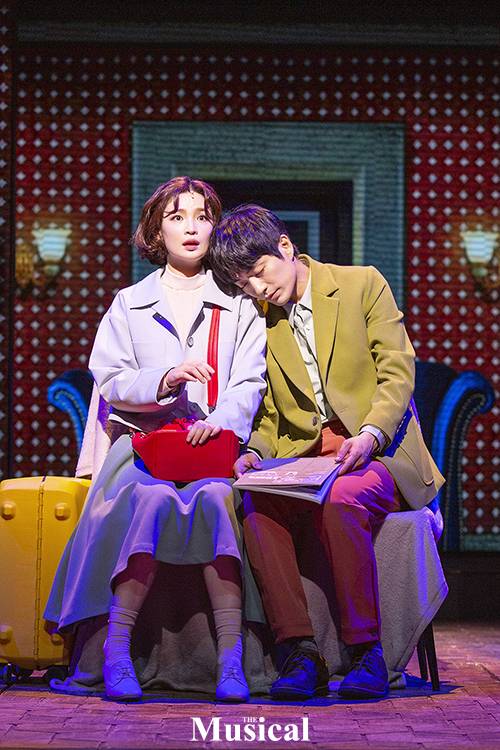
Set in 2064, the show drops us into an unfamiliar but recognizable world where human owners and humanoid helperbots live in tandem. Oliver, a Helperbot 3, has been abandoned by his owner and lives alone in a small apartment, his days organized around a stack of 1950s jazz records and a plant he calls HwaBoon. Claire, a newer Helperbot 5, moves in next door with a failing battery and no working charger. What begins as a reluctant proximity slowly becomes something neither robot has the programming to anticipate.
Oliver and Claire are different models in ways that carry social weight beyond their specifications: Oliver is classic, durable, and limited in scope, while Claire is more advanced but fragile. The show turns this into quiet commentary on generational difference and on what it means to be cast aside — by owners, by obsolescence, by a world that has simply moved on. Their eventual road trip together, in search of Oliver's former owner, gives the musical its journey structure, while the emotional core remains resolutely small and interior.
The term Park and Aronson use to describe their overall vision for the show is "epic intimacy" — a story that feels intimate in scale but emotionally grand in ambition. It is a phrase that captures the show's essential tension, and its essential achievement.
The Broadway Production
The Broadway transfer brought a significant shift in production scope. The biggest difference between Seoul and New York was an elaborate, expensive production design that represented one of the biggest risks of the American staging. In Seoul, the show was performed in a small theater with a three-person cast; on Broadway, it arrived with a fourth cast member and a technical apparatus that critics uniformly described as extraordinary.
Scenic designer Dane Laffrey and video designer George Reeve created an environment in which on-stage characters interact with ghostly black-and-white video projections, and the stage transforms to accommodate a forest of fireflies and the ghostly presence of a 1950s jazz singer performed live by a fourth cast member. The result is a production that manages to feel simultaneously handcrafted and technologically spectacular — a difficult balance that the design team navigates with considerable skill.
Directed with what The New York Times critic Jesse Green called "breathtaking bravura" by Michael Arden, the show earned comparisons to previous Broadway productions celebrated for combining emotional intelligence with formal invention — among them Fun Home, The Band's Visit, and Kimberly Akimbo.
At the center of it all are two performances that critics found impossible to separate from the show's emotional success. Darren Criss, an Emmy and Golden Globe winner known primarily for his television work, plays Oliver with a physical restraint that communicates volumes: staccato movements, slight delays, the faint impression of someone calculating each gesture before executing it. Helen J. Shen, making her Broadway debut as Claire, uses smoother gestures to convey a more advanced but more fragile model, and the chemistry between the two — from reluctant neighbors to tentative friends to something richer — is noted by every major review as the production's irreducible engine.
The Awards and What They Mean
By late April 2025, the production had surpassed 200 performances and $20.89 million in total box office revenue. Then came the Tony Awards. Maybe Happy Ending took home six awards on June 8, 2025: Best Musical, Best Leading Actor for Darren Criss, Best Direction for Michael Arden, Best Book and Best Original Score for Park and Aronson, and Best Scenic Design.
The significance of those wins extends beyond the production itself. Hue Park became the first Korean national to win a Tony Award in the musical theater category. The milestone arrives in the context of a decades-long effort by Korean theater to establish a presence on Broadway — an effort that has accelerated in recent years, from the commercial production of The Great Gatsby led by a Korean producer to the West End transfer of Marie Curie, but which had not, until this moment, produced a Best Musical winner with Korean authorship at its core.
In a statement released around the time of the Tony wins, Park and Aronson reflected on the show's decade-long journey: "To have this story continue for 10 years feels like a small miracle. We're especially grateful to the audiences who have joined us on this journey."
What the Show Is About, Really
It would be a mistake to read Maybe Happy Ending primarily as a cultural milestone, or as a data point in Broadway's expanding relationship with international theater markets. Those things matter, but they are not what the show is when the lights go down.
The musical makes the quiet and somewhat bold claim that we are not so different from robots — or that robots are not so different from us. Just as robots have much to learn from humans, we in turn can learn from them: how to care for each other, and for ourselves, and when to be willing to share a charger with someone in need.
That idea, delivered without irony and without condescension, through two hours of music that borrows from jazz standards and tender ballads and the occasional wry comedy number, is what distinguishes the show from its contemporaries. A musical about sentient robots carries extra resonance in South Korea, which has the highest robot density in the world — one industrial robot for every ten employees — but the show's concerns are not sociological. They are entirely personal: memory, longing, the fear of being left behind, and the tentative hope that connection remains possible even at the end of a designated lifespan.
Park and Aronson have also hinted at bringing the Broadway version — which includes new songs, expanded character arcs, and subtle reinterpretations — back to Seoul, with the stated goal of creating a show that resonates equally with Korean and international audiences. The wheel, in other words, keeps turning. A story that began in a small foundation-funded workshop in Seoul, sold out in three minutes, traveled to Atlanta, crossed to Broadway, and swept the industry's most prestigious awards is now preparing to come home — changed by the journey, but still, at its center, the same quiet fable about two forgotten machines discovering that they were never as alone as they thought.
That might, in fact, be the closest thing the show has to a thesis. And it lands, consistently, like a small and perfect weight against the chest.
Sources
- Variety: Christian Lewis, Broadway review, November 12, 2024
- Deadline: Broadway review, November 12, 2024
- Broadway.com: "A Kind of Love Story" — Park and Aronson feature
- TDF Stages (Theatre Development Fund): Will Aronson and Hue Park interview
- The Korea Herald: Tony Awards coverage, June 2025; Drama League and Critics' Circle awards coverage
- Korea Times: "Maybe Happy Ending Returns to Seoul," September 2025
- Gordon Cox / Substack (Stagecraft): "Maybe Happy Ending: The History of Broadway's Korean Import," November 2024
- Broadway Scorecard: Critical aggregation, November 2024
- Show-Score: Jesse Green / New York Times review excerpt, November 2024
- Will Aronson official website: production history
